Taking your children to Europe can be one of the most rewarding journeys of your life—or an expensive, high-friction exercise in managing logistics, exhaustion, and jet-lagged meltdowns.
The difference between those two outcomes rarely comes down to how much money you spend. It comes down to pacing, accommodation choices, and setting realistic daily expectations.
Too many family itineraries are designed like adult sightseeing marathons compressed into a two-week window. Parents try to stack four capital cities, seven train transfers, and ten major art museums into 12 days, only to find themselves carrying heavy luggage over cobblestones while pushing a stroller up endless flight of stairs in 35°C (95°F) summer heat.
Before you book flights or reserve hotel rooms, this editorial guide explains how a European family vacation actually works, what is genuinely worth your time and money, what you can safely skip, and how to build an itinerary that everyone—parents included—will actually enjoy.
Quick Verdict: Is a European Family Vacation Worth It?
Yes—provided you travel at half your normal adult speed and stay at least three nights per location.
Europe is exceptionally safe, incredibly well-connected by passenger rail, and deeply enriching for children of all ages. However, if your ideal family vacation involves effortless door-to-door handholding, predictable kids’ menus at every corner, and vast resort suites with instant laundry service, Europe requires a deliberate mindset shift.
- Who Should Go: Families who value cultural exposure, walkability, hands-on history, and public transit, and who are willing to trade luxurious square footage for central, authentic neighborhood living.
- Who Should Skip: Families with infants or toddlers who rely heavily on bulky gear and cars, parents who get easily stressed by minor schedule changes or language barriers, and anyone expecting standard North American-style oversized hotel rooms and universal central air conditioning.
- The Biggest Trade-Off: Space and convenience versus location and atmosphere. Central European accommodations are smaller and older, requiring families to pack lighter and live more like locals.
Quick Facts for Family Travel in Europe
| Information | Details | Decision Impact |
|---|---|---|
| Best Time to Visit | May to early June; September to October | Avoids brutal summer heatwaves, massive tourist queues, and inflated peak rates. |
| Pacing Golden Rule | Minimum 3 nights per destination hub | Prevents single-day transition burnout and gives kids time to adjust. |
| Transit Strategy | High-speed rail for cities; rental car for rural areas | City-center to city-center train routes eliminate airport wait times and luggage fees. |
| Room Occupancy | Strict fire codes; double rooms max out at 2 adults | Families of 4+ usually require dedicated Family Rooms or vacation rentals. |
| Comfort Budget | €350 – €550 / day for a family of four | Covers 2-bedroom rental/family room, regional rail, casual dining, and entry fees. |
What a European Trip with Kids Is Actually Like (The Reality Check)
The Atmosphere and Walking Pace
European cities are designed around human-scale walkability rather than automobile transport. On an average day in Paris, Rome, or London, your family will walk between 10,000 and 18,000 steps.
For kids aged seven and up, this walkability is liberating. They can explore grand plazas, wander car-free pedestrian zones, climb historic towers, and stop at neighborhood bakeries.
For toddlers and children under five, however, European infrastructure presents distinct physical challenges:
- Cobblestones & Stairs: Historic centers (like Rome’s Trastevere, Edinburgh’s Old Town, or Prague’s Malá Strana) feature uneven cobblestone paving, narrow sidewalks, and frequent staircases. Ultra-lightweight umbrella strollers with small wheels struggle on cobblestones, while heavy jogging strollers are cumbersome on public buses and inside historic cafes.
- Elevator Scarcity: Many 18th- and 19th-century residential buildings converted into vacation rentals or boutique hotels lack elevators. Carrying two 23kg (50lb) suitcases and a stroller up four flights of spiral stone stairs is a common surprise for unprepared travelers.
+-----------------------------------------------------------------------+
|                       THE 1-1-1 DAILY PACING RULE                     |
|                                                                       |
|  [ MORNING ]   --> 1 Key Cultural Sight (e.g., Colosseum / Louvre)     |
|  [ AFTERNOON ] --> 1 Outdoor / Unstructured Activity (e.g., Park)      |
|  [ EVENING ]   --> 1 Casual Local Food Experience (e.g., Gelato/Piazza)|
+-----------------------------------------------------------------------+
The Climate & Air Conditioning Reality
A major shock for non-European travelers is the relative lack of high-capacity air conditioning across Central and Southern Europe. While high-end international chain hotels offer modern central climate control, mid-range family-run guesthouses, historic apartment rentals, and regional feeder trains often rely on cross-breezes, shutters, or portable AC units.
During July and August heatwaves—when temperatures routinely top 38°C (100°F)—sightseeing with kids becomes physically draining. Planning outdoor monument visits for early morning and reserving mid-afternoon hours for air-conditioned museums, shaded parks, or rest periods is essential.
The Golden Rules of Family Itinerary Pacing
The most frequent mistake parents make when planning a European vacation is treated Europe like a single country where destinations can be checked off in rapid succession.
1.Adopt the ‘Hub and Spoke’ Model:Stay 5-7 nights in one city.
Instead of moving to a new hotel every two nights, select one central, well-connected base city (such as Florence, Munich, or Copenhagen). Spend your mornings exploring the base city and take 30-to-60-minute regional train trips on alternate days to explore surrounding medieval towns, castles, or beaches. You only pack and unpack once.
2.Cap Daily Transit at 3 Hours:Protect energy levels.
When changing major bases, restrict rail or transit travel to under three hours. A two-hour train ride feels like an enjoyable novelty to children; a six-hour multi-transfer transit day eats an entire day of your trip and leaves everyone exhausted by dinner.
3.Enforce One Anchor Sight Per Day:Avoid museum fatigue.
Schedule one primary cultural or historical activity in the morning when patience and energy are high (e.g., visiting the Tower of London or the Accademia in Florence). Reserve afternoons for unstructured play in public gardens, gelato breaks, or relaxing at your accommodation.
4.Build in ‘Zero Days’:Every 4th or 5th day.
Designate every fourth or fifth day as a zero-schedule day. No timed entry tickets, no alarm clocks, and no fixed itinerary. Use this day for laundry, lingering at local playgrounds, visiting neighborhood grocery stores, and letting kids set the pace.
Destinational Matchmaking: Where to Go Based on Your Kids’ Ages
Not every European destination caters equally well to every age group. Matching your choice to your children’s physical capabilities and interests guarantees a significantly better trip.
1. Best for Toddlers & Early School-Age (Ages 2–6)
At this stage, children do not care about Renaissance architecture or complex historical context. They need green space, low-friction transit, flat walking surfaces, and welcoming local cultures.
- Copenhagen, Denmark: Exceptionally family-friendly. The city is flat, impeccably clean, and designed around bicycles and pedestrians. Tivoli Gardens—one of the world’s oldest amusement parks—offers classic rides, historic gardens, and open-air puppet shows directly opposite the central train station.
- Naxos & The Cyclades, Greece: Unlike steep, stairs-heavy Santorini, Naxos features long, shallow sandy beaches (like St. George Beach) where toddlers can safely wade in calm water. The port town is vibrant yet compact, and Greek culture is famously warm toward young children in restaurants.
- Vienna, Austria: Home to Schönbrunn Palace, which features a world-class dedicated Children’s Museum where kids can dress up in imperial costumes, alongside the world’s oldest continuously operating zoo (Tiergarten Schönbrunn) and expansive, manicured public gardens.
2. Best for Mid-Childhood (Ages 7–11)
Children in this bracket possess the physical stamina for longer walking days and are old enough to engage with world history, myths, legends, and hands-on activities.
- Rome, Italy: History feels like a real-life storybook. Visiting the Colosseum, subterranean catacombs, and Roman Forum captivates kids who have studied ancient civilizations. Pair sights with interactive cooking classes where children learn to make fresh pasta or artisan gelato.
- London, United Kingdom: Offers world-class, budget-friendly sightseeing. The majority of London’s premier institutions—including the Natural History Museum, the Science Museum, and the British Museum—offer completely free general admission, making short 1-hour visits easy without feeling guilty about ticket costs.
- Salzburg & The Austrian Alps: Perfect for active families. Kids can ride cable cars up to high alpine meadows, explore the massive medieval Festung Hohensalzburg fortress, and tour the historic salt mines in nearby Hallein, featuring underground wooden slides and raft rides across subterranean lakes.
3. Best for Tweens & Teens (Ages 12+)
Older kids want autonomy, striking landscapes, recognizable pop-culture connections, and engaging activities.
- Paris, France: Best appreciated when teenagers can navigate the city’s iconic neighborhoods, visit art galleries like the Musée d’Orsay, explore pop-culture spots, and experience night-time views from the Eiffel Tower or a Seine river cruise.
- Bernese Oberland, Switzerland (Interlaken / Grindelwald): An outdoor paradise. Teens can experience mountain carting down alpine paths, ride ziplines at Grindelwald-First, hike past tumbling waterfalls in Lauterbrunnen, and ride cogwheel trains up to the Jungfraujoch.
- Budapest, Hungary: Delivers grand European architecture at a fraction of Western European prices. Teens love exploring the grand Fisherman’s Bastion, riding speedboats on the Danube at sunset, and soaking in the thermal waters of Széchenyi Baths.
Accommodation Realities: Hotels vs. Vacation Rentals
Choosing where to stay as a family in Europe requires understanding strict local regulations regarding room occupancy and space limits.
+-----------------------------------------------------------------------------------+
|                        EUROPEAN ACCOMMODATION COMPARISON                          |
+------------------------------------+----------------------------------------------+
| STANDARD HOTEL ROOMS               | APARTMENT RENTALS (Airbnb / VRBO)            |
+------------------------------------+----------------------------------------------+
| • Max occupancy strictly enforced  | • Multiple bedrooms + separate living room   |
| • Rooms average 18-24 sqm (190-250 sqft) | • Kitchen facilities save €40-80/day on food |
| • Daily housekeeping & breakfast   | • In-unit washing machines for lighter packing|
| • Elevator & 24/7 front desk guaranteed | • Stairs often required; self check-in rules  |
+------------------------------------+----------------------------------------------+
The Hotel Occupancy Trap
In North America, booking a standard hotel room with two queen beds for two adults and two children is standard practice. In Europe, strict fire safety codes enforce maximum room occupancies. A standard European “Double Room” contains one bed and strictly permits two guests. Attempting to check in with four people to a single double room will result in being forced to purchase an additional room at rack rates—if one is even available.
To stay in hotels as a family of four or more, you must specifically search for:
- Family Rooms: Specially designed configurations featuring one double bed and two twin beds or bunk beds.
- Connecting Rooms: Two adjacent rooms linked by an interior door.
- Aparthotels: Properties (such as Citadines, Adagio, or Wilde by Staycity) that combine hotel services (24-hour reception, luggage storage) with full apartment layouts (kitchenettes and extra living space).
Why Vacation Rentals Often Win for Families
For stays of three nights or longer, renting a multi-bedroom apartment is usually the most practical choice for families:
- Laundry Infrastructure: Having an in-unit washing machine allows you to pack half as many clothes, eliminating heavy luggage stress on trains.
- Meal Flexibility: Buying breakfast items, fresh fruit, yogurt, and snacks at local neighborhood markets (Supermercato or Épicerie) saves €40 to €80 per day compared to hotel breakfasts or morning cafes.
- Downtime Space: When young children nap or go to sleep at 8:00 PM, parents have a separate living area and terrace rather than sitting in a dark hotel room in silence.
Getting Around Europe as a Family: Trains, Cars, or Planes?
High-Speed Rail: The Gold Standard
For travel between major European metropolitan hubs, high-speed passenger rail is almost always superior to air or car travel.
+-----------------------------------------------------------------------------------+
|                           TRAIN VS. PLANE: THE REAL TIME                          |
|                                                                                   |
| PARIS TO LONDON VIA EUROSTAR (TRAIN)                                              |
| [City Center] ---> Train Ride (2h 15m) ---> [City Center]   = TOTAL: ~3 hours    |
|                                                                                   |
| PARIS TO LONDON VIA COMMERCIAL FLIGHT                                             |
| [Transit to CDG] -> [Security/Gate (2h)] -> [Flight (1h)] -> [Immigration]        |
| -> [Transit from LHR]                                       = TOTAL: ~6.5 hours  |
+-----------------------------------------------------------------------------------+
Why Trains Work Better for Families
- No Baggage Liquid Limits: You can bring water bottles, milk cartons, and snacks onboard without TSA/security restrictions.
- City-to-City Convenience: Stations (like London St Pancras, Paris Gare du Nord, or Roma Termini) are located directly in city centers, dropping you straight into local transit networks.
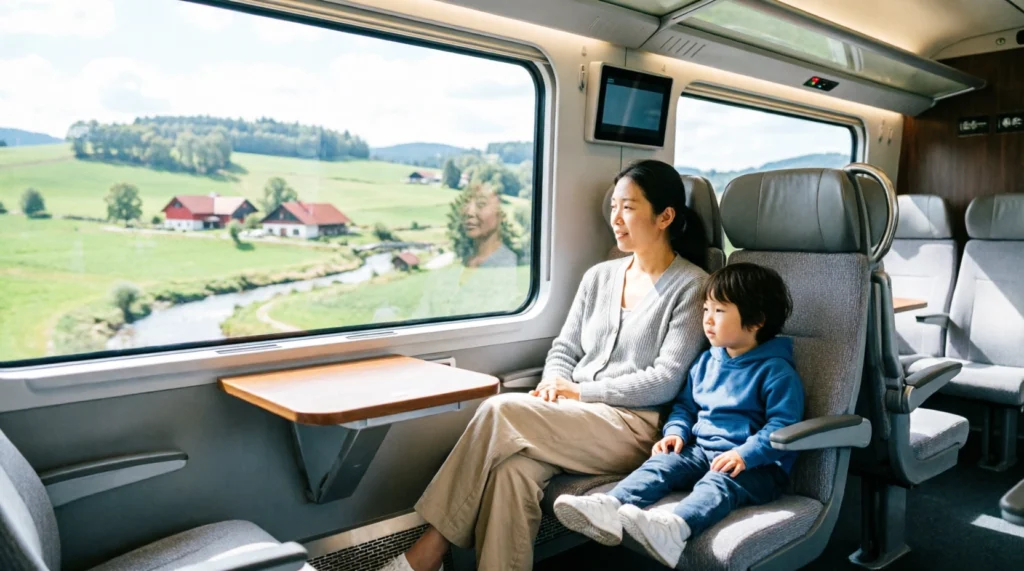
- Mobility: Children can stand up, walk down aisles, visit the café car, and use spacious restrooms during the journey.
- Substantial Child Discounts: Children under 4 generally travel free on European rail networks (if sitting on a parent’s lap), while kids aged 4–11 enjoy 50% fare reductions or free child passes (such as the Swiss Family Card).
When Renting a Car Makes Sense
Renting an automobile is only recommended if your itinerary focuses primarily on rural regions—such as exploring hilltop towns in Tuscany, driving through the countryside of Provence, driving around Ireland’s Wild Atlantic Way, or touring the Bavarian Alps.
Critical Warnings for Driving in Europe
- ZTL Zones (Zona a Traffico Limitato): In Italy and Spain, historical city centers are strictly closed to non-resident vehicles. Cameras automatically photograph license plates that enter without a permit, issuing automatic fines ranging from €110 to €250 per pass.
- Expensive Parking: City-center parking garages routinely cost €30 to €60 per 24-hour period.
- Manual Transmissions: Automatic rental cars carry premium rates and must be reserved months in advance during high season.
Realistic Budget Breakdown for Families
Travel costs across Europe vary dramatically depending on whether you are visiting Western/Northern Europe (UK, France, Switzerland, Scandinavia) or Southern/Central Europe (Italy, Spain, Portugal, Hungary).
Below is a realistic daily spending expectation for a family of four (2 adults, 2 children):
+-----------------------------------------------------------------------+
|              DAILY BUDGET BREAKDOWN (FAMILY OF 4)                     |
+-------------------+--------------------+------------------------------+
| TRAVEL TIER       | DAILY COST (AVG)   | WHAT IT INCLUDES             |
+-------------------+--------------------+------------------------------+
| Budget Tier       | €180 – €260        | 2-bed suburban apartment,    |
|                   |                    | grocery meals + street food, |
|                   |                    | public transit, free parks.  |
+-------------------+--------------------+------------------------------+
| Comfort Tier      | €350 – €550        | Central 2-bed rental/family  |
| (Recommended)     |                    | room, mix of casual dining,  |
|                   |                    | regional train transfers,    |
|                   |                    | pre-booked major sight fees. |
+-------------------+--------------------+------------------------------+
| Premium Tier      | €750 – €1,400+     | Central 4/5-star suite,      |
|                   |                    | private transfers & guides,  |
|                   |                    | fine dining + babysitting.   |
+-------------------+--------------------+------------------------------+
Unspoken Hidden Costs to Watch
- City Tourist Taxes: Most major European cities (including Rome, Paris, Venice, and Amsterdam) levy a daily per-person tourist tax (Tassa di Soggiorno) payable in cash or card at check-out. Rates range from €2 to €10 per adult per night.
- Restaurant Cover Charges (Coperto): In Italy, restaurants charge a service fee per person (typically €2 to €4) for bread and table setup.
- Public Restrooms: Standard public restrooms across European train stations and city squares require small cash coins or contactless card payments (€0.50 to €1.00 per entry).
What to Skip and What to Do Instead
To keep your family vacation engaging and low-friction, avoid high-crowd, low-payoff tourist traps in favor of accessible, child-friendly alternatives.
1. Overrated: Exhausting Main-Gallery Museum Marathons
- The Trap: Standing in 2-hour lines at the Louvre (Paris) or Uffizi Gallery (Florence) to push through dense crowds so your children can view famous paintings from 30 feet away.
- The Better Alternative: Book a 90-minute specialized family scavenger hunt tour (via companies like LivTours or Context Travel). Alternatively, visit interactive, child-centric museums like the Cité des Sciences et de l’Industrie in Paris, the Leonardo da Vinci Interactive Museum in Florence, or open-air sculpture parks.
2. Overrated: Visiting Stroller-Unfriendly Steep Destinations
- The Trap: Taking toddlers or infants in heavy strollers to destinations built entirely on steep cliffside stairs, such as Cinque Terre (Italy) or Santorini (Greece).
- The Better Alternative: Choose flatter, expansive coastal alternatives. Instead of Cinque Terre, explore Lucca (Italy), where families can rent four-person tandem bicycles and pedal along the flat, shaded top of intact Renaissance city walls. Instead of Santorini, choose Naxos or Crete.
3. Overrated: Trying to Visit Too Many Countries on One Trip
- The Trap: Booking a “London – Paris – Brussels – Amsterdam – Swiss Alps – Rome” itinerary over 12 days. You will spend 40% of your vacation in transit hubs, packing bags, and managing tired children.
- The Better Alternative: Pick two complementary base hubs (e.g., London and Paris connected by Eurostar, or Florence and Rome connected by a 90-minute train ride) for a 10-to-12-day vacation.
How to Structure an Unbeatable 10-Day Family Itinerary
Below is a field-tested, low-stress blueprint for a classic first-time European trip (The “London & Paris Rail Connection”):
+-----------------------------------------------------------------------------------+
|               10-DAY CLASSIC FAMILY ITINERARY (LONDON & PARIS)                   |
+--------+--------------------------------------------------------------------------+
| DAY    | PLAN & PACING                                                            |
+--------+--------------------------------------------------------------------------+
| Day 1  | Arrive London. Settle into rental apartment. Casual neighborhood walk,   |
|        | playground time at Hyde Park (Diana Memorial Playground), early sleep.   |
| Day 2  | Morning: Tower of London (Beefeater tour). Afternoon: St. James's Park   |
|        | walk and view Buckingham Palace from outside.                            |
| Day 3  | Morning: British Museum (pick 3 key exhibits max). Afternoon: Covent     |
|        | Garden street performers and street food snacks.                        |
| Day 4  | Day Trip: 50-minute train to Windsor Castle, or a relaxed boat ride along|
|        | the Thames to Greenwich.                                                 |
| Day 5  | Morning: Board morning Eurostar train to Paris (2h 15m). Afternoon: Check|
|        | into Marais apartment; sail toy boats at Luxembourg Gardens.            |
| Day 6  | Morning: Eiffel Tower timed summit tickets. Afternoon: Relaxing picnic in|
|        | the Champ de Mars park. Evening: Seine River boat cruise.                |
| Day 7  | Morning: Musée d'Orsay (spacious Impressionist galleries). Afternoon:    |
|        | Pastry and hot chocolate tasting in Saint-Germain-des-Prés.             |
| Day 8  | Day Trip: 45-minute RER train to Château de Versailles (gardens & bikes) |
|        | OR 40-minute train to Parc Astérix / Disneyland Paris.                    |
| Day 9  | Zero-Schedule Day: Explore Montmartre cobblestone streets, street artists|
|        | at Place du Tertre, souvenir shopping, relaxed cafe dining.              |
| Day 10 | Morning pastry walk, packing, airport transfer for flight home.          |
+--------+--------------------------------------------------------------------------+
Final Editorial Recommendation
A European vacation with your children does not need to feel like an endurance test.
By resisting the temptation to see everything, choosing central accommodations with space to breathe, relying on high-speed trains, and protecting your afternoons for unstructured play, you turn what could be a high-stress logistics puzzle into an effortless, unforgettable family experience.
Prioritize depth over breadth. Your kids won’t remember the fifteenth church or seventh art gallery you visited—they will remember watching street performers in Covent Garden, sailing wooden boats in Paris, racing through castle courtyards, and stopping every afternoon for fresh gelato.
FAQ
What is the best age to take kids to Europe for the first time?
Ages 7 to 11 are ideal for a first European trip. Children at this stage have the physical stamina to walk 10,000+ daily steps, do not require strollers or afternoon naps, and are old enough to understand historical contexts, navigate foreign cultures, and build lasting memories.
How far in advance should we book European train tickets and attraction passes?
Book high-speed train tickets (Eurostar, TGV, Frecciarossa) 2 to 4 months in advance when schedule windows open for savings up to 60%. Essential timed-entry attractions (the Colosseum, Louvre, Eiffel Tower, Anne Frank House, Sagrada Família) must be pre-booked 30 to 90 days in advance online to skip hours-long ticket lines.
Should we bring a stroller to Europe?
If traveling with children under 4, bring an ultra-compact lightweight travel stroller that folds up small enough to fit inside train overhead racks and cabin airplane bins (such as the Babyzen Yoyo). Avoid heavy, wide jogging strollers, which are virtually impossible to carry up narrow stairs or push through tight European doorways.
How do we handle laundry on a two-week European trip?
Book a vacation rental apartment equipped with an in-unit washing machine midway through your itinerary (e.g., around Day 5 or 6). Note that European washer-dryer combination units take significantly longer to dry clothes than standard North American dryers; hanging clothes on drying racks or window lines is the standard local practice.