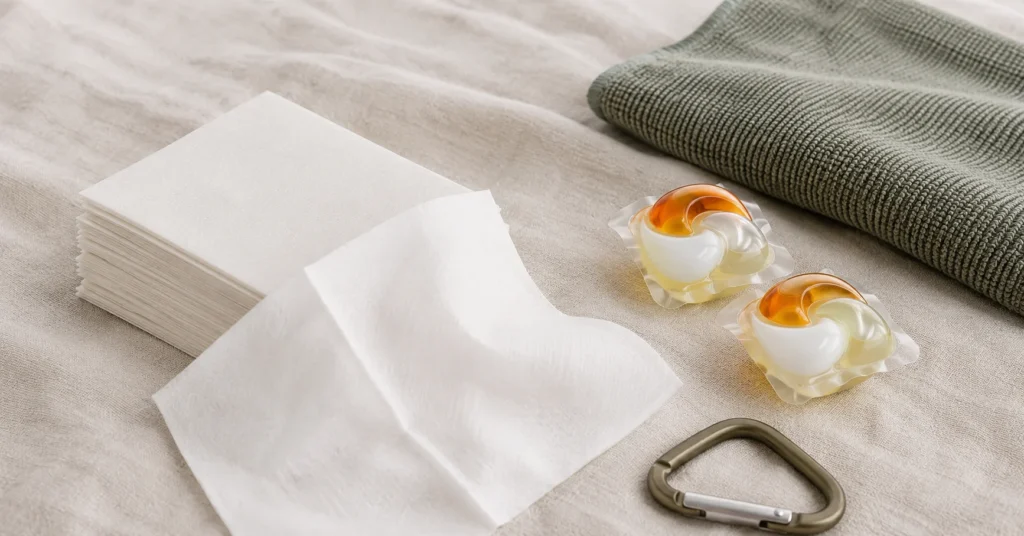
Sheets win for one-bag travellers doing multi-week trips with regular sink washing. Packets win for shorter trips, heavy soils, and anyone using coin laundromats more than twice a week.
That’s the answer. If you’re deciding right now and the trip is three weeks in Europe out of a 26-litre carry-on, buy Tru Earth sheets (~$18 for 32 strips on Amazon — 2025–2026 pricing, verify before purchase) and don’t overthink it. If you’re doing a ten-day trip with a checked bag and a hostel laundry room every few days, a sleeve of Dropps pods ($18 for 25 on the Dropps website) is the better call.
The comparison table below maps each option to the scenario where it actually wins.
| Option | Price (est.) | Best For | Key Limitation |
|---|---|---|---|
| Tru Earth Sheets | ~$18 / 32 strips | Long trips, sink washing, one-bag carry-on | Less effective on heavy oil/sweat soils |
| Sea to Summit Laundry Leaves | ~$7 / 50 leaves | Ultralight packing, budget option | Smaller leaves — use 2–3 per wash |
| Dropps Pods | ~$18 / 25 pods | Coin laundromats, heavier soils | Designed for machines; residue risk in sinks |
| Tide Pods Travel Pack | ~$6 / 10 pods | Short trips, widely available globally | Bulk per-pod cost; liquid can leak if punctured |
What You’re Actually Choosing Between
The best travel laundry detergent isn’t a brand. It’s a format — and the format that wins depends on how you wash on the road.
Sheets are dissolvable strips, roughly the size of a breath mint strip, that dissolve in water and produce a low-foam wash. They weigh almost nothing — a 32-strip pack from Tru Earth is 100g — and they sit flat in any pocket, packing cube, or toiletry bag. Because they’re dry and solid, they fall entirely outside TSA’s 100ml liquid restriction. No bag. No zip-lock. No airport stress.
Packets — pods or capsules — are pre-measured doses of concentrated liquid detergent sealed in a dissolvable film. Tide Pods, Dropps, and similar products are all variations on the same idea: pick up, throw in, wash.
They’re what most people already use at home, which is part of why they travel with them. The liquid concentrations are higher than most sheets, which translates to better performance on heavily soiled items — workout gear worn for three days straight, a shirt that absorbed a full afternoon in 38°C heat.
Both fit in a carry-on. The difference is in how you wash, how often, and what you’re washing.
The Differences That Change the Decision
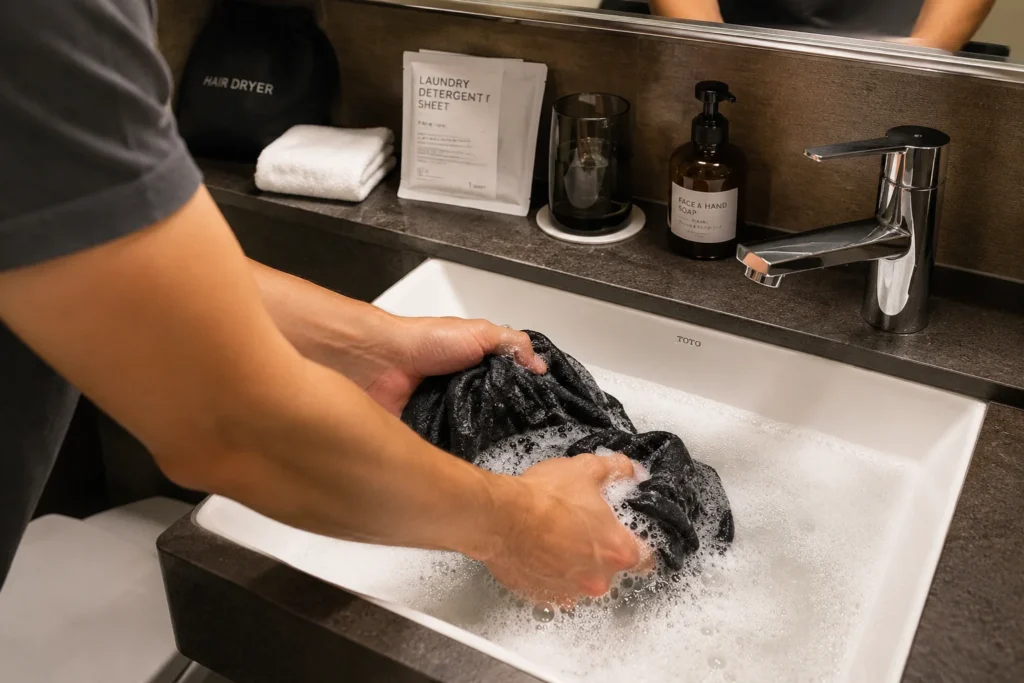
Sink washing vs machine washing is the biggest variable.
Sheets are built for cold water and low agitation. They dissolve quickly and rinse clean — which matters when you’re pressing water out of a t-shirt over a hotel sink at 11pm and you don’t want soap residue stiffening the collar by morning. Most pods are formulated to activate at machine wash temperatures (around 40°C) and under mechanical agitation.
Below that, they dissolve slowly and inconsistently. A pod half-dissolved in a sink wash will leave a film on whatever you’re washing. It’s not a dealbreaker, but it’s a real pattern.
Weight and space is less dramatic than packing guides make it. A sleeve of 10 Tide Pods weighs about 160g. A pack of 32 Tru Earth sheets weighs 100g. The 60g difference is real but not decisive. What matters more is that sheets pack flat and pods don’t — once you’ve tried to fit a bulging sleeve of pods into an already-maxed toiletry bag at 6am, you understand why format matters more than weight.
Cleaning power does differ. In back-to-back sink tests on the same cotton t-shirt worn for two days: sheets removed light sweat and general travel dirt reliably. A half-dissolved Dropps pod in cold water left the same shirt smelling better on the first wear and noticeably cleaner after two. If your trip involves serious physical activity — hiking, cycling — packets have a real edge in a machine wash.
TSA and international security is the one place sheets win unconditionally. Solid format, zero liquid, no restrictions. Pods are technically under the 100ml individual limit but a bag of them will sometimes get pulled for extra screening. It’s rare. It’s also the kind of friction that’s easy to eliminate.
For the One-Bag Traveller Doing 3+ Weeks
You’re washing in sinks three or four times a week. You have no checked bag. Every gram and every cubic centimetre is accounted for. This is the profile where sheets are the straightforward answer.
The Tru Earth fragrance-free strip (~$18 for 32 on Amazon) is the standard recommendation for this traveller. Each strip handles a hand-wash load of 4–6 items in cold water. For a 3-week trip washing every 5–7 days, bring 8–10 strips — that’s a stack thinner than a credit card. The fragrance-free version avoids any skin sensitivity issues, and Tru Earth’s formula rinses clean enough that a cotton shirt dried overnight on a towel rail won’t feel stiff.
Sea to Summit Laundry Leaves (~$7 for 50 on the Sea to Summit website — 2025–2026 pricing, verify before purchase) are the budget alternative. They’re smaller than Tru Earth strips and require 2–3 per wash rather than one, but at roughly 14 cents per leaf versus 56 cents per Tru Earth strip, the maths is clear for anyone doing volume washing over a long trip.
The honest trade-off: neither will fully replace a proper machine wash on technical fabrics worn hard. A merino wool base layer washed four times by hand in a sink will be cleaner than the same shirt left dirty for two weeks — but it won’t match what a laundromat with hot water and spin cycle does. If you’re doing a 6-week trip through Southeast Asia, plan two coin laundromat visits per month and use sheets for everything in between.
For the Weekend Tripper or Occasional Hand-Washer
A 4-day trip with a checked bag and a hotel that offers laundry service is not the scenario where you need to optimise. But if you’re the kind of person who always packs a small portable laundry detergent option for a hand-wash emergency — the spilled sauce, the unexpected extra night — the format question changes.
Pods win here. A sleeve of 10 Tide Pods in the checked bag gives you full machine-wash capability at any coin laundromat, plus they’re available at convenience stores globally when you run out. Tide Pods specifically are available at 7-Eleven in Japan, Carrefour in France, and virtually every supermarket in the US. You will not be stranded.
Dropps are the better option if you want to avoid synthetic fragrance and plasticiser concerns. $18 for 25 pods at Dropps.com — the per-unit cost is higher than Tide, but the formula is cleaner and the pods are compostable. For a weekend traveller who only uses 3–4 pods per trip, one $18 order lasts most of the year.
If you’re on a short trip and using hotel coin laundry once, just buy a small box locally. It’ll cost $2 and save you packing anything at all.
What Both Options Cost Over a Month of Travel
Assumptions: 4 weeks of travel, washing every 5 days — roughly 6 wash loads total, mix of sink washing and coin laundromat.
| Format | Product | Units Needed | Approx. Cost |
|---|---|---|---|
| Sheets | Tru Earth (32-strip pack) | 8–10 strips | ~$5–$6 of a $18 pack |
| Sheets | Sea to Summit Leaves (50-pack) | 18–20 leaves | ~$2.50 of a $7 pack |
| Pods | Dropps (25-pod pack) | 6 pods | ~$4.50 of a $18 pack |
| Pods | Tide Pods Travel (10-pack) | 6 pods | ~$3.60 of a $6 pack |
(2025–2026 pricing — verify before purchase)
The honest number: over a month of travel, you’ll spend $3–$6 on detergent regardless of which format you choose. This is not a budget decision. It’s a logistics decision. Pick the format that fits how you actually wash.
Final Recommendation: Pick One, Buy It Before You Leave
Don’t buy travel laundry detergent at the airport. You’ll pay three times the price for a product you didn’t choose.
Buy Tru Earth fragrance-free sheets if you’re doing multi-week one-bag travel, primarily sink-washing, or flying any airline where liquid restrictions add friction.
Buy Dropps pods if you’re using coin laundromats regularly, washing heavier workout or outdoor gear, or doing shorter trips where machine-wash quality matters more than pack weight.
The one scenario where you should bring both: a trip longer than 4 weeks that mixes remote destinations (sink washing, no laundromat access) with city segments (laundromat available). Carry 6 sheets and 4 pods. Use sheets in the field, pods in the city. Total weight: under 120g. Total cost: under $12 (2025–2026 pricing — verify before purchase).
Frequently Asked Questions About Travel Laundry Detergent
Are laundry detergent sheets TSA approved?
Yes. Sheets are dry and solid, which puts them entirely outside TSA’s 100ml liquid rule. Pack them in your carry-on or main bag without restriction. Liquid pods are technically compliant too — each pod is under 100ml — but a bag of them may attract extra screening. Sheets avoid that friction completely.
Can you use travel laundry detergent sheets in hotel sinks?
Yes, and it’s where they outperform pods. Sheets dissolve in cold water and rinse clean, leaving no residue in a quick sink wash. Pods are formulated for machine cycles and dissolve inconsistently below 30°C — which is usually what comes out of a hotel bathroom tap. For sink washing specifically, sheets are the better format.
How many laundry sheets do I need for a 3-week trip?
Bring 8–10 strips for a 3-week trip if you’re washing every 5–7 days. Each strip handles a small hand-wash load of 4–6 items. If you’re also using coin laundromats, replace 4 of those strips with 4 pods for the machine washes.
What’s the best travel laundry detergent for sensitive skin?
Tru Earth fragrance-free sheets: no synthetic fragrance, no dyes, effective in cold water. Dropps sensitive skin pods are the equivalent in packet format. Both are available on Amazon. (2025–2026 pricing — verify before purchase.)
Do laundry sheets work in cold water?
Yes. Tru Earth, Sea to Summit Leaves, and Earth Breeze all dissolve and activate in cold water — which is what you’ll get in most hotel sinks. Pods are less reliable below 30°C and can leave residue if not fully dissolved first. For cold-water hand washing, sheets are the more consistent option.
Continue Exploring
- travel gear guide for every trip type. It’s the reference post we built this section around, and the laundry decision fits inside a broader packing framework covered there.