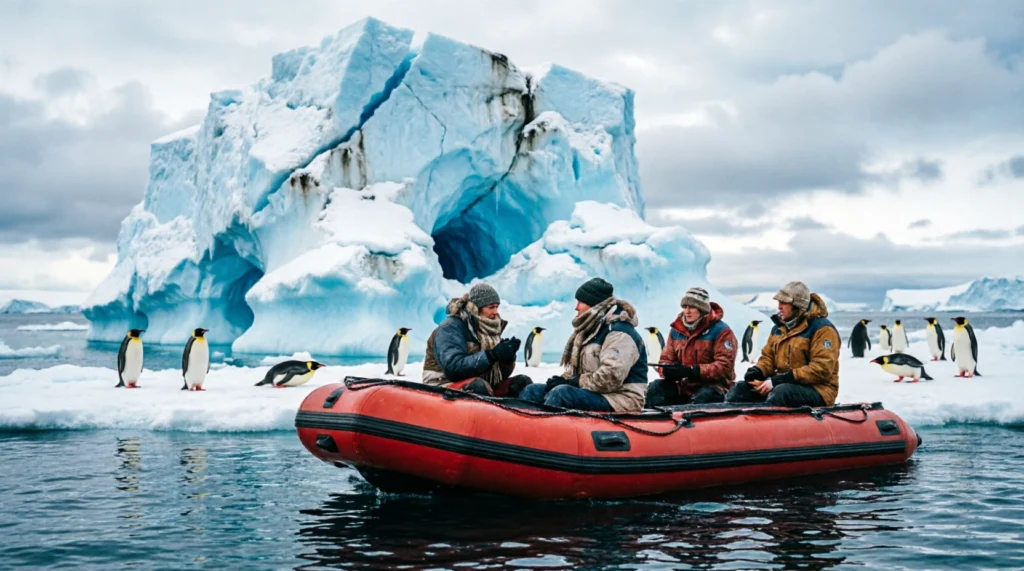
Taking your kids to Antarctica sounds like the ultimate parenting flex. It is the rawest, most remote wilderness on the planet—a continent of towering ice, breaching humpbacks, and hundreds of thousands of fearless penguins.
For well-traveled families attempting to check off all seven continents, it is the crown jewel.
But let’s be entirely transparent before you deposit $40,000 to $80,000 for a family of four: Antarctica is not a theme park, and an expedition ship is not a floating resort.
There are no waterslides, no kids’ clubs with arcade games, no quick land excursions if someone throws a tantrum, and no cell service for two weeks. Getting there requires flying to the tip of South America, followed by two days crossing the Drake Passage—a stretch of water famous for producing 30-foot swells and widespread seasickness.
So, can a kid-friendly expedition to Antarctica actually be a magical family vacation, or is it an expensive trial by ice? Here is our honest, editorially independent breakdown of how it works, what it costs, and who should actually book it.
Quick Verdict: Is a Family Antarctica Expedition Worth It?
Yes, but strictly for engaged, outdoor-loving children aged 10 and up on the right ship.
If your kids are fascinated by wildlife, marine science, or adventure—and are mature enough to follow strict safety instructions on freezing Zodiac boats—an Antarctic expedition will be the single most impactful trip of their lives.
However, if your children rely heavily on constant screen time, structured resort activities, or warm swimming pools, paying five figures per seat to take them to the icy south will feel like an agonizing ordeal for everyone involved.
- Who Should Go: Adventurous families with pre-teens and teenagers (ages 10–17), budding marine biologists, multi-generational families celebrating major milestones, and children who genuinely enjoy wildlife and nature.
- Who Should Skip: Families with kids under 8; children prone to severe, unmanageable motion sickness; travellers looking for a relaxed, warm-weather luxury cruise.
- The Biggest Trade-off: The sheer effort and cost. Getting a family of four to the White Continent requires multiple long-haul flights, 48 hours of rough open-ocean transit each way, and a financial investment equivalent to a new midsize luxury SUV.
Quick Facts: At a Glance
| Factor | Details |
| Recommended Age | Ages 10 to 17 (Most operators enforce a minimum age of 8 or 12) |
| Best Travel Window | December to February (Austral summer: maximum daylight, hatching penguins, whale activity) |
| Trip Duration | 10 to 14 days minimum (including transit to/from South America) |
| Departure Ports | Ushuaia, Argentina (ship crossing) or Punta Arenas, Chile (fly-cruise options) |
| Cost Range | $10,000 to $25,000+ USD per person (very few child discounts exist) |
| Wildlife Encounters | Gentoo, Chinstrap, and Adélie penguins, humpback & killer whales, leopard & Weddell seals |
What a Polar Expedition Is Actually Like for Kids
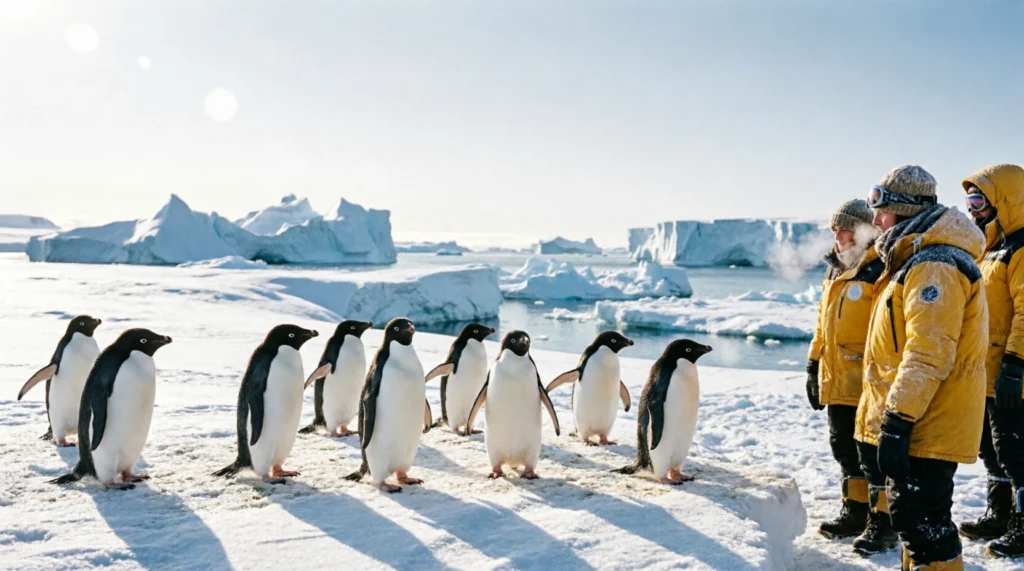
A family trip to Antarctica bears zero resemblance to a Caribbean cruise. You live on a heavily reinforced, ice-strengthened expedition ship navigating through channels lined with glaciers and floating icebergs.
       [ USHUAIA, ARGENTINA ]
                 |
   48-Hour Drake Passage Crossing
   (30-ft swells or "Drake Lake")
                 |
                 v
     [ SOUTH SHETLAND ISLANDS ]
                 |
   Daily Zodiac Transfers (2x / day)
                 |
                 v
      [ ANTARCTIC PENINSULA ]
   (Penguin Colonies, Kayaking, Glaciers)
Daily life revolves around the expedition schedule:
- Two Excursions per Day: Weather permitting, guests gear up in thermal layers, waterproof pants, and heavy polar boots twice daily. You board heavy-duty inflatable Zodiac boats to land on gravel beaches amidst penguin colonies or cruise among blue icebergs.
- Onboard Education: Between landings, expedition teams—comprising marine biologists, geologists, ornithologists, and historians—deliver interactive lectures.
- No Fixed Itineraries: Captains and Expedition Leaders adjust the schedule hourly based on sea ice, wind speeds, and polar weather shifts. Flexibility is non-negotiable.
For kids who love hands-on learning, this environment is extraordinary. They aren’t looking at animals through glass; they are sitting on a snowbank while a curious Gentoo penguin chick waddles up to inspect their boots.
The Reality of the Drake Passage with Children
To reach the Antarctic Peninsula by sea, every ship must cross the Drake Passage—the 600-mile stretch of ocean between Cape Horn and the South Shetland Islands.
+--------------------------------------------------------------------+
|                      DRAKE PASSAGE REALITY                         |
+------------------------------------+-------------------------------+
| THE "DRAKE SHAKE"                  | THE "DRAKE LAKE"              |
+------------------------------------+-------------------------------+
| • 20 to 35-foot ocean swells       | • Uncharacteristically calm   |
| • Widespread seasickness           | • Smooth, glassy water        |
| • 48 hours confined to staterooms  | • Easy deck walking           |
| • Heavy rolling and pitching       | • Outdoor wildlife viewing    |
+------------------------------------+-------------------------------+
| REALITY: You cannot predict which version you will get in advance. |
+--------------------------------------------------------------------+
Managing Motion Sickness
If you take children across the Drake, assume they will get seasick and prepare before the ship leaves port.
- Medication First: Consult your pediatrician well in advance for child-safe scopolamine patches, dimenhydrinate (Dramamine), or sea-bands. Administer treatment before the ship enters open ocean.
- Stateroom Selection: Book a mid-ship cabin on a lower deck. Mid-ship low-deck cabins experience significantly less roll and pitch than high-deck bow or stern suites.
- The Alternative (Fly the Drake): If the thought of 48 hours of heavy ocean rolling is a dealbreaker, operators like Antarctica21 offer “fly-cruise” itineraries. You fly from Punta Arenas, Chile directly to King George Island in Antarctica on a charter aircraft, bypassing the Drake Passage entirely in two hours.
Choosing the Right Ship: Small vs. Large
Not all expedition ships are created equal, and ship size directly impacts what your family can actually do.
Under International Association of Antarctica Tour Operators (IAATO) regulations, no more than 100 passengers are allowed on land in Antarctica at any single time.
       +-------------------------------------------------------------+
       |                 SHIP SIZE COMPARISON GUIDE                  |
       +-------------------------------+-----------------------------+
       | SMALL EXPEDITION SHIPS        | LARGE LUXURY SHIPS          |
       | (Under 200 Passengers)        | (500+ Passengers)           |
       +-------------------------------+-----------------------------+
       | • ALL guests land together    | • Strict shift rotations    |
       | • Maximum time on shore       | • Limited shore time        |
       | • Deep hands-on exploration   | • "Cruise-only" (some never |
       | • Best for active kids        |   allow guests on land)     |
       +-------------------------------+-----------------------------+
If you travel on a 150-passenger vessel, your kids will spend up to 3 to 4 hours on land per day. On a 400-passenger ship, guests must take turns in small shifts, drastically reducing actual time spent on shore.
Top Family-Focused Operators
- Lindblad Expeditions / National Geographic: Features the National Geographic Global Explorers Program. Kids participate in citizen science tasks, learn field photography from Nat Geo experts, take micro-microscope ocean samples, and earn informal “fun” polar certifications.
- Adventures by Disney (Chartering Ponant): Blends Ponant’s sleek French luxury vessels with Disney’s legendary youth expedition guides. Ships carry dedicated Adventure Guides who host youth-only dinners, trivia nights, and structured kids’ activities during sea days.
- Quark Expeditions: Excellent adventure-focused operations featuring sea kayaking, paddleboarding, and family-friendly expedition team members.
What It Really Costs
An Antarctic expedition is one of the most expensive travel experiences on Earth. Unlike standard Caribbean cruises where children travel at steep discounts, polar operators charge full or near-full fares for kids because ship passenger capacity is strictly capped.
- Standard Budget (10–12 Days): ~$10,000 – $14,000 USD per person.
- Mid-Tier / Premium Family Charter: ~$15,000 – $22,000 USD per person.
- Ultra-Luxury / Private Suites: $25,000+ USD per person.
The Real Cost Breakdown for a Family of Four
- Expedition Cruise Fares (4x $15,000): $60,000
- Long-Haul & Regional Airfare: $6,000 – $10,000
- Pre/Post Night Hotels (Buenos Aires/Ushuaia): $1,500
- Polar Gear (Waterproof pants, base layers, gloves): $1,000
- Gratuities & Incidentals: $1,500
- Estimated Total Outlay: $70,000 – $74,000 USD
What to Skip and What to Do Instead
- SKIP: Bringing children under 8 years old.Why: Most operators will not allow kids under 8 into Zodiac boats due to safety harness sizing and extreme cold exposure risks. Paying tens of thousands of dollars to keep a child confined to an indoor lounge is a complete waste.DO INSTEAD: Wait until your child is at least 10 to 12 years old, when they can fully appreciate the science, endure cold excursions, and remember the milestone.
- SKIP: Giant cruise ships carrying 500+ passengers.Why: Large ships cannot land all passengers at once. Your kids will spend hours waiting in lounge queues for a brief 45-minute land turn.DO INSTEAD: Book an ice-class vessel carrying between 100 and 199 passengers to maximize daily land and Zodiac time.
- SKIP: Buying all-new heavy down parkas for your kids.Why: Almost all reputable expedition lines (Lindblad, Quark, Ponant, Aurora) provide complimentary, high-performance waterproof polar parkas that you keep after the trip, plus free rental of heavy-duty insulated rubber boots.DO INSTEAD: Invest your money in high-quality merino wool base layers, fleece mid-layers, ski goggles, and 100% waterproof snow pants.
Final Recommendation
An Antarctic family expedition is not a passive holiday—it is an intense, transformative educational journey.
Book this trip if: You have active, inquisitive pre-teens or teenagers who love nature, can handle unpredictable cold weather, and you want to share a once-in-a-lifetime milestone before they leave home for college.
Look elsewhere if: Your children require structured resort animation, cannot handle rough seas, or if spending $50,000+ requires sacrificing your family’s broader long-term travel budget. For younger kids, destinations like the Galápagos or Alaska deliver incredible wildlife encounters at a fraction of the cost, cold, and friction.
FAQ
What is the minimum age for a child on an Antarctica cruise?
Most expedition cruise operators enforce a minimum age limit of 8 or 12 years old. A very small number of lines permit children as young as 5, but safety restrictions generally prevent children under 8 from participating in Zodiac boat landings or sea kayaking excursions.
How cold does it get in Antarctica during the tourist season?
During the Antarctic summer (December to February), coastal temperatures along the Antarctic Peninsula are surprisingly mild, usually ranging between -2°C and 5°C (28°F to 41°F). However, strong wind chill and ocean spray can make conditions feel significantly colder, requiring high-quality waterproof and windproof outerwear.
Is Wi-Fi available on expedition ships for kids?
While most modern expedition ships now carry Starlink satellite Wi-Fi, connection speeds can be inconsistent due to high polar latitudes and stormy weather. It is best to prepare children for a digital detox by downloading books, offline movies, and games onto devices before departing South America.
How safe are Zodiac boat landings for children?
Zodiac landings are exceptionally safe when guided by professional expedition crews. Children are required to wear fitted life vests at all times and must use the “sailor’s grip” wrist-hold when embarking and disembarking boats onto wet shorelines or slippery gangways.