For decades, the standard Bali holiday playbook was simple: step off the plane, head to a street shop in Seminyak or Canggu, hand over $6 a day, and ride off on a 125cc scooter in flip-flops.
That era is officially over.
Between announcements from Bali provincial authorities targeted at curbing reckless foreign driving and an aggressive police crackdown on unlicensed riders, navigating the island on two wheels has become one of the trickiest decisions a traveller can make. You need a quick reality check before booking your flights and accommodation.
Here is what is actually happening on the ground, what the legal changes mean for your budget, and how to get around without ending up in a police checkpoint—or a hospital bed.
Quick Verdict: Is Renting a Scooter in Bali Still Worth It?
The Short Answer: For 80% of travellers, no. Renting a self-drive scooter in Bali is no longer the stress-free default it used to be. Unless you hold a valid motorcycle license from home plus an International Driving Permit (IDP) with a motorcycle endorsement, renting a bike is illegal, exposes you to steep fines, and completely voids your travel insurance.
- Who should do it: Experienced motorcyclists with full licensing who are comfortable navigating aggressive, chaotic traffic on narrow, unpaved roads.
- Who should skip it: First-time riders, families, budget travellers trying to cut corners without proper licenses, and anyone intimidated by bumper-to-bumper traffic gridlock.
- The Biggest Trade-Off: Choosing not to rent a scooter means paying slightly more for ride-hailing apps or private drivers, but you trade away high accident risks, local police fines, and financial liability.
Quick Facts: Bali Transport & Traffic Rules
| Category | Practical Details |
| Legal Licensing | Home country motorcycle license + International Driving Permit (IDP) motorcycle stamp required. |
| Enforcement | Strict police checkpoints targeting unhelmeted riders, missing licenses, and improper paperwork. |
| Insurance Coverage | Travel insurance policies will not pay medical claims if you crash without a valid motorcycle IDP. |
| Best Alternative (Short Trips) | GrabBike or Gojek (ride-hailing scooter taxis driven by licensed locals). |
| Best Alternative (Day Trips) | Private car with driver ($35–$55 USD for 10–12 hours, fuel included). |
What the “Ban” Actually Means on the Ground
When provincial leadership announced proposals to restrict foreign tourists from renting motorbikes, headlines around the world claimed scooters were banned outright for visitors. The reality on the ground is more nuanced, but equally consequential.
Indonesian authorities did not suddenly confiscate every rental bike. Instead, they enforced existing traffic laws that were ignored for a decade. Local police and traffic directorates have systematically cracked down on:
- Unlicensed foreign drivers: Riding without an International Driving Permit that specifically covers motorcycles (a standard car driver’s license does not qualify).
- Safety and conduct violations: Riding without helmets, shirtless driving, carrying three people on a single scooter, or driving recklessly.
- Illegal rental operations: Unregistered rental shops operating without proper business permits or providing poorly maintained bikes.
In practical terms: if you lack a valid motorcycle endorsement from your home country, renting a scooter in Bali now carries massive legal risk. Rental vendors might still hand you the keys without checking your papers, but the moment you hit a police checkpoint or get into an accident, the legal and financial responsibility falls entirely on you.
What Driving in Bali Is Actually Like: Atmosphere & Hazards
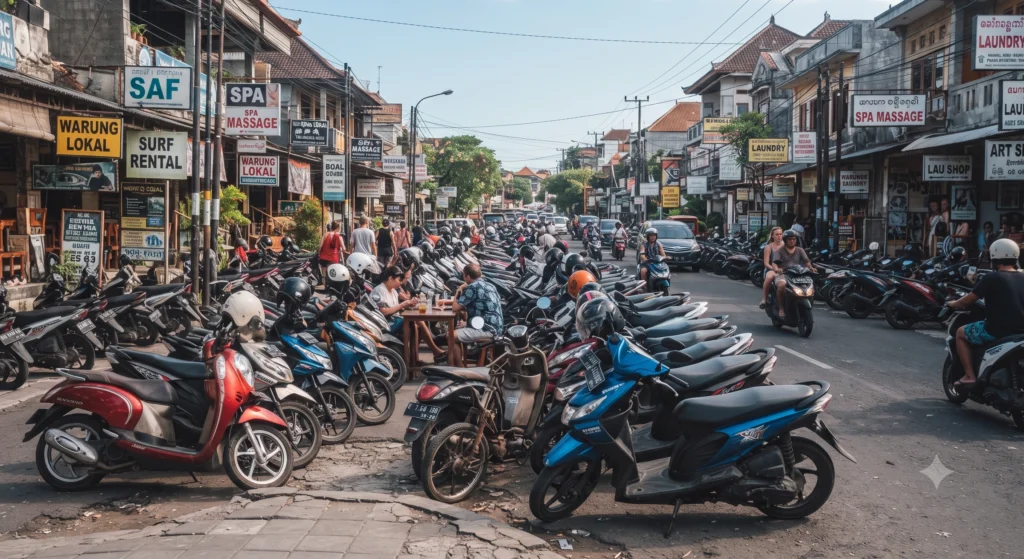
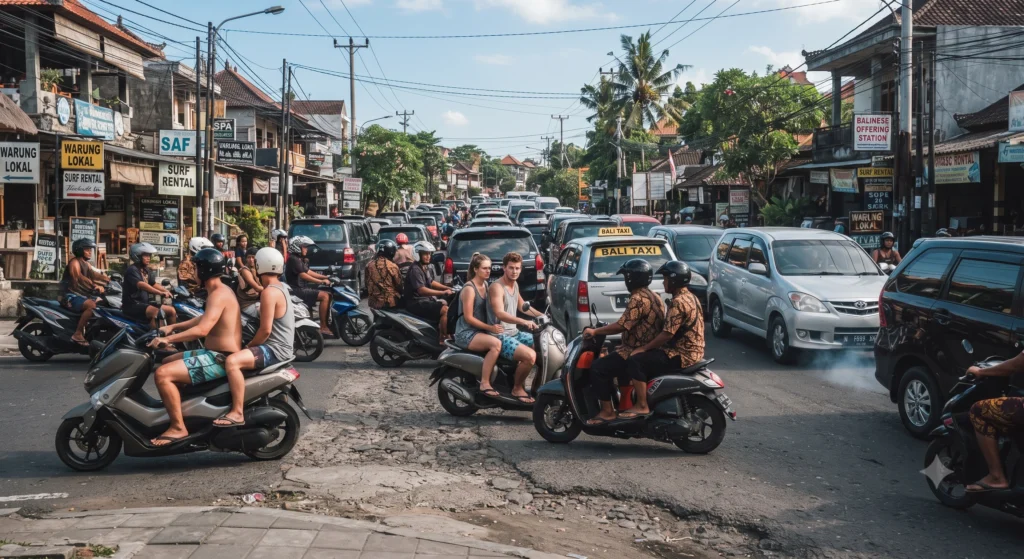
Promotional travel videos show sun-drenched travellers coasting smoothly past emerald palm trees. The daily physical experience of driving in Bali’s major tourist hubs—Canggu, Seminyak, Kuta, and Uluwatu—feels drastically different.
The Gridlock Reality: Streets designed decades ago for quiet agricultural villages now choke under thousands of cars and scooters. A 5-kilometer journey from Pererenan to Central Canggu can take 45 minutes during peak hours.
Visitors who choose to ride often face several harsh realities:
- Unpredictable Traffic Patterns: Traffic flows organically rather than strictly following lanes. Local riders routinely merge without looking, undertake on narrow dirt shoulders, and weave through tight gaps between trucks.
- Infamous “Gang” Shortcuts: Navigation apps often direct drivers down extremely narrow residential alleys (gangs). These paths feature blind corners, deep open drainage gutters (got), and barely enough space for two scooters to pass each other.
- Infrastructure Hazards: Expect unpaved roads, sudden potholed asphalt, loose gravel, and unlit stretches along rural coastal roads near Uluwatu or Nusa Penida.
- The Rainy Season Risk: Rain showers transform dry, dusty roads into slick oil-and-mud surfaces within minutes. Slipping on wet tiles or smooth tarmac is one of the leading causes of tourist injuries (commonly dubbed the “Bali Tattoo”).
The Travel Insurance Trap Most Visitors Ignore
This is the single most important financial detail before booking your trip: your travel insurance likely will not cover a scooter accident.
Most travellers assume that buying a comprehensive travel insurance policy automatically covers medical emergencies overseas. However, insurance fine print is explicit regarding two-wheeled motorized vehicles:
- Licensing Requirement: If you do not hold a valid motorcycle license in your home country and an International Driving Permit with a motorcycle classification, your policy is null and void for any two-wheeler incidents.
- Engine Capacity Limits: Many insurance policies limit coverage to bikes under 125cc. Many popular rental models in Bali (like the Yamaha NMAX or Honda PCX) are 150cc or higher.
- Helmet Clauses: Failing to wear an approved helmet at the exact moment of impact forfeits your coverage immediately.
Medical care at international hospitals in Denpasar or Kuta for serious road trauma can easily exceed $20,000 to $50,000 USD. If you are unlicensed, you will pay every cent out of pocket.
Smarter Ways to Get Around Bali
Giving up a self-drive scooter does not mean you are stranded at your villa. In fact, choosing alternative transport often results in a far more relaxing vacation.
1. Ride-Hailing Apps (Grab & Gojek)
For short hops around Canggu, Seminyak, Kuta, or Ubud, ride-hailing apps are the absolute best choice. You can order a GrabBike or Gojek scooter taxi. An experienced local driver handles the chaotic traffic, provides a helmet, and navigates the shortcuts.
- Cost: Expect to pay roughly $1.50 to $4.00 USD (IDR 25,000 – 60,000) per trip.
- What to know: Certain traditional taxi zones (specifically parts of Central Ubud, Canggu beach roads, and Uluwatu) have local taxi bans on app pickups. You may need to walk 200 meters outside designated drop-off zones to meet your driver.
2. Hiring a Private Local Driver
If you are planning day trips—such as visiting waterfalls in Munduk, temples in Bedugul, or beach-hopping in Uluwatu—hiring a private car with a dedicated driver is the gold standard for comfort and value.
- Cost: Current rates range between $35 and $55 USD (IDR 550,000 – 850,000) for a full 10-to-12-hour day, including vehicle, driver, and fuel.
- Why it wins: Air-conditioned comfort during 30°C+ heat, zero navigation stress, safe storage for your bags, and local insights from your driver.
3. Self-Drive Rental Cars
While renting a small car (like a Suzuki Jimny or Toyota Avanza) gives you autonomy, it comes with a major catch: gridlock. Sitting in a air-conditioned car stuck in a 2-hour standstill on Jalan Raya Canggu can consume half your day. Self-drive cars are only recommended if you are exploring remote regions in North or East Bali.
What to Skip and What to Do Instead
- SKIP: Renting a scooter at the airport or your hotel “just to try it out.” If you haven’t ridden a motorcycle at home, Bali is the absolute worst place to learn.
- DO INSTEAD: Download Gojek and Grab before arriving. Set up your credit card details in the app at the airport so you can seamlessly order rides the moment you land.
- SKIP: Relying on walkability. Outside small pockets of Sanur, Kuta, and central Seminyak, Bali is not a walkable destination. Sidewalks are rare, obstructed, or non-existent.
- DO INSTEAD: Choose your accommodation based on lifestyle hub location. Stay within 500 meters of the cafes or beaches you plan to visit daily so you can walk locally and use ride-apps for longer trips.
Final Recommendation: How to Plan Your Bali Trip
Bali remains an incredible destination, but the days of consequence-free, unlicensed scooter rentals are gone.
If you possess a valid home motorcycle license and IDP, by all means rent from an established, reputable shop that provides quality helmets and full vehicle registration documents.
For everyone else: factor transport costs directly into your holiday budget. Budgeting $30–$40 a day for a combination of Grab/Gojek rides and occasional private drivers will save you from police fines, hospital visits, and insurance nightmares—allowing you to actually enjoy your vacation.
FAQ SECTION
Is the Bali tourist motorbike ban actively enforced?
Yes. While rental shops may still hand over keys without asking for paperwork, local traffic police conduct regular spot-checks in major tourist areas like Canggu, Seminyak, and Uluwatu. Riders without proper motorcycle licensing, helmets, or vehicle registration face immediate fines or vehicle impoundment.
Can I drive a scooter in Bali with a standard car driver’s license?
No. Indonesian law requires an International Driving Permit (IDP) with a specific motorcycle stamp, alongside your valid home motorcycle license. A standard car driver’s license does not legally entitle you to ride a scooter or motorcycle in Bali.
What happens if I get into a scooter accident in Bali without a motorcycle license?
Your travel insurance will almost certainly deny your claim. You will be personally liable for all medical bills, property damage, and hospital costs, which can reach tens of thousands of dollars at private international hospitals in Bali.
Are Grab and Gojek available everywhere in Bali?
Grab and Gojek operate widely across southern Bali (Canggu, Seminyak, Kuta, Sanur) and Ubud. However, some local communities enforce pickup restrictions to protect local taxi driver associations, requiring you to walk to a designated main road pickup point.