
For most travelers, travel insurance for Europe isn’t legally required—but skipping it is a financial gamble you can’t afford. If you need a Schengen visa, you must show proof of medical coverage with at least €30,000 for emergency care and repatriation. If you’re from the US, UK, Canada, Australia, or other visa-exempt countries, no one checks at the border.
But here’s what they don’t tell you: a single emergency room visit in Europe costs €500–€2,000, and medical evacuation back home runs €25,000–€100,000. I’ve watched travelers decline coverage to save $80, then face a €3,400 hospital bill in Barcelona after a cycling accident. The math is brutal. Get the insurance.
What Europe Actually Requires vs. What You Actually Need
Europe’s insurance requirements split into two categories: what’s mandatory and what’s smart. The Schengen Area—26 European countries including France, Germany, Italy, Spain, and Greece—requires visa applicants to prove they have travel medical insurance covering at least €30,000 for emergency medical treatment and repatriation. This isn’t optional. No proof, no visa.
If you’re visa-exempt, nobody asks. But “not required” doesn’t mean “not necessary.” Your domestic health insurance almost certainly won’t cover you. Medicare provides zero coverage outside the US. Even private plans that claim “worldwide coverage” typically require upfront payment and reimbursement, and they exclude medical evacuation entirely.
The gap between “legal minimum” and “financial protection” is where most travelers get burned. You need coverage that handles three scenarios: medical emergencies (€50,000–€100,000 minimum), medical evacuation (€100,000+), and trip cancellation/interruption (100% of non-refundable trip costs).
The Three Types of Coverage That Matter (and the Rest You Can Skip)
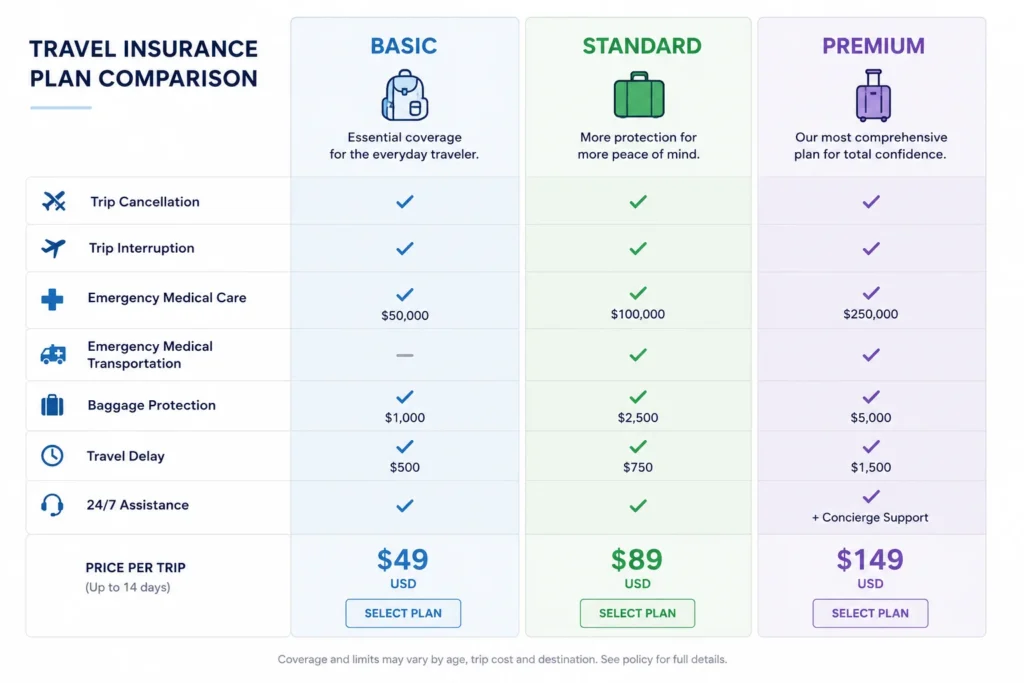
Travel insurance policies bundle dozens of coverages, but only three categories actually protect you in Europe.
Medical coverage is non-negotiable. Look for $50,000–$100,000 in emergency medical and dental coverage. This covers hospital stays, doctor visits, prescriptions, and emergency dental work. The average ER visit in Western Europe runs €800–€1,500 for minor issues; serious injuries or illnesses quickly hit five figures. (2025–2026 rates — verify before travel)
Medical evacuation is the coverage you hope to never use but can’t afford to skip. If you’re hiking in the Alps, cycling through Tuscany, or even just crossing a busy Paris street, an accident could require air ambulance transport back home. That costs $25,000–$100,000. Most basic policies include $100,000–$500,000 in evacuation coverage. Don’t go below $100,000.
Trip cancellation/interruption protects your financial investment. If you book a €3,000 trip and have to cancel due to illness, family emergency, or job loss, comprehensive insurance reimburses your non-refundable costs. This coverage typically costs more but pays for itself with one cancelled trip.
Skip the rental car damage waivers (your credit card likely covers this), baggage delay coverage under $500 (not worth the premium), and “cancel for any reason” upgrades unless you’re booking a trip 6+ months in advance.
How to Choose in 5 Minutes: The Decision Framework
Follow these steps to select the right policy without overthinking it.
Step 1: Determine if you need visa-required coverage. If you’re applying for a Schengen visa, you must have insurance meeting specific requirements: €30,000 minimum medical coverage, valid across all Schengen countries, covering the entire duration of your stay. Not all policies qualify—verify the policy explicitly states it meets Schengen visa requirements.
Step 2: Assess your existing coverage. Pull your health insurance card and call the number on the back. Ask: “What coverage do I have for emergency medical care in Europe?” Write down the answer. Then check your credit card benefits guide for travel protections. Most cards offer trip cancellation up to $1,500–$10,000 and minimal medical coverage ($500–$2,500). This helps you identify gaps but rarely eliminates the need for separate insurance.
Step 3: Choose your coverage tier. For a 2-week Europe trip, budget travelers should get medical-only coverage ($50–$100) with $50,000 medical and $100,000 evacuation limits. Mid-range travelers should get comprehensive coverage ($100–$250) including trip cancellation up to 100% of trip cost. High-risk travelers (over 65, adventure activities, expensive trips) should get premium coverage ($200–$400+) with higher limits and adventure sports riders. (2025–2026 rates — verify before travel)
Step 4: Compare 3–5 policies. Use comparison sites like Squaremouth or InsureMyTrip. Enter your trip dates, destination, and traveler ages. Filter for your coverage needs. Compare the top 3–5 results side-by-side, focusing on medical limits, evacuation limits, exclusions, and deductible amounts. Don’t just pick the cheapest—read the exclusions.
Step 5: Purchase within the waiver window. Buy your policy within 14–21 days of making your first trip deposit (flight or hotel) to qualify for pre-existing condition waivers. If you wait longer, any medical condition you had before buying insurance won’t be covered. This deadline matters more than most travelers realize.
What We Actually Use: Real Policies, Real Prices (2025–2026)
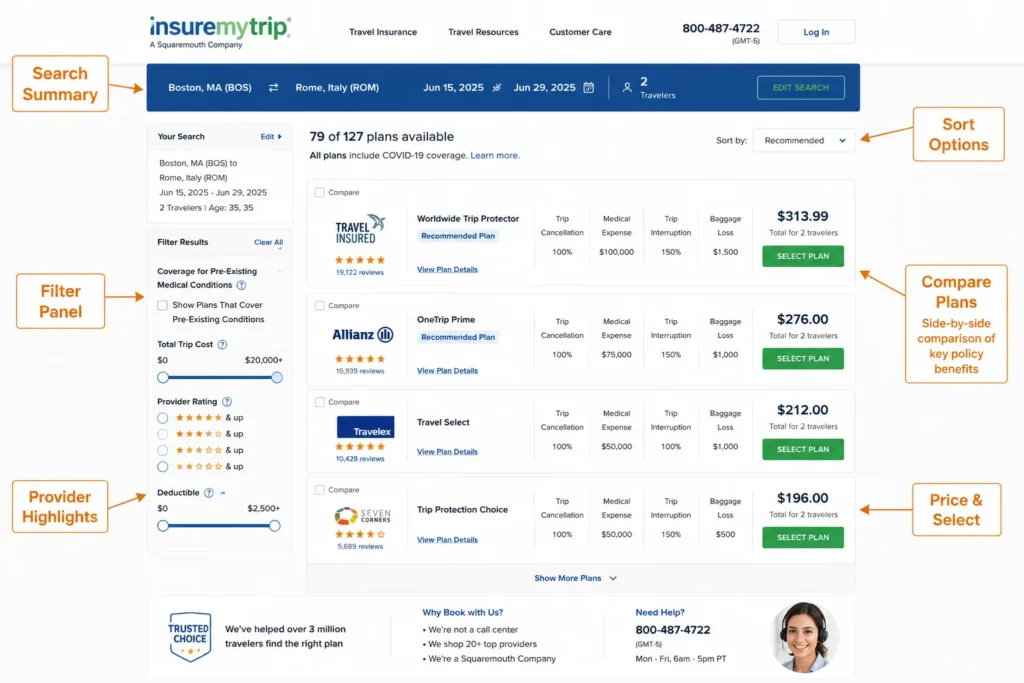
After testing multiple providers across dozens of Europe trips, here’s what we recommend based on actual use cases.
For budget travelers and digital nomads: SafetyWing Nomad Insurance costs $45–$60 for 4 weeks of coverage with $250,000 medical coverage and a $250 deductible. It’s designed for long-term travelers and covers 180 days at a time with the option to extend. The coverage is basic but solid for healthy travelers under 40. We’ve used it for 3-week trips through Portugal and Croatia without issues. (2025–2026 rates — verify before travel)
For comprehensive coverage: Allianz OneTrip Prime runs $100–$180 for a 2-week trip for travelers under 50, with $50,000 medical coverage, $500,000 evacuation, and trip cancellation up to 100% of trip cost. The claims process is straightforward—we filed a claim for a cancelled flight in 2024 and received reimbursement in 11 business days. The policy covers adventure activities like hiking and cycling without requiring a rider.
For adventure travelers: World Nomads Standard costs $120–$220 for 2 weeks with $100,000 medical coverage and covers 200+ activities including skiing, scuba diving, and bungee jumping. If you’re planning active pursuits, the higher premium is worth avoiding claim denials. We’ve seen travelers denied claims with standard policies after skiing accidents because they didn’t purchase the adventure sports rider.
For travelers over 65: IMG Patriot Platinum provides $500,000 medical coverage and accepts travelers up to age 84, though premiums jump to $200–$400 for a 2-week trip. Age-based pricing is brutal, but the coverage is comprehensive and the company has a solid reputation for paying claims.
Use travel finance tools to understand how these costs fit into your overall Europe budget and where travel insurance ranks against other protections like Wise or Revolut cards.
What Goes Wrong: When You Skip It and When Your Card “Covers” You
The two biggest mistakes travelers make: assuming they don’t need insurance, and assuming their credit card provides adequate coverage.
The “I’m young and healthy” trap. I met a 28-year-old in Rome who skipped insurance to save $90. He slipped on wet marble at the Colosseum, fractured his wrist, and faced a €2,800 bill for the ER visit, X-rays, and cast. He had to borrow money from family to get home. Young doesn’t mean invincible—accidents don’t check your health status.
The “my credit card covers everything” myth. Premium cards like Chase Sapphire Reserve and American Express Platinum do offer travel protections, but they’re limited. Chase Sapphire Reserve covers emergency medical up to $2,500 and medical evacuation up to $100,000. That $2,500 medical limit disappears after one night in a European hospital. The card also excludes pre-existing conditions and high-risk activities. Read the Certificate of Insurance—don’t rely on marketing summaries.
The dynamic currency conversion trap. When paying for medical care abroad, you’ll sometimes be offered the choice to pay in your home currency instead of euros. This is dynamic currency conversion (DCC), and it costs you 3–8% extra every time. Always decline. Always pay in local currency. This applies to insurance claims too—submit claims in the currency you were charged, not your home currency.
The pre-existing condition exclusion. If you have diabetes, heart disease, or any chronic condition, and you don’t buy insurance within 14–21 days of your first trip payment, any claim related to that condition will be denied. This catches thousands of travelers annually. Buy early or disclose everything.
For visa requirements and entry rules that intersect with insurance needs, check [IL → /visas-pillar/ | visas and entry requirements] to ensure your coverage meets Schengen standards if applicable.
Frequently Asked Questions About Travel Insurance for Europe
Is travel insurance mandatory for Europe?
Travel insurance is mandatory only if you need a Schengen visa—you must show proof of medical coverage with at least €30,000 for emergency care and repatriation. If you’re from the US, UK, Canada, Australia, or other visa-exempt countries, travel insurance is not legally required to enter Europe. However, it’s financially essential: a single emergency room visit can cost €500–€2,000, and medical evacuation runs €25,000–€100,000.
Does my credit card cover travel insurance in Europe?
Most premium credit cards offer some travel protection, but it’s rarely comprehensive. Chase Sapphire Reserve covers trip cancellation up to $10,000 and emergency medical up to $2,500—far below the cost of serious medical care in Europe. American Express Platinum covers baggage loss and trip delays but provides minimal medical coverage. Never assume your card covers medical evacuation or pre-existing conditions. Always read the Certificate of Insurance and buy a standalone policy if you need real medical coverage.
How much does travel insurance for Europe cost?
For a 2-week trip to Europe, expect to pay $50–$100 for basic medical-only coverage ($50,000–$100,000 limits), $100–$250 for comprehensive coverage (including trip cancellation and baggage), or $200–$400+ for high-risk activities or travelers over 65. The cost is typically 4–8% of your total trip expenses. (2025–2026 rates — verify before travel)
What happens if I don’t have travel insurance in Europe?
If you need medical care without insurance, you’ll pay out-of-pocket at European rates: €500–€2,000 for an ER visit, €2,000–€10,000 for hospitalization per day, and €25,000–€100,000 for medical evacuation back home. If you need a Schengen visa and can’t prove insurance coverage, your visa will be denied. For trip cancellations, you lose all non-refundable costs—flights, hotels, tours—unless your credit card provides limited protection.
Do I need travel insurance if I have health insurance?
Most US health insurance plans provide little to no coverage outside the United States. Medicare doesn’t cover international care at all. Even plans that claim “worldwide coverage” often require you to pay upfront and file for reimbursement, and they rarely cover medical evacuation. European health insurance cards (EHIC/GHIC) only work for EU/UK citizens. If you’re traveling from outside Europe, assume your domestic health insurance won’t cover you and buy separate travel medical insurance.
Continue Exploring
- Ready to optimize your Europe trip budget? master travel finance strategies to understand how insurance fits into your overall money plan and which cards actually protect you abroad.
- Planning your itinerary? navigate Europe visa requirements to ensure your documentation—including insurance proof—meets Schengen standards if needed.