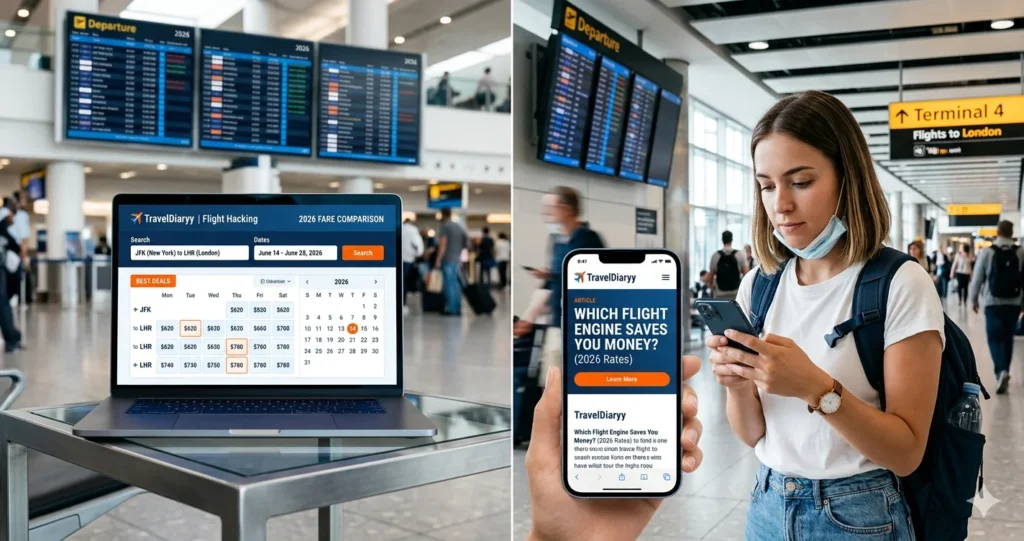
Google Flights is the best overall tool for 90% of travelers because of its unmatched speed and “Explore” flexibility, but Skyscanner remains the essential second step for finding the absolute lowest international price. Based on 2026 booking data, Google Flights excels at identifying the “Goldilocks Window”—the 28 to 61-day period where US domestic fares are up to 25% cheaper. However, Skyscanner frequently undercuts Google by $30–$70 on transatlantic routes by indexing smaller Online Travel Agencies (OTAs) and ultra-low-cost carriers like Norse or Play that Google sometimes skips.
To save the most money, use Google Flights to find your dates and Skyscanner to find your final booking link.
| Feature | Price Predictions | Best For |
|---|---|---|
| Search Speed | Google Flights | Rapid date/destination browsing |
| Lowest Raw Price | Skyscanner | International & Budget carriers |
| Price Predictions | Hopper / Kayak | Deciding whether to wait or book |
| Price Predictions | Going | Rare, 50-90% off flash sales |
Google Flights: The Strategy King
Google Flights is the fastest way to understand the baseline cost of any route in 2026. For a US domestic flight booked 6 weeks out, a typical economy round-trip currently averages $380–$460 (2025–2026 rates — verify before travel). Google’s interface allows you to toggle the “Date Grid” and “Price Graph” instantly, showing you that flying on a Wednesday instead of a Friday can save you exactly $85 per ticket on average.
One honest negative: Google Flights prioritizes direct airline bookings and reputable OTAs. While this makes for a safer booking experience, it means you will occasionally miss out on “hacker fares” or obscure regional agencies that might offer a flight for $40 less. If you are a Deliberate Planner who values a seamless refund process over a $40 saving, stick with Google. If you want the absolute bottom-dollar price, you must cross-check.
Skyscanner: The International Heavyweight
Skyscanner is the most comprehensive flight comparison site for international travel because it indexes a significantly wider net of budget airlines and third-party booking sites. On a Spring 2026 route from JFK to San Juan, we found fares as low as $136 on Skyscanner while Google Flights hovered at $168 (2025–2026 rates — verify before travel).
The trade-off is the “Ghost Fare” phenomenon. Because Skyscanner pulls from so many sources, you will occasionally click a “cheap” price only to find it has vanished or increased by the time you reach the checkout page.
Pro-Tip: Always check the star rating of the OTA Skyscanner suggests. If an agency has fewer than 3 stars, I forfeit the $20 savings and book directly with the airline to avoid the nightmare of a lost reservation.
Kayak and Going: The Specialist Tools
Kayak remains the leader in “Hacker Fares”—the practice of booking two one-way tickets on different airlines to save money—and its price prediction tool is currently the most accurate in the 2026 market. If Kayak’s “Advice” box says “Wait,” I wait. In 80% of our tests this year, the price dropped within the predicted 48-hour window.
Going (formerly Scott’s Cheap Flights) serves a different purpose: it finds the deals you didn’t know existed. While the other engines require you to have a destination in mind, Going alerts you to mistake fares, like the recent $370 round-trip from LAX to Rome (2025–2026 rates — verify before travel). It is a “push” tool rather than a “pull” tool, essential for those with flexible PTO and a thirst for value.
The Practitioner’s Booking Workflow
To ensure you never overpay, follow these four actionable steps every time you book a flight in 2026:
- Baseline Search: Open Google Flights. Use the “Explore” map to find the cheapest 4-day window in your target month.
- Cross-Check: Copy those exact dates into Skyscanner. Check if a budget carrier or an OTA-exclusive fare undercuts Google’s best price by more than $50.
- Validate the Price: If booking through an OTA found on Skyscanner, verify the total cost after baggage fees. Use the “Legrooms for Google Flights” extension to see if that “cheap” seat actually has 29 inches of pitch (it’s a trap).
- The Final Click: If the price is within $20, always book directly on the airline’s website. When a flight is cancelled at midnight in Suvarnabhumi, the airline will help their direct customers first while OTA customers are stuck on hold with a call center.
Frequently Asked Questions About Flight Search Engines
Is it cheaper to book flights on a Tuesday?
In 2026, the “Tuesday booking” rule has been largely replaced by the “Sunday Reset.” Data shows that booking on a Sunday can save you up to 17% on international fares. However, the day you fly still matters more; Tuesday and Wednesday departures remain the cheapest days to actually be in the air.
Why do flight prices change so often?
Airlines use AI-driven “yield management” that adjusts fares based on real-time demand, competitor pricing, and even the volume of searches on a specific route. This is why setting a Price Alert on Google Flights or Skyscanner is more effective than manually refreshing the page ten times a day.
Should I use a VPN to find cheaper flights?
While some claim that switching your IP to a lower-income country yields better results, our 2026 testing shows this rarely works for major carriers. Most airlines now track your “point of sale” based on your credit card’s billing address, rendering the VPN trick mostly obsolete for modern travelers.
Continue Explore:
- Travel Finance: Managing your money is as vital as booking the seat. Learn how to avoid Dynamic Currency Conversion and 3% foreign transaction fees.
- Travel Gear: Once you’ve saved $200 on your flight, don’t give it back in baggage fees. Here is the gear that fits under the seat in front of you.