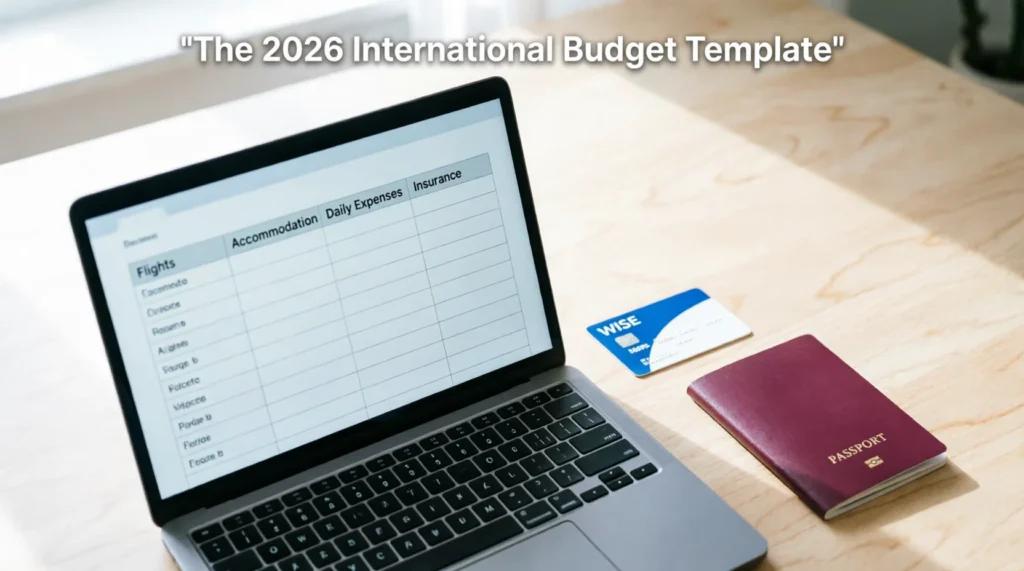
To accurately calculate how to budget for international travel, you must categorize your spending into three tiers—Backpacker, Mid-range, and Luxury—then multiply the daily rate by your trip length and add 15% for a “hidden fee” buffer. This method eliminates the guesswork that leads to mid-trip cash shortages. In 2026, a mid-range solo traveler should expect to spend $180–$250 per day in Western Europe or $70–$110 per day in Southeast Asia, excluding long-haul flights.
(2025–2026 rates — verify before travel.) This guide provides the specific logistical steps to build a bulletproof international trip budget from scratch.
The Tiered Budgeting Framework
The most effective way to build a travel budget planner is to assign yourself a spending tier before looking at destinations.
- Backpacker Tier: You prioritize the experience over comfort. You sleep in hostel dorms, use public transit exclusively, and eat 70% of your meals from street stalls or grocery stores.
- Mid-range Tier: You want a private room and a hot shower every night. You mix public transit with occasional rideshares and eat one sit-down meal per day.
- Luxury Tier: You stay in 5-star properties, use private transfers, and dine at top-rated establishments daily.
I learned the hard way in Tokyo that failing to pick a tier leads to “budget creep.” I started as a mid-range traveler but didn’t account for the ¥1,500 ($10.50) Shinkansen seat upgrades or the $100-per-night premium for staying in Minato instead of a cheaper ward like Arakawa. (2025–2026 rates — verify before travel.)
Average Daily Costs by Global Region
Daily costs fluctuate based on local inflation and exchange rates, so you must benchmark your destination against current 2026 data.
- Southeast Asia (Thailand, Vietnam): $45 (Backpacker) | $95 (Mid-range) | $250+ (Luxury).
- Western Europe (France, UK): $90 (Backpacker) | $210 (Mid-range) | $550+ (Luxury).
- Central/South America (Colombia, Peru): $55 (Backpacker) | $120 (Mid-range) | $300+ (Luxury).
- Japan/Korea: $85 (Backpacker) | $190 (Mid-range) | $450+ (Luxury).
(2025–2026 rates — verify before travel.)
How to Calculate International Accommodation Costs
Accommodation will consume 30% to 50% of your daily spend, and prices are currently 12% higher on weekends in major hubs like London or NYC compared to Tuesday–Wednesday rates. For a mid-range hotel in Lisbon, budget $140–$180 per night in 2026. If you are a solo traveler, remember that “single supplements” in hotels often mean you pay 80–90% of the price of a double room; hostels remain the only true way to halve this cost. (2025–2026 rates — verify before travel.)
Budgeting for Food and Dining Expenses
Calculate your food budget by totaling one grocery run, two “grab-and-go” meals, and one sit-down dinner per day. In Paris, a boulangerie sandwich costs €7–€10, while a three-course prix-fixe dinner at a non-tourist bistro averages €45–€60 per person. (2025–2026 rates — verify before travel.) If you drink alcohol, add 15% to your daily total; a pint of beer in Oslo or Singapore can easily reach $12–$15, which can derail a tight budget in under 48 hours.
Transportation Costs: Local and Long-Distance
Local transit is the most underestimated expense in an international trip budget, often costing more than the flight if you rely on airport taxis.
- Long-distance: Use Google Flights to track routes 4 months out. Transatlantic budget fares currently average $550–$850. (2025–2026 rates — verify before travel.)
- Local: Use Citymapper or Google Maps to find the “Day Pass” rate. In London, the Oyster cap is approximately £15.60 per day for Zones 1-6. (2025–2026 rates — verify before travel.)
- Airport Transfers: Never take a “black cab” or “unmarked taxi” from the arrivals hall without checking the Uber or Bolt price first. In Rome (FCO), a fixed-fee taxi to the city center is €55; the Leonardo Express train is €14. (2025–2026 rates — verify before travel.)
Activity and Tour Budgeting
Allocate a flat fee for “Big Bucket List” items and a daily average for smaller museums or walking tours. Major attractions in 2026, such as the Sagrada Familia or the Louvre, cost $25–$40 per ticket. (2025–2026 rates — verify before travel.) I recommend the “one-in, one-out” rule: if you pay for a $150 hot air balloon ride in Cappadocia, the next two days must be “free” activities like hiking or self-guided walking tours to balance the ledger.
Practical Money-Saving Logistics
Use a Charles Schwab or Wise debit card to eliminate ATM fees and the standard 3% foreign transaction fee charged by traditional banks.
When using your card at a restaurant or ATM, you will often see a screen asking if you want to pay in “USD” or the “Local Currency.” Always choose local currency. This avoids Dynamic Currency Conversion (DCC). If you choose USD, the merchant’s bank sets the exchange rate—usually 5–10% worse than the mid-market rate. This is essentially a “convenience tax” that offers zero convenience.
For more detailed strategies on managing your accounts abroad, see our comprehensive [IL → /travel-budget-guide/ | travel budget guide] which covers multi-currency accounts and fraud protection.
The Master Budget Breakdown Template
To finalize your budget, use this 5-step action list to ensure you haven’t missed the “invisible” costs.
- Fixed Costs: Flights + Travel Insurance + Visa Fees.
- Daily Multiplier: (Daily Tier Rate × Number of Days).
- The Big Ticket Fund: Total of all pre-booked tours over $50.
- Connectivity: $3–$5 per day for an Airalo or Holafly eSIM. (2025–2026 rates — verify before travel.)
- The 15% Buffer: Multiply the total of steps 1–4 by 1.15.
This buffer covers the $15 Western Union fee you’ll pay if you lose your primary card or the sudden price hike in Uber fares during a tropical downpour in Ubud.
Frequently Asked Questions
How much cash should I carry when traveling abroad?
Carry the equivalent of $100–$200 USD in local currency as an emergency backup for cash-only stalls or transit. Use ATMs at the airport (inside the secure arrivals hall) to withdraw this upon arrival. Avoid “Travelex” kiosks which offer predatory rates compared to bank ATMs.
Is it cheaper to book everything in advance?
Flights and trains (like the Eurostar) are significantly cheaper 2–3 months out. However, booking every meal or local tour in advance removes your ability to pivot based on local advice, often leading to “tourist tax” prices. Balance is key: lock in transport, but leave 50% of your activities flexible.
Does travel insurance count as a budget item?
Yes, and it is non-negotiable. A basic policy for a 2-week trip costs $60–$100. (2025–2026 rates — verify before travel.) Failing to budget for this is a gamble; an uninsured medical evacuation from a remote location can exceed $50,000, instantly ending your traveling career.
Continue Exploring
- digital nomad banking: Learn the technical differences between Revolut and Wise for long-term international spending.
- save money for travel: Practical lifestyle shifts to fund your next international trip without taking on credit card debt.