The Pacific Coast Highway looks shorter on a map than it feels in your rental car. Google Maps will tell you San Francisco to Los Angeles is 10 hours. That’s true if you drive straight through at 2am on a Tuesday in February. It’s not true if you’re actually seeing the coast, stopping at pullouts, dealing with RV traffic, and fighting fog that rolls in at 4pm like clockwork in summer.
Wildfire season runs June through October along this route. When the Air Quality Index climbs above 150, outdoor activities become uncomfortable. Above 200, they’re hazardous. Check air quality before you commit dates — it’s that simple.
This guide gives you real drive times with traffic, actual 2025–2026 costs by tier, the specific mile markers worth stopping at, and the honest truth about which sections justify the hype and which you can skip without regret. You’ll know exactly what to book, when to drive, and where your money actually goes.
What the Pacific Coast Highway Actually Demands from You
Direct Answer: A Pacific Coast Highway road trip requires 5–7 days minimum, a rental car, $200–$400/day depending on your tier, and strategic booking 2–3 months ahead for summer travel. Drive southbound (San Francisco to Los Angeles) for ocean views on your side of the car and easier pullouts.
The PCH isn’t one road — it’s Highway 1 stitched together with sections of Highway 101 and Interstate 5. The iconic coastal portion runs roughly 650 miles from San Francisco to Los Angeles, but “doing the PCH” properly means adding Monterey, Big Sur, Hearst Castle, and Santa Barbara. That pushes you to 750+ miles over 5–7 days.
You need a car. Not “a car is recommended” — required. Public transit doesn’t exist between these coastal towns in any meaningful way. The rental will cost you $60–$120/day depending on season and vehicle class. Add $50–$80/day for gas — California has the highest fuel prices in the continental US at $4.50–$5.50/gallon (2025–2026 rates — verify before travel).
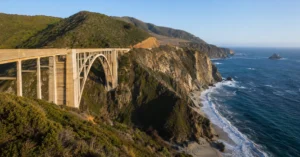
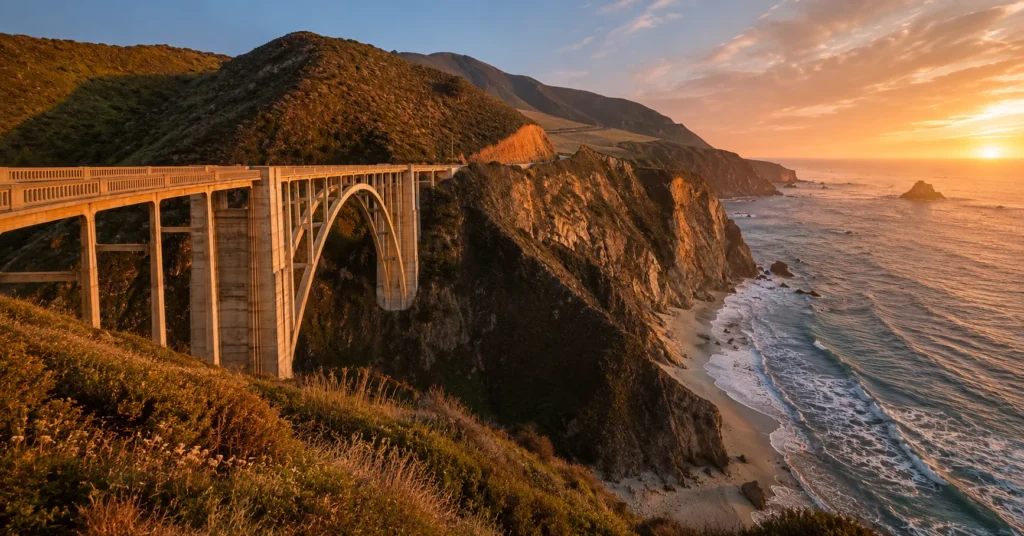
Big Sur at mile marker 46 on PCH, northbound, at 7am before the RVs arrive — that’s when the coast belongs to you. By 10am, tour buses from Monterey claim every pullout between Bixby Bridge and Nepenthe. This isn’t hyperbole. I’ve stood at both.
Quick Facts: PCH by the Numbers
Structured Element: Quick Facts Block
| Category | Detail |
|---|---|
| Total Distance | 650 miles (1,046 km) San Francisco to LA via Highway 1 |
| Minimum Days | 5 days (rushed), 7 days (comfortable) |
| Best Direction | Southbound (SF → LA) for ocean views, easier pullouts |
| Best Months | May, September, October (avoid summer fog, winter rain) |
| Daily Budget | Budget: $150/day | Mid-range: $300/day | Premium: $500+/day |
| Car Required | Yes — no viable public transit between coastal towns |
| Book Ahead | 2–3 months for summer, 1 month for shoulder season |
| Wildfire Season | June–October (check AQI before travel) |
| Fog Season | May–September (afternoons/evenings, especially Big Sur) |
| Road Closures | Big Sur section closes during landslides — check Caltrans before booking |
Cost Freshness Tag: All costs reflect 2025–2026 rates — verify before travel.
The Stops That Justify the Drive (and the Ones That Don’t)
Not every coastal town deserves your night. Some are drive-throughs. Others justify building your entire itinerary around them. Here’s the hierarchy.
Monterey and Carmel-by-the-Sea
Monterey works as a base. The Aquarium is legitimately world-class if you’re into marine biology — $50/adult, 3–4 hours minimum. But the real draw is the 17-Mile Drive through Pebble Beach. It costs $11.25 per vehicle (2025–2026 rates — verify before travel), which feels predatory until you see the Lone Cypress and realize you’re driving through what amounts to a gated community that happens to sit on spectacular coastline.
Carmel-by-the-Sea, adjacent to Monterey, is the village that Instagram built. It’s genuinely charming if you ignore the prices: $8–$12 for a coffee, $25+ for lunch that amounts to a sandwich. Stay here if budget isn’t your constraint. The cottages run $300–$600/night.
Carmel Mission Boulevard at 8am on a Wednesday — you can actually photograph the white stucco and red tile roofs without tour groups in your frame. By 11am on Saturday, forget it.
Big Sur: The Section Everyone Talks About
Big Sur isn’t a town. It’s 90 miles of Highway 1 between Carmel and San Simeon where the mountains meet the ocean with no regard for your motion sickness. This is the section that justifies the entire PCH reputation.
Must-stop pullouts (southbound, with mile markers):
- Bixby Creek Bridge (mile marker 46): The postcard shot. Arrive before 9am or after 5pm to avoid the tour bus convoys.
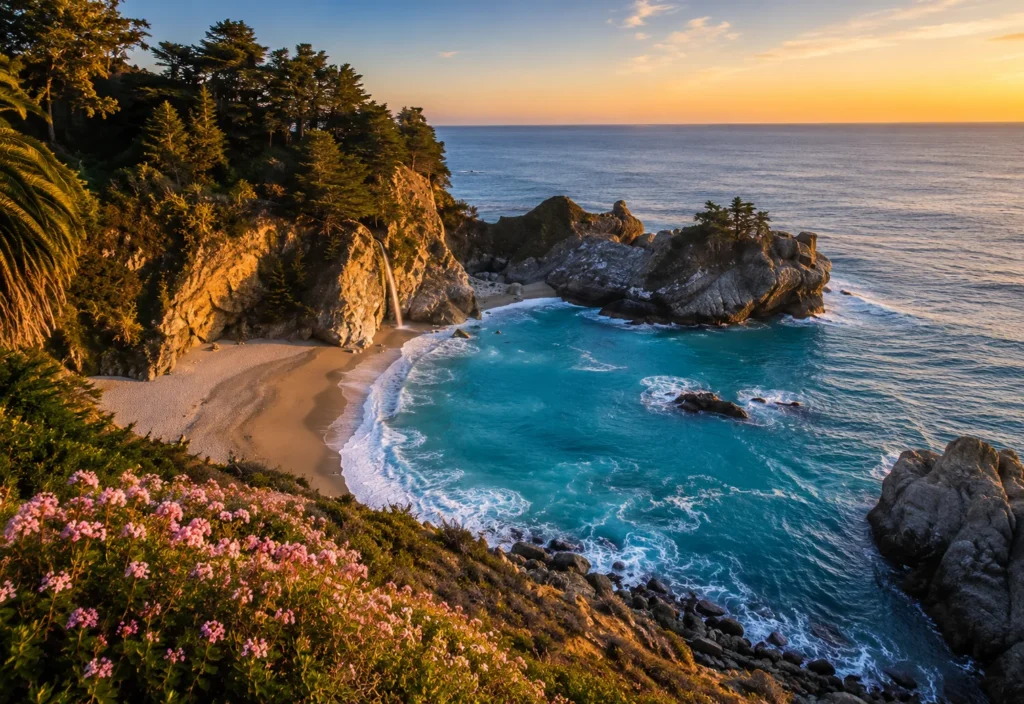
- McWay Falls at Julia Pfeiffer Burns State Park (mile marker 37.5): An 80-foot waterfall that drops directly onto a beach you can’t access. The viewpoint is a 0.5-mile walk from the parking area. $10 parking fee (2025–2026 rates — verify before travel).
- Pfeiffer Beach (Sycamore Canyon Road, turnoff at mile marker 41.5): Purple sand, keyhole rock formation. The turnoff is unmarked and easy to miss. $12 parking fee.
What to skip: Nepenthe restaurant. Yes, the views are spectacular. No, the $28 burger doesn’t justify them. Eat in Carmel or San Simeon instead.
Pfeiffer Beach access road is unmarked except for a small brown sign that says “Sycamore Canyon.” If you’re looking for a big “Pfeiffer Beach” sign, you’ve already driven past it. Turn around at the next opportunity — it’s 15 miles to the next U-turn spot.
Hearst Castle: Worth the Detour or Tourist Trap?
Hearst Castle in San Simeon sits 5 miles inland from Highway 1. The tours run $30–$45 depending on which house you visit (2025–2026 rates — verify before travel). The Grand Rooms Tour is the standard — 2 hours, covers the main house and Neptune Pool.
Is it worth it? If you care about Gilded Age excess and William Randolph Hearst’s bizarre collection of European art and antiquities, yes. If you’re just checking boxes, no. The drive from Big Sur to San Simeon is only 90 minutes without stops. Adding the tour pushes this day to 6–7 hours of driving plus 2–3 hours touring.
Santa Barbara: The Stop Everyone Loves
Santa Barbara is where the PCH stops feeling like a road trip and starts feeling like you’re approaching a real city. The Spanish colonial architecture is genuine, not staged. State Street runs from the waterfront into the hills — restaurants, bars, shops.
Stay here if you want walkability. The Funk Zone (warehouse district turned wine tasting destination) is 10 blocks from the beach. Accommodation runs $200–$400/night for anything decent.
What to skip: Stearns Wharf. It’s a pier with tourist shops selling the same inventory as every other California pier. The beach is fine, but you’ve seen better beaches by this point in the trip.
Los Angeles: Where the PCH Ends
Technically, the PCH ends at the intersection of Highway 1 and Interstate 5 near downtown LA. Practically, you’ll want to end in Santa Monica or Malibu. Santa Monica Pier is the traditional endpoint — there’s even a sign. Malibu is where Highway 1 becomes Pacific Coast Highway (the actual street name) and runs through some of LA’s most expensive real estate.
What to skip: Driving PCH through Malibu in rush hour. It’s a two-lane road with no shoulders, lined with driveways for $10M homes. One stopped car backs up traffic for miles. If you’re arriving in LA, switch to I-5 or I-405 once you hit Oxnard.
Where to Stay: Zones, Prices, and the Motel Trap
Accommodation on the PCH breaks into three categories: coastal towns with options, coastal stretches with nothing, and cities where you’re paying for location.
Monterey/Carmel Zone
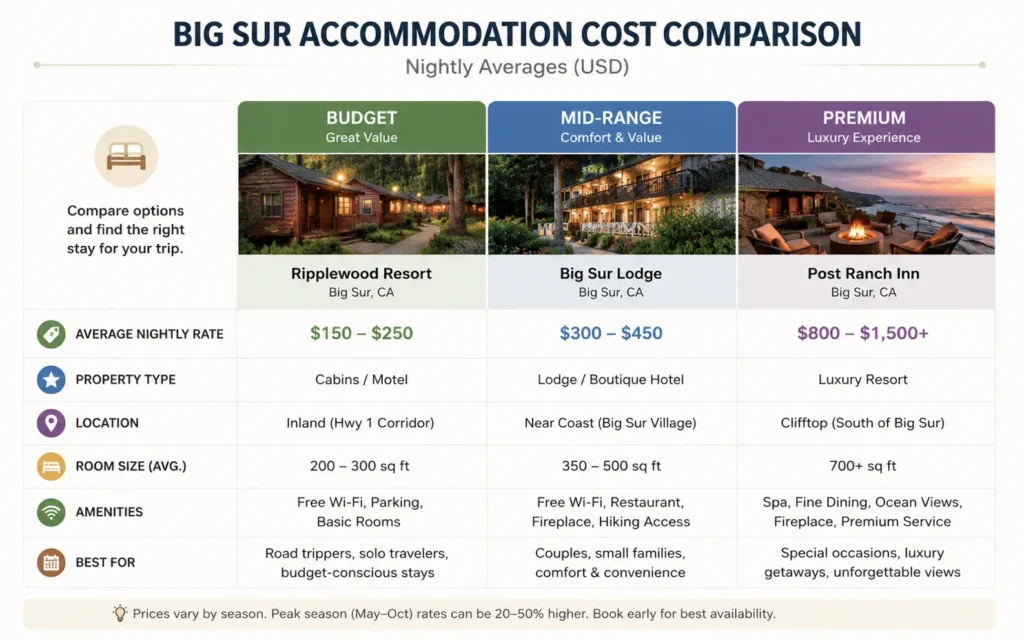
Budget: Monterey has motels from $120–$180/night. They’re not charming. They’re clean, they have parking, they’re 10 minutes from Cannery Row. The Monterey Bay Lodge on Munras Avenue is representative — $150/night in shoulder season (2025–2026 rates — verify before travel).
Mid-range: $250–$400/night gets you a proper hotel in Monterey or a cottage in Carmel. The Portola Hotel in Monterey runs $300/night and includes parking (rare in this zone).
Premium: $500+/night. Carmel Valley Ranch, Post Ranch Inn in Big Sur (if you can get a reservation — book 6 months ahead).
Big Sur: The Problem
Big Sur has approximately 10 places to stay along 90 miles of highway. They’re all expensive. They’re all booked months in advance for summer weekends. The Post Ranch Inn starts at $1,200/night. Ventana Big Sur starts at $900/night.
The workaround: Stay in Carmel (north) or San Simeon/Cambria (south). Drive Big Sur as a day trip. You’ll save $600+/night and you won’t be stuck if fog rolls in at 4pm and you can’t see the road.
San Simeon/Cambria Zone
This is where you stay if you’re doing Big Sur as a day trip from the south. Cambria has B&Bs and small hotels. San Simeon has motels near Hearst Castle.
Budget: $100–$150/night. The Sea Venture Motel in Cambria runs $130/night (2025–2026 rates — verify before travel).
Mid-range: $180–$280/night. The Cambria Pines Lodge runs $240/night and includes breakfast.
Santa Barbara Zone
Santa Barbara is expensive. Period.
Budget: $150–$220/night for a motel. The Motel 6 on Milpas Street runs $160/night in shoulder season — it’s not charming, but it’s clean and walkable to State Street.
Mid-range: $280–$450/night. The Hyatt Centric runs $350/night.
Premium: $500+/night. The Four Seasons Biltmore starts at $700/night.
Los Angeles Zone
Don’t stay on the PCH in LA. Stay in Santa Monica if you want beach access ($250–$400/night), or move inland to Culver City or West Hollywood where you get better value ($180–$300/night).
Getting Around: Your Car, Your Schedule, Your Sanity
You need a car. Not an SUV, not a convertible, not a specific type — just a car with working AC and brakes you trust.
Rental Car Costs
Economy/compact: $60–$90/day
Mid-size: $80–$120/day
SUV: $120–$180/day
Convertible: $150–$250/day
All rates: 2025–2026 — verify before travel. Summer prices run 30–50% higher than shoulder season. Book 2–3 months ahead for summer.
Gas Costs
California gas prices: $4.50–$5.50/gallon (2025–2026 rates — verify before travel). The PCH from San Francisco to LA is roughly 650 miles. A car getting 30 mpg will burn 22 gallons = $100–$120 in fuel one-way.
Fill up in bigger towns (Monterey, San Luis Obispo, Santa Barbara). Gas stations in Big Sur charge $0.50–$1.00/gallon more.
Real Drive Times (Traffic-Adjusted)
San Francisco to Monterey: 2 hours without stops, 2.5–3 hours with Santa Cruz stop. Google Maps says 2 hours. That’s accurate at 6am on Tuesday. At 2pm on Saturday, add 30–45 minutes.
Monterey to Big Sur (to Nepenthe): 1.5 hours. This is 45 miles of two-lane road with no passing zones. You will be behind an RV doing 35 mph. Accept this.
Big Sur to San Simeon: 1.5 hours. Another 90 miles of coastal driving.
San Simeon to Santa Barbara: 2.5 hours. 145 miles. You can speed up on 101 after San Simeon.
Santa Barbara to Los Angeles (Santa Monica): 2 hours without traffic, 3–4 hours in rush hour. Leave before 7am or after 10am. Never drive this section 3–7pm on a weekday.
Highway 1 through Big Sur has no cell service for approximately 60 miles between mile markers 30 and 50. Download offline maps before you leave Monterey. This is not a suggestion — it’s a requirement.
Road Closure Reality
The Big Sur section of Highway 1 closes during landslides. It’s happened multiple times in the last decade. The most recent major closure was 2017–2018. Check Caltrans (California Department of Transportation) before you book: search “Caltrans Highway 1 Big Sur conditions.”
If the road is closed, your PCH trip becomes a 101 freeway trip. It’s still beautiful, but it’s not the PCH.
What This Trip Actually Costs: Three Real Tiers
| Category | Budget Tier | Mid-Range Tier | Premium Tier |
|---|---|---|---|
| Daily Total | $150–$200/day | $300–$400/day | $500+/day |
| Accommodation | Motel: $120–$180/night | Hotel/B&B: $250–$350/night | Boutique/Resort: $500–$1,200/night |
| Meals | $30–$40/day (groceries, fast casual) | $80–$120/day (mix of casual + 1 nice dinner) | $150+/day (full-service dining) |
| Car Rental | Economy: $60–$80/day | Mid-size: $90–$120/day | SUV/Convertible: $150–$250/day |
| Gas | $50–$70/day | $50–$70/day | $70–$100/day (larger vehicle) |
| Activities | Free beaches, hiking | Paid attractions ($10–$50 each) | Private tours, wine tastings |
| Parking Fees | $10–$20/day | $15–$30/day | $25–$50/day (valet) |
What Budget Actually Gets You
Budget tier ($150–$200/day): You’re staying in motels 10–15 minutes from the coast, eating breakfast from a grocery store, packing lunch, and having one inexpensive dinner ($15–$20). You’re doing free activities — beaches, hiking, scenic pullouts. You’re driving an economy car. This is doable, but it’s not relaxing. You’re watching every dollar.
Mid-range tier ($300–$400/day): You’re staying in proper hotels or B&Bs within walking distance of town centers. You’re having breakfast at cafes ($12–$18), lunch at casual restaurants ($15–$25), and one nice dinner ($35–$50). You’re paying for parking ($15–$30/day in towns). You’re doing paid attractions — Hearst Castle tour ($30–$45), Monterey Aquarium ($50). This is the sweet spot for most travelers.
Premium tier ($500+/day): You’re staying at Post Ranch Inn or equivalent. You’re eating at Nepenthe, Sierra Mar, or other destination restaurants ($80–$150/person for dinner). You’re doing private wine tastings in Santa Barbara ($75–$150/person). You’re renting a convertible or luxury SUV. Money is not the constraint — availability is.
Hidden Costs Nobody Mentions
→ Resort fees: Some hotels charge $25–$50/night “resort fees” even if you don’t use the resort. Always check the fine print.
→ Parking: Santa Barbara hotels charge $30–$50/night for parking. Monterey hotels charge $20–$40/night. Budget motels include it free.
→ State park fees: $10–$12 per vehicle per day. If you’re visiting multiple state parks, buy the California State Parks Annual Pass for $125 (2025–2026 rates — verify before travel).
→ Tolls: The 17-Mile Drive charges $11.25 per vehicle. Golden Gate Bridge (if you start in SF) is $9.40 southbound (2025–2026 rates — verify before travel).
The Seven-Day PCH Itinerary That Works
This assumes you’re flying into San Francisco and out of Los Angeles. Reverse it if your flights don’t align.
Day 1: San Francisco to Monterey
Drive time: 2.5 hours (with Santa Cruz stop)
Distance: 120 miles (193 km)
Leave San Francisco by 9am. Drive south on Highway 1 through Daly City — the city views are spectacular. Stop in Santa Cruz for lunch (1 hour). The Beach Boardwalk is a tourist trap, but the downtown has decent cafes.
Arrive Monterey by 3pm. Check in. Walk Cannery Row if you must, but the real value is the coastal trail from Fisherman’s Wharf to Pacific Grove — 5 miles, flat, ocean views.
Stay: Monterey (better value) or Carmel (more charming, higher prices)
Day 2: Monterey to Big Sur to San Simeon
Drive time: 3.5 hours driving, 6–7 hours with stops
Distance: 135 miles (217 km)
Leave by 8am. You want Big Sur before the crowds. Stop at Bixby Bridge (mile marker 46) — 20 minutes for photos. Continue to McWay Falls (mile marker 37.5) — 1 hour including the 0.5-mile walk to the viewpoint.
Lunch at Big Sur Roadhouse or pack a picnic. Stop at Pfeiffer Beach if you have time (add 1.5 hours).
Arrive San Simeon or Cambria by 5pm. Dinner in town.
Stay: Cambria (more charming) or San Simeon (closer to Hearst Castle)
Day 3: Hearst Castle to Santa Barbara
Drive time: 3 hours driving, 5–6 hours with tour
Distance: 145 miles (233 km)
If you’re doing Hearst Castle, book the 9am Grand Rooms Tour (2 hours). Leave by 12pm. Drive south on Highway 1 to San Luis Obispo (45 minutes). You can detour through Morro Bay to see Morro Rock if you have time (add 1 hour).
Continue on Highway 101 to Santa Barbara. Arrive by 4pm. Check in. Walk State Street. Dinner in the Funk Zone.
Stay: Santa Barbara
Day 4: Santa Barbara to Malibu to Los Angeles
Drive time: 2.5 hours driving, 4–5 hours with stops
Distance: 95 miles (153 km)
Leave Santa Barbara by 9am. Drive through Carpinteria and Ventura. Stop in Malibu at El Matador Beach (parking is $15, arrive before 11am or parking is full).
Continue to Santa Monica. Walk the pier. End your PCH trip at the “End of the Trail” sign.
Stay: Santa Monica (beach access, expensive) or Culver City (better value, 20 minutes inland)
Days 5–7: Los Angeles
You’ve finished the PCH. Spend 2–3 days in LA doing what LA does — museums, hiking, food. That’s a different guide.
What to Book First (In Order)
- Rental car (2–3 months ahead for summer)
- Accommodation in Big Sur zone (Carmel or San Simeon — 2–3 months ahead for summer)
- Hearst Castle tour (if doing it — 1 month ahead for summer)
- Monterey Aquarium tickets (if doing it — 2 weeks ahead)
- Everything else (can book 1–2 weeks ahead)
Pro Tips: What Nobody Tells You Until It’s Too Late
Fog is a daily reality in summer. It rolls in around 4pm in Big Sur and Monterey. If you want clear photos, shoot before 11am or after 6pm. Midday in July and August is often foggy.
Cell service doesn’t exist in Big Sur. Download offline Google Maps before you leave Monterey. Download this guide. Tell someone your itinerary.
Gas up in towns, not on Highway 1. Gas stations in Big Sur charge $0.50–$1.00/gallon more than Monterey or San Luis Obispo.
Southbound is easier than northbound. Ocean views are on your side of the car. Pullouts are on your side. You’re not crossing traffic to stop.
May and September are the best months. Summer has fog and crowds. Winter has rain and landslides. May and September give you clear skies, fewer people, and lower prices.
Bring layers even in summer. Coastal temperatures run 60–70°F (15–21°C) even when inland is 90°F (32°C). The wind off the ocean is cold.
Don’t drive Big Sur at night. It’s a two-lane road with no shoulders, no lighting, and cliffs on one side. Finish your driving by 6pm.
The turnoff for Pfeiffer Beach is unmarked except for a small brown sign that says “Sycamore Canyon Road.” It’s on the west side of Highway 1, just south of mile marker 41. If you see a big redwood tree at the corner, you’re in the right place. If you’ve passed it, the next U-turn is 15 miles away.
Frequently Asked Questions About Pacific Coast Highway Road Trips
How many days do I need for the Pacific Coast Highway?
Five days minimum, seven days comfortable. Five days means you’re driving 5–6 hours daily with limited stops. Seven days lets you explore Monterey, Big Sur, Hearst Castle, and Santa Barbara without rushing. Anything less than five days and you’re just driving, not experiencing.
What’s the best time of year to drive the Pacific Coast Highway?
May and September–October are ideal. May gives you spring wildflowers and fewer crowds before summer. September–October offers clear skies, warm temperatures, and summer crowds have left. Avoid June–August if you hate fog and crowds. Avoid November–March if you hate rain and landslide closures.
Can I drive the Pacific Coast Highway in one day?
Technically yes, practically no. It’s 650 miles and Google Maps says 10–12 hours. That’s without stops, without traffic, without seeing anything. You’d leave at 5am and arrive at 7pm having seen nothing but highway. Don’t do this. The PCH is about the journey, not the destination.
Is the Pacific Coast Highway dangerous?
It’s not dangerous if you’re a cautious driver. It’s a two-lane road with no shoulders in sections, steep drop-offs, and frequent fog. Don’t drive it at night. Don’t drive it in heavy rain. Don’t try to pass on blind curves. If you’re comfortable with mountain driving, you’ll be fine. If you’re nervous about heights, consider the 101 inland route.
Do I need a 4WD or SUV for the Pacific Coast Highway?
No. Highway 1 is paved and maintained. A standard sedan is fine. An SUV gives you more comfort and storage, but it’s not required. Don’t rent a convertible expecting to drive with the top down — it’s often too cold and windy, even in summer.
Continue Exploring
- California Travel Guide: The Complete Planning Resource — This PCH guide covers one route. The California pillar covers the entire state — from Yosemite to Joshua Tree, Napa to San Diego. Use it to extend your trip beyond the coast.
- One-Bag Travel: The Complete Packing Guide — You’re driving, so baggage limits don’t apply. But packing light still matters. This guide shows you what to actually bring for a week on the coast — layers for 60°F fog and 85°F inland heat, hiking shoes for Big Sur trails, and the one jacket that works everywhere.