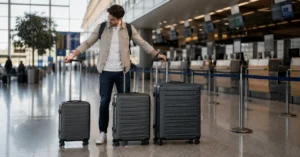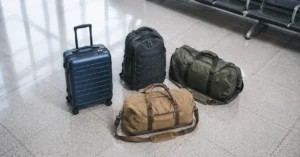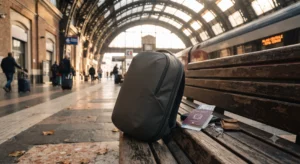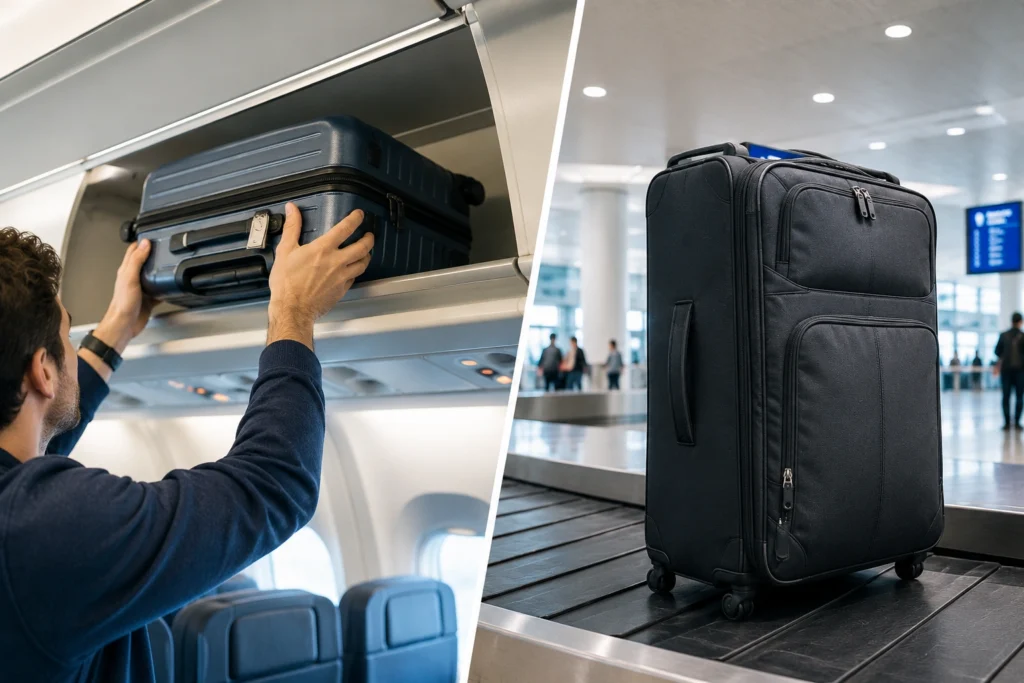
The luggage carousel at Rome Fiumicino Airport in July is a masterclass in travel regret. You watch hundreds of people crowd three-deep against a moving rubber belt, waiting for massive 29-inch suitcases that may or may not have arrived on the same flight. Meanwhile, the travellers who restricted themselves to an overhead cabin bag are already standing at the train platform buying tickets into the city. Choosing your packing strategy isn’t just about how many shirts you can pack.
It changes how you move through train stations, how much money you hand over to budget airlines, and how much energy you waste dragging your gear over old stone streets. This breakdown unpacks the realities of carry on vs checked luggage so you can buy the right travel bags for your specific trip style.
Carry On vs Checked Luggage Decision Matrix
| Luggage Choice | Standard Size Limits | Average Weight Limit | Best For | Main Limitation | The Honest Verdict |
| Cabin Carry-On | 56 x 36 x 23 cm | 7 kg – 10 kg | 2-10 day trips, fast transit, city hops | Strict liquid rules, zero space for souvenirs | Buy this if you hate waiting at carousels and want to avoid baggage fees entirely. |
| Checked Suitcase | Up to 158 cm (L+W+H) | 23 kg (50 lbs) | 2+ week trips, cold climates, winter gear | Risk of loss, heavy to lift, taxi upgrade costs | Use this when heavy coats or specialized gear make small bags physically impossible. |
What Travel Luggage Rewards—and What It Punishes When You Choose Wrong
Every airport terminal has two kinds of people. The first group glides through the boarding gate with a single, compact rectangular bag that fits smoothly into the overhead locker. The second group stands by the check-in desk, sweating while trying to extract three pairs of heavy boots to get a giant bag under the 23-kilogram weight limit. Luggage choice is a direct trade-off between personal autonomy and wardrobe variety.
Choosing a cabin bag rewards speed and structural flexibility. You skip the check-in queues, bypass the baggage claim crowds, and never experience the specific panic of an airline losing your belongings in a foreign hub. But it punishes anyone who packs without a strict strategy. If you choose this path, you must accept the reality of doing laundry in a hotel sink or paying a local service to wash your gear mid-trip.
Going big with a checked suitcase rewards the over-packer and the winter traveller. It lets you pack full-sized toiletries, multiple heavy layers, and thick leather shoes without calculating millimetres of space. The punishment arrives outside the airport doors. You will feel every extra kilogram when dragging that bag up four flights of stairs in a Parisian boutique hotel that lacks a lift.
The Quick Verdict: Carry On vs Checked Luggage at a Glance
Choose a carry on bag if your trip lasts under two weeks, moves across multiple locations, and requires fast transit through train stations or budget airline gates. Opt for a checked suitcase only when traveling for more than 14 days, packing bulky winter gear, or carrying liquids over 100 milliliters. For the vast majority of regional trips, a standard 22-inch cabin bag saves money on luggage fees and cuts transit time by at least 45 minutes per flight.
Your decision must factor in the specific operating rules of the airlines you intend to fly. European low-cost carriers like Ryanair or EasyJet routinely charge up to $60 per flight segment for a standard cabin bag that legacy carriers include for free. If you are flying three different budget airlines inside a single week, a large checked bag can easily double the total cost of your flight tickets.
Consider the local terrain of your destination before picking a large bag. The historic centres of cities like Venice, Edinburgh, or Lisbon are covered in deep cobblestones, steep hills, and narrow footpaths. A heavy 25-kilogram suitcase with cheap wheels turns a simple ten-minute walk from the station into an exhausting physical struggle. A lightweight cabin bag stays manageable, even when you have to carry it over a series of canal bridges.
Understanding the Options: Overhead Bags vs Hold Luggage
A standard carry on bag is built to fit inside the metal sizing crates placed near airport check-in counters. For most domestic and international legacy airlines, the dimension limit is 56 by 36 by 23 centimetres (22 by 14 by 9 inches). This space must hold your clothing, footwear, and your personal toiletry kit. You are limited to small bottles under 100 millilitres packed into a single transparent plastic zip bag.
+-------------------------------------------------------------+
|               AIRPORT LUGGAGE DIMENSION GUIDE               |
+-------------------------------------------------------------+
|                                                             |
|  [ PERSONAL ITEM ]                                          |
|  Dimensions: 45 x 35 x 20 cm                                |
|  Location: Must fit completely under the seat in front.     |
|                                                             |
|  [ CABIN CARRY-ON ]                                         |
|  Dimensions: 56 x 36 x 23 cm                                |
|  Location: Must fit inside the overhead storage lockers.     |
|                                                             |
|  [ CHECKED SUITCASE ]                                       |
|  Dimensions: Max 158 cm total (Length + Width + Height)      |
|  Location: Travels inside the cargo hold of the aircraft.   |
|                                                             |
+-------------------------------------------------------------+
Checked suitcases cross into a completely different size tier, allowing dimensions up to 158 total linear centimetres (length plus width plus height added together). The weight threshold is the real boundary here — standard airline regulations enforce a hard cap of 23 kilograms (50 pounds) for standard economy tickets (2025–2026 rates — verify before travel). Exceeding this limit by even half a kilogram triggers heavy overweight baggage charges at the counter, often starting at $100.
The mechanics of your trip should dictate your choice. If your itinerary involves changing hotels every three days via trains or small buses, checked bags become a major liability. You will waste time searching for oversized luggage lockers at train stations or trying to force a giant hard-shell case into the tiny boot of a standard taxi. Small bags stay with you, fit into overhead train racks, and keep you mobile.
The Suitcase Guide: Materials, Wheels, and Durability Realities
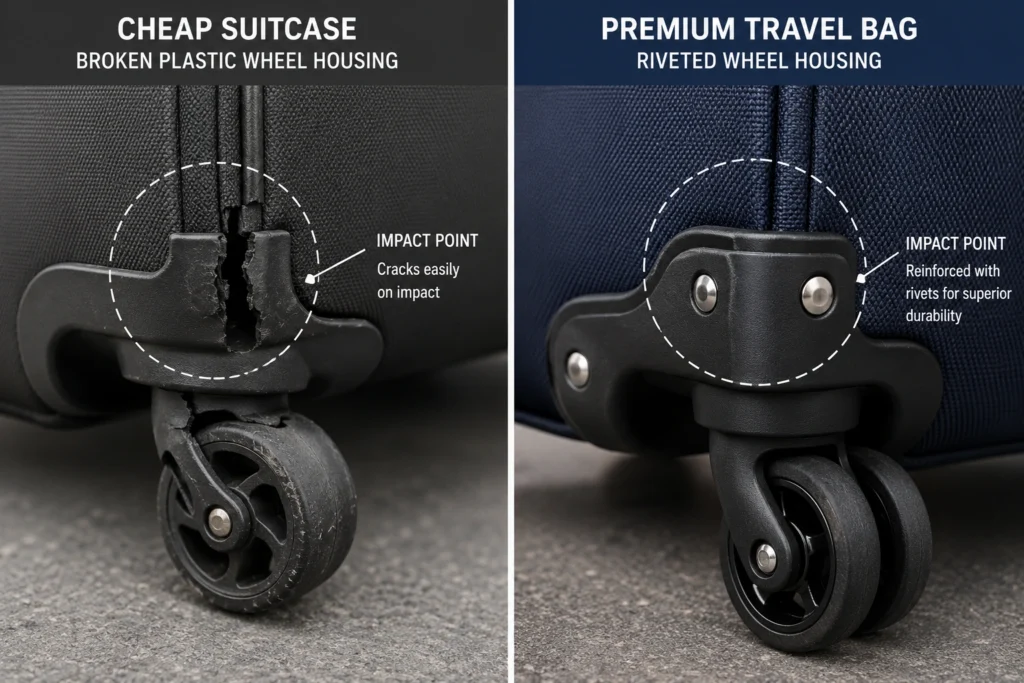
Do not buy a suitcase based on its exterior appearance or the number of pockets it has. Look directly at the fabric grade or the plastic composition of the outer shell. For soft-sided travel bags, look for ballistic nylon or Cordura with a denier rating of at least 800D. Cheap polyester suitcases at low prices will tear along the seams the first time a baggage handler drags them across a concrete cargo ramp.
If you prefer a hard-shell suitcase, avoid cheap ABS plastic entirely. ABS is brittle, turns white at stress points, and cracks easily under low temperatures inside an airplane cargo hold. Look for 100% polycarbonate or polypropylene shells. Polycarbonate flexes under pressure, absorbing violent impacts from airport sorting conveyor belts without shattering, then pops back into its original shape.
       [SPINNER SUITCASE]                      [TWO-WHEEL ROLLER]

         +-----------+                           +-----------+
         |           |                           |           |
         |           |                           |           |
         |           |                           |           |
         +-----------+                           +-----------+
          o|o     o|o                             [O]     [O]
     (Four 360-degree wheels)                (Two recessed wheels)
   Best for: Smooth airport floors          Best for: Cobblestones & curbs
   Limitation: Break off easily             Limitation: Must be tilted to pull
The wheel system is the most common failure point on modern luggage. Four-wheel “spinner” suitcases roll smoothly on polished airport floors, but those exposed wheels protrude directly from the base of the bag. A heavy impact against a high curb can snap a plastic spinner wheel clean off its housing. For rugged environments or old cities, choose a two-wheel inline skate design. These wheels are recessed into the frame, protected from side impacts, and use durable rubber that handles rough paths easily.
What It Actually Costs: Three Tiers of Travel Bags
Buying luggage requires matching your purchase price to your actual annual travel frequency. If you fly twice a year, spending top dollar on a premium aluminum case is an expensive mistake that ties up capital you could use for flights. If you travel every month, buying entry-level budget bags ensures you will be replacing a broken suitcase within a year.
- The Budget Tier ($50 – $120): These bags use ABS plastic or basic polyester fabrics. They are perfectly fine for occasional direct flights or simple road trips where you handle the bag yourself. Expect basic internal compression straps and plastic zippers that will jam if you overstuff the main compartment.
- The Mid-Range Workhorse ($150 – $350): This is the sweet spot for the vast majority of travellers. Brands in this bracket use pure polycarbonate shells, durable YKK zippers, and reliable wheel assemblies. These bags survive frequent handling, offer smart interior dividers, and often include functional lifetime warranties covering functional damage.
- The Worth-the-Splurge Tier ($400 – $800+): Here you find luggage made from high-grade aluminum or advanced ballistic nylon composites. These cases feature heavy-duty integrated locks, riveted wheel housings, and internal organization systems that compress clothing without wrinkling. Buy into this tier only if you travel constantly and require a bag that can handle relentless commercial abuse.
Common Packing Mistakes and Exactly How to Avoid Them
The single biggest mistake new travellers make is filling every empty square centimetre of their suitcase before they leave home. An overstuffed bag leaves zero room for small items you buy during your journey, forcing you to purchase an expensive souvenir bag at an airport shop. Aim to leave at least 20% of your interior suitcase capacity completely empty on your outward journey.
+---------------------------------------------------------------+
|                THE TWO-WEEK PACKING CHECKLIST                 |
+---------------------------------------------------------------+
|  [ ] 5 Tees / Base Layers     [ ] 1 Heavy Jacket (Wear on PC) |
|  [ ] 1 Smart Shirt / Dress    [ ] 1 Pair Sturdy Walking Shoes |
|  [ ] 3 Bottoms (Chinos/Jeans) [ ] 1 Tech Organizer Pouch     |
|  [ ] 7 Pairs Underwear / Socks[ ] 1 Solid Toiletry Kit        |
+---------------------------------------------------------------+
|  PRO TIP: Use compression packing cubes to divide by category |
+---------------------------------------------------------------+
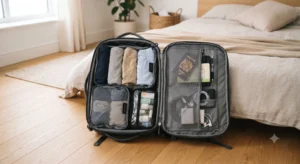
Another common error is failing to use compression packing cubes. When you throw loose shirts and trousers directly into a main suitcase compartment, they shift during transit, creating a disorganized mass that wrinkles your clothing. Use structured nylon packing cubes to separate your gear by category. This system compresses your clothing by squeezing out trapped air, keeping your bag organized throughout your trip.
Never place your critical items — including medication, house keys, passports, or high-value electronics — inside a checked bag destined for the airplane hold. If your suitcase gets misrouted during a tight connection in Frankfurt, you could spend four days without vital daily prescriptions. Keep every essential item, along with a spare set of underwear, inside your smaller personal item bag beneath the seat in front of you.
Final Recommendations: How to Choose Your Packing Strategy
Your packing strategy must align with your destination’s climate and the structural realities of your trip itinerary. Do not default to a massive suitcase simply because you are worried about running out of clothing options mid-trip.
- Choose the Carry-On Route If: You are planning a summer trip to destinations like southern Spain or Thailand, where your wardrobe consists of lightweight fabrics. This path is ideal if you have tight flight connections under 90 minutes or intend to use regional trains to jump between cities.
- Choose the Checked Suitcase Route If: You are headed to cold regions like Hokkaido or the Swiss Alps in January, where bulky wool sweaters and heavy winter coats are non-negotiable. It is also the correct choice if you need to carry specialized gear, such as hiking poles, which airport security screeners ban from cabin luggage.
If you are still undecided, balance your setup by pairing a 22-inch roller bag with a durable 25-litre travel backpack as your personal item. This combination provides enough packing capacity for a two-week trip without requiring you to hand over your gear to the airline baggage handlers at the front desk.
Frequently Asked Questions About Carry On vs Checked Luggage
What happens if my carry on bag is too big at the boarding gate?
The airline will force you to gate-check the bag into the aircraft hold. You will face a penalty fee ranging from $35 to $75 depending on the carrier. They will take the bag right at the jet bridge, and you must remove your lithium batteries and passports instantly.
Can I bring liquids inside a checked suitcase without any size restrictions?
Yes. Checked bags do not follow the 100ml liquid restriction rule. You can pack full-sized shampoos, bottles of wine, or lotion containers. Secure them inside a heavy-duty plastic zip bag to prevent pressure leaks inside the cargo hold during altitude changes.
How do I know if my suitcase qualifies as a personal item or a carry on?
A personal item must slide completely beneath the seat in front of you, typically measuring under 45 by 35 by 20 centimetres. A carry on bag fits into the overhead locker bins, with standard limits hovering around 56 by 36 by 23 centimetres across main legacy airlines.
Continue Exploring
- travel gear guide — Read our complete breakdown of durable travel gear to pick the right packing cubes and accessories for your next trip.
- Check our regional transit breakdowns to see how local train networks handle oversized bags across Europe and Asia.