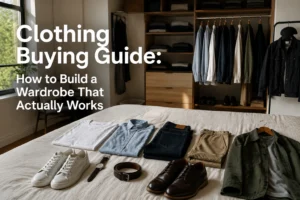
Most modern closets operate as chaotic storage lockers rather than functional tools. We accumulate inexpensive garments during flash sales, hold onto outdated items out of guilt, and purchase specific pieces for single events that never happen again. The result is an overwhelming visual noise that costs you time every morning and leaves you feeling poorly dressed despite owning dozens of shirts.
This capsule wardrobe guide provides a clear roadmap to reverse this cycle by focusing on a 24-piece modular framework based on fabric weight, garment architecture, and strict interchangeability. You will learn how to transition away from disposable textiles, optimize your shopping budget around true material lifespan, and assemble an easy-to-manage wardrobe where every single item fits you properly and combines naturally with everything else.
The 24-Piece First-Timer Capsule Framework
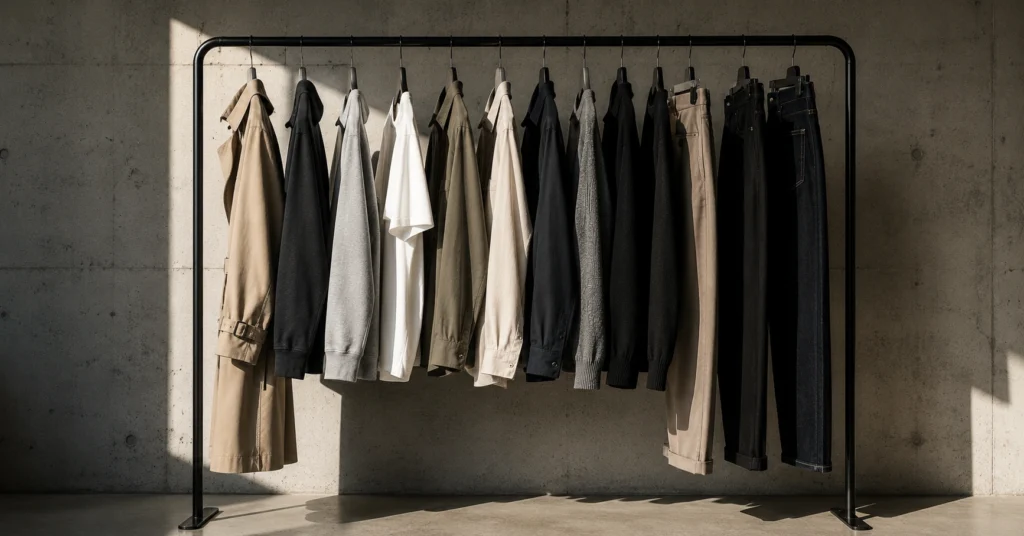
A successful minimalist closet requires a deliberate structural balance between your top layers, bottom layers, and footwear to maximize outfit combinations without adding volume.
| Garment Category | Target Quantity | Fabric Target Specs | Primary Color Rule | Critical Function |
| Everyday Tops | 9 Items | 180–220 GSM Long-Staple Cotton | 5 Neutrals, 3 Secondary, 1 Accent | Forms the primary base layer against the skin; requires high breathability. |
| Structural Bottoms | 5 Items | 12–14 oz Raw Denim / Cotton Twill | Dark Navy, Charcoal, Khaki, Olive | Anchors the silhouette; must endure heavy surface friction. |
| Layering Outerwear | 3 Items | 100% Merino Wool / Heavy Canvas | Mid-Grey, Navy, or Tan | Dictates the formal or casual register of the overall look. |
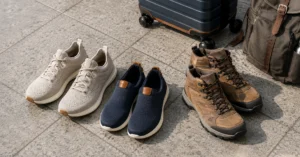
| Interchangeable Shoes | 4 Pairs | Goodyear-Welted Leather / Rubber Sole | Black, Dark Brown, Clean White | Determines the physical range and terrain capability of the outfit. |
| Core Accessories | 3 Items | Full-Grain Leather / Solid Brass | Matches primary shoe tone | Ties disparate garment textures together at the waist and wrist. |
What a Capsule Wardrobe Rewards—And What a Cluttered Closet Punishes
A capsule wardrobe rewards you with immediate cognitive clarity. When you reduce your clothing options down to a small selection of highly compatible items, you eliminate the daily decision fatigue that comes from digging through piles of mismatched fabric. The math behind a 24-piece capsule wardrobe guide reveals that when every top matches every bottom, you generate over 60 unique outfit combinations from less than two dozen pieces. You save valuable mental energy and time simply because there are no incorrect choices waiting for you in the dark of your closet.
Conversely, a cluttered closet punishes you through the hidden cost of underutilized garments. Every cheap, impulsive purchase sitting on your hangers represents frozen capital that steadily degrades in value while taking up physical space. Low-quality synthetic items also create a false sense of variety; you feel like you have nothing to wear because your options are individually flawed—a shirt that rides up your back, trousers that pinch your waist after a meal, or a jacket with a broken plastic zipper slider.
The real trade-off comes down to the cost-per-wear formula. A poorly made $20 fast-fashion shirt that you wear twice before it warps in the wash costs you $10 per wear. A high-grade $90 pima cotton button-down that you wear 45 times over two years costs you $2 per wear. True financial efficiency means shifting your budget away from volume and focusing entirely on material resilience.
The First-Timer Framework: What to Know Before You Purge Your Closet
To build an interchangeable closet from scratch, you must follow a methodical sequence rather than throwing away all your clothes on a whim. The transition process requires an honest assessment of your current lifestyle data before making any new purchases.
First, pull every item of clothing out of your wardrobe and lay it flat under bright, natural light. Separate your garments into three distinct piles based on actual usage over the past 365 days: Active, Hesitant, and Dead. The Active pile contains pieces you have worn within the last month; the Dead pile contains items that do not fit your physical body right now or have permanent fabric damage. Box up the Hesitant pile and store it out of sight for exactly eight weeks—if you never dig into that box to retrieve an item, it can be safely donated or sold.
Second, establish a strict color ratio rule for your remaining active clothes to maintain total modular compatibility. Your 24-piece capsule must consist of 60% base neutrals (navy, charcoal, black, or olive), 30% secondary tones (cream, tan, light grey, or off-white), and a maximum of 10% accent color (such as dark burgundy or bottle green). This specific mathematical distribution ensures that you can blindly grab any top and any bottom layer from your rack and dress yourself successfully without looking down.
Finally, understand your local climate constraints instead of copying generic minimalist checklists online. If you live in a region with high humidity and frequent rainfall, your capsule requires technical high-GSM cotton weaves and water-repellent canvas shells rather than delicate luxury suede jackets or heavy wool knits. Build for the weather you experience every Tuesday afternoon, not the idealized climate you see in travel brochures.
The Versatile Wardrobe Staples Worth Building Your Capsule Around
A high-performing capsule wardrobe functions best when built on six foundational versatile wardrobe staples. These specific items serve as the structural pillars of your collection, bridging the gap between formal workspaces and casual weekend environments.
- The Heavyweight Cotton Oxford Shirt: A robust 200 GSM button-down crafted from long-staple cotton threads that develops a softer texture with every wash cycle.
- Raw Dark Indigo Denim Jeans: A straight-cut 12-to-14-ounce pair of jeans with less than 2% synthetic elastane, designed to mold permanently to your hips over time.
- The 100% Merino Wool Crewneck: A mid-weight 250 GSM sweater that naturally regulates your body temperature, resists wrinkles, and repels ambient odors.
- Tailored Cotton Twill Chinos: A flat-front trouser in a neutral khaki or olive shade, featuring an interior split-back waistband that allows a tailor to adjust the fit.
- The Unstructured Navy Sport Coat: A wool or high-density cotton canvas jacket without thick shoulder pads, allowing it to transition easily from casual settings to business environments.
- Minimalist Full-Grain Leather Boots: Footwear assembled using a repairable Goodyear welt or Blake stitch, allowing you to replace the worn-out rubber sole multiple times over a decade.
Read our complete fashion buying guide to learn how to source these foundational layers without overpaying for superficial brand markings.
Where to Spend and Save: A Practical Capsule Wardrobe Budget
Constructing a minimalist wardrobe does not require a large upfront investment. The secret to long-term cost efficiency is spending heavily on structural garments that face direct friction and environmental stress, while saving money on your lightweight base layers.
The Capsule Wardrobe Budget Allocation
- The Investment Tier ($150–$350): Footwear, heavy outerwear, and denim. Your boots and winter jackets endure continuous friction, rain, and pavement impact. Spending more here guarantees high-grade full-grain leathers and tightly woven natural wool linings that keep you dry and can be repaired by a cobbler.
- The Mid-Range Tier ($40–$95): Mid-layers, casual trousers, and woven button-down shirts. Focus your search on direct-to-consumer labels that eliminate retail middleman markups but maintain a high stitch-per-inch count on their seams.
- The Economy Tier ($15–$30): Everyday t-shirts, undershirts, and base socks. Because these cotton garments sit directly against your sweat glands and require frequent hot laundering, their fibers break down quickly regardless of the price tag. Keep your costs minimal here and replace them as needed.
Always ground your budget in structural reality. A cheap winter coat uses loose synthetic polyester fill that shifts and clumps inside the lining after its first trip through a washing machine, creating cold patches. A high-quality wool coat utilizes naturally crimped animal fibers that lock out cold air even when damp, maintaining its insulating shape for years.
Common Clothing Fit Mistakes That Ruin a Minimalist Wardrobe
When you own fewer items of clothing, every single fit error becomes obvious. The most common clothing fit mistakes occur when buyers choose garments based on vanity size tags rather than their actual physical dimensions.
[Image highlighting the correct drop of a shirt sleeve at the shoulder bone]
Pay strict attention to the shoulder seam alignment when trying on shirts, sweaters, or jackets in the fitting room. The seam where the sleeve panel attaches to the main body must sit precisely on the outer edge of your shoulder bone. If the seam drops down onto your upper bicep, the shirt is too large and will create an unsightly ballooning effect around your waist. If the seam pinches inward toward your collarbone, the item is too small, which will pull the fabric tight and eventually pop the back seams when you move your arms.
Another widespread mistake is ignoring the trouser break—the small fold of fabric that forms where your pant hem hits your shoe leather. A full break, where the fabric folds over itself multiple times, looks sloppy and cuts your visual height in half. Ask a local tailor to shorten your trousers to a clean “slight break” or “no-break” length, creating a straight, uninterrupted line from your waist down to your ankles.
Never buy clothes based on the size you plan to be after a new diet or exercise routine. Buy garments that fit your physical frame perfectly on the day you purchase them. If a pair of trousers pinches your stomach when you sit down in the fitting room, do not buy them; discomfort ensures that the item will sit unused on your rack, defeating the entire purpose of a capsule system.
How to Audit Your Textiles: A Practical Clothing Quality Checklist
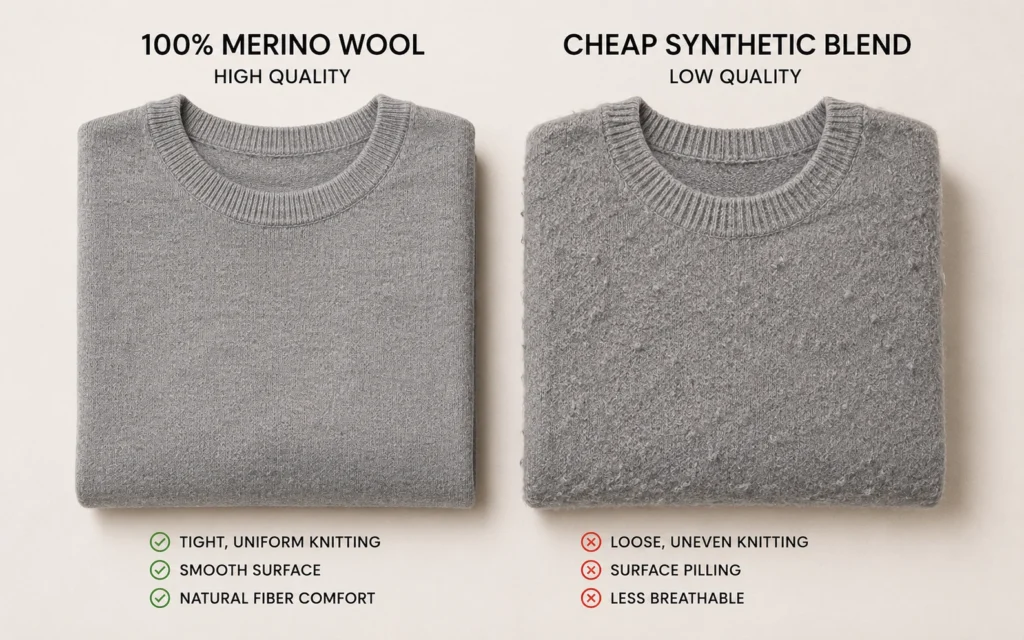
Before you add any new item to your capsule wardrobe guide list, you must turn it completely inside out to inspect its internal construction. The interior details reveal the true lifespan of a garment far better than any external marketing label.
[Image comparing uniform double-stitching with loose overlock chain-stitching]
- The Seam Stretch Test: Grasp the fabric firmly on both sides of an internal seam and pull apart with moderate pressure. If you see the thread stretching open to reveal daylight between the fabric panels, the stitch count is too sparse. Reliable construction requires at least 10 stitches per inch to handle daily movement.
- The Internal Edge Inspection: Look closely at the raw edges of the fabric inside the garment. Low-quality manufacturers use a rapid overlock chain-stitch that easily unravels after a few spins in a washing machine. Demand clean flat-felled or French seams that fold the raw edges deeply inside a secondary protective stitch line.
- The Hardware Verification: Test all metal sliders, snaps, and buttons three times. Zippers must glide smoothly without catching on the surrounding liner fabric. Look for stamped metal sliders from reliable suppliers like YKK; cheap, unbranded cast-plastic alternatives will split under pressure within months.
- The Weave Light Check: Hold the fabric up directly against a bright store light. If the light passes through a mid-weight cotton or wool shirt unevenly, or if you can clearly see the outline of your fingers through the yarn, the thread density is insufficient to survive regular wear.
- The Buttonhole Reinforcement Test: Examine the buttonholes for dense, tight thread binding along the cut edge. If you notice loose threads looping out from the button slit on a new shirt, the hole will stretch out and fray rapidly, eventually allowing the button to slip out on its own.
Frequently Asked Questions About Building a Capsule Wardrobe
How many total items should be in a first-timer capsule wardrobe?
A standard beginner capsule functions best with exactly 24 items, excluding underwear, activewear, and loungewear. This count consists of 9 tops, 5 bottoms, 3 pieces of outerwear, 4 pairs of shoes, and 3 functional accessories, which mathematically yield over 60 unique outfit combinations when color-coordinated correctly.
Do I have to wear only grey, black, and white for a capsule wardrobe to work?
No, you do not need an exclusively monochrome closet, but you must follow a structured color ratio. Allocate 60% of your capsule to true neutrals like navy, charcoal, or olive, 30% to coordinating complementary shades like cream or tan, and only 10% to a single accent color to ensure total interchangeability.
How often do I need to rotate or change my capsule wardrobe items?
Capsule rotations should happen twice a year, separating the calendar into warm-weather months and cold-weather months. Rather than completely rebuilding your closet every three months, you swap out approximately 6 to 8 seasonal pieces—like swapping linen shorts for heavy wool trousers—while retaining your core base layers.
Continue Exploring
- Explore our fashion tenets to master the relationship between fabric weights, material origins, and structural garment cuts.
- Review our wardrobe organization tips to establish an efficient closet sorting workflow that keeps your minimalist capsule organized year-round.