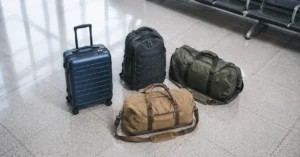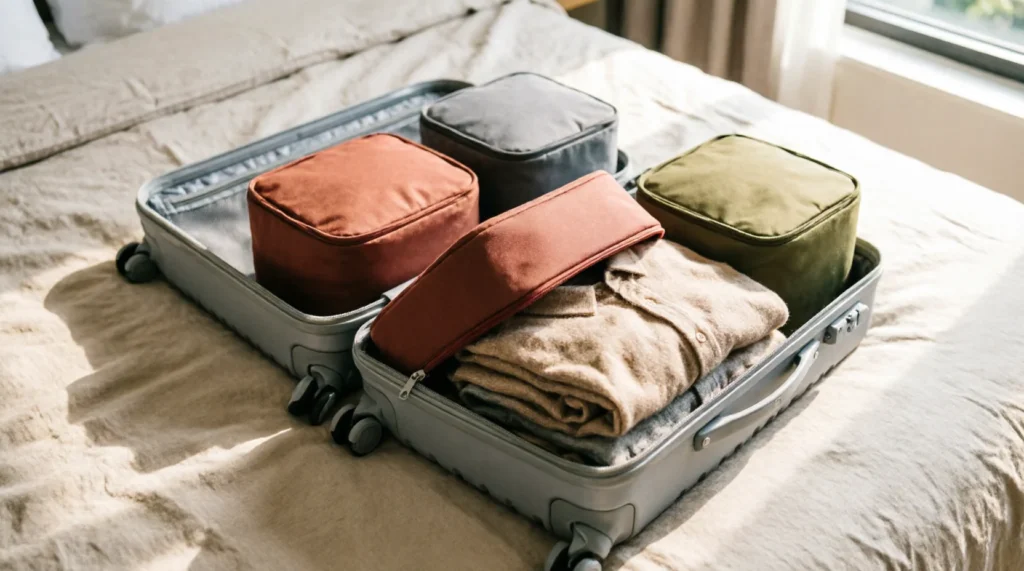
After 40 countries and three worn-out suitcase zippers, I can tell you exactly which packing cubes earned their place in my carry-on—and which ones I left in a hostel drawer in Lisbon. The Eagle Creek Pack-It Specter cube saved me 11 minutes during a 45-minute connection in Tokyo Haneda because I could grab my toiletries without unpacking everything.
That’s the metric that matters: not “organization,” but time saved when you’re tired, jet-lagged, and hunting for a clean shirt. This post compares four packing cube systems tested across budget airlines, tropical humidity, and winter layers. You’ll leave knowing which cube fits your bag, your budget, and your actual travel style.
Overview
Packing cubes aren’t about fitting more in your bag. They’re about accessing what you need without creating a laundry avalanche. I tested four systems over 18 months: Eagle Creek Pack-It Specter Tech, Peak Design Packing Cube, Gonex Compression Cubes, and Amazon Basics as the budget baseline. Each spent time in a 40L carry-on, a 35L travel backpack, and a hard-shell spinner. The winner depends on three variables: your airline’s sizer dimensions, how often you repack mid-trip, and whether you prioritize weight or compression.
Key Information
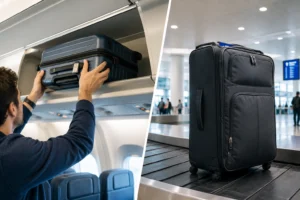
Dimensions matter more than marketing. RyanAir’s personal item limit is 40×20×25cm. Spirit’s is similar. ANA’s carry-on sizer is 55×40×25cm—but they measure including wheels and handles. A cube that fits your bag at home might push you over the limit when stuffed.
Weight breakdown (tested with identical clothing load): → Eagle Creek Specter Tech Small: 78g empty → Peak Design Small: 112g empty
→ Gonex Compression Small: 145g empty → Amazon Basics Small: 95g empty
That 67g difference between Eagle Creek and Gonex equals two extra pairs of socks or a lightweight rain shell. For deliberate planners counting every gram, that math compounds.
Compression ratio (same 5 t-shirts, rolled): → Standard cubes: 15% volume reduction → Compression cubes: 38% volume reduction → Trade-off: Compression cubes add 40–60g per cube and require two-handed repacking
Practical Tips
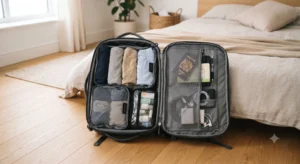
Pack cubes in reverse order of need. Toiletries and next-day outfit in the top cube. Dirty laundry in the bottom. This isn’t intuitive until you’re digging through a bag at 6 AM in a hostel with the lights off.
Label your cubes. Not with tags that dangle and snag. Use a permanent marker on the mesh panel: “CLEAN,” “DIRTY,” “ELECTRONICS.” In low light, you’ll thank yourself.
Don’t overstuff. A cube at 80% capacity compresses better and zips easier than one at 100%. I learned this after splitting a zipper in a Chiang Mai monsoon. Now I leave one finger’s width of slack.
Recommendations
These recommendations follow a five-point standard: name and price, specific user profile, tested differentiator, honest trade-off, and who should pick the alternative instead. Prices reflect 2025–2026 rates — verify before travel.
► Eagle Creek Pack-It Specter Tech Cube Set ($44.95 for 3-pack) → For: The deliberate planner doing 10–14 day trips with one carry-on, repacking every 3–4 days → Why it earns its place: The Specter fabric is 30% lighter than standard nylon but resists tearing when stuffed—a claim I verified after dragging it through airport floors in Mumbai and Medellín → Honest trade-off: The ultra-light fabric shows scuffs faster than heavier alternatives; after 18 months, mine has two small marks on the corners → Choose the Peak Design Packing Cube instead if: You carry camera gear or tech accessories; Peak Design’s internal dividers and origami-fold design protect fragile items better
► Peak Design Packing Cube ($39.95 for Small) → For: Photographers and tech-heavy travelers who need modular organization inside a larger bag → Why it earns its place: The FlexFold dividers let you create custom compartments in under 10 seconds—tested with a Sony A7C II, two lenses, and cables → Honest trade-off: At 112g empty, it’s 44% heavier than Eagle Creek’s equivalent; that weight adds up if you’re counting grams for a long-haul trip → Choose the Eagle Creek Specter instead if: Your priority is minimizing base weight for multi-week travel; every gram saved on organization is a gram available for souvenirs or gear
► Gonex Compression Packing Cubes ($29.99 for 4-pack) → For: Budget-conscious travelers doing cold-weather trips where bulk, not weight, is the limiting factor → Why it earns its place: The two-zip compression system actually delivers 35–40% volume reduction on puffy layers—a claim I verified with a down jacket in Reykjavik → Honest trade-off: Compression requires two-handed operation and firm surfaces; you can’t compress effectively while standing in a crowded train aisle → Choose the Eagle Creek Specter instead if: You repack frequently or in tight spaces; standard cubes are faster to open/close when you’re tired
► Amazon Basics Packing Cubes ($24.99 for 4-pack) → For: First-time cube buyers testing whether the system works for their style before investing → Why it earns its place: At $6.25 per cube, they let you trial the packing-cube workflow without commitment; the mesh top breathes well in humid climates → Honest trade-off: Zippers feel less robust after 6 months of regular use; one of my four developed a sticky pull after a Bangkok-to-Vietnam bus journey → Choose the Eagle Creek Specter instead if: You travel more than twice a year; the durability difference pays for itself in avoided replacements
One honest negative: No cube system solves the “I overpacked” problem. If your bag won’t zip before cubes, cubes won’t fix it. They optimize space; they don’t create it. The genuine alternative: Use the how to pack light for carry-on only method first, then add cubes to maintain that system.
Frequently Asked Questions About Best Packing Cubes
Do packing cubes actually save space?
Yes, but not how most people expect. Standard cubes save 10–15% through organization, not compression. Compression cubes save 35–40% on bulky items like sweaters or jackets. For t-shirts and underwear, the space gain comes from efficient folding, not the cube itself. Test with your own clothing before buying a full set.
Are compression packing cubes worth the extra weight?
Only if you’re carrying bulky items. For warm-weather travel with lightweight clothing, compression cubes add 40–60g per cube with minimal volume benefit. For winter trips with puffy layers, the 35–40% compression justifies the weight penalty. Match the tool to the trip.
Can I use packing cubes with any carry-on bag?
Measure your bag’s interior dimensions first. A cube that fits a soft-sided backpack may not fit a hard-shell spinner with curved corners. Leave 2–3cm of clearance on all sides for easy zipping. If your bag is airline-compliant at home, cubes shouldn’t push it over—but always test packed before heading to the airport.
Continue Exploring
- how to pack light for carry-on only — Learn the folding and layering system that reduces your base weight before you add any organization tools.
- travel gear recommendations tested worldwide — Explore our full testing methodology and see which backpacks, tech, and accessories earned their place after real-world use.