The first time I landed in Bangkok, I was lugging a 65-liter hiking pack that towered over my head. Within three hours of navigating the humidity and the narrow aisles of the BTS Skytrain, I realized my mistake: I hadn’t bought gear for travel; I had bought gear for a version of myself that didn’t exist. Selecting the best travel gear isn’t about buying the most expensive items in the catalog; it’s about reducing the friction between you and the destination.
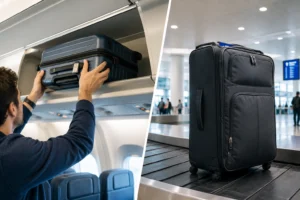
In 2024, I watched a traveler struggle for twenty minutes to fit an oversized “carry-on” into an ANA sizer at Haneda airport, only to be forced to pay a $60 gate-check fee. This guide exists so that traveler isn’t you.
We will break down the essential equipment guide for your first major trip, focusing on what actually survives 40 countries and what is merely marketing fluff.
Quick Overview
If you are in a rush and need the “Goldilocks” setup for a two-week trip, here is the verified baseline.
| Category | Recommended Product | Verdict |
|---|---|---|
| Main Pack | Peak Design Travel Backpack 30L | Best for strict airline compliance. |
| Tech Hub | Satechi 165W USB-C GaN Charger | One plug to charge everything. |
| Organization | Peak Design Packing Cubes | Compressed space without broken zippers. |
| Security | Pacsafe Proshield Wallet | Necessary for high-theft transit hubs. |
The Foundation: Choosing Your Primary Carry System
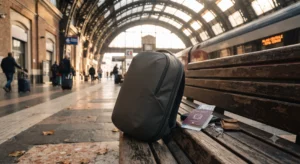
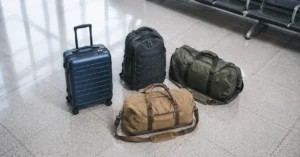
Your bag is your home. If it doesn’t fit the airline’s rules, it’s an expensive liability. For a first-timer, the temptation is to go big. Resist it.
Peak Design Travel Backpack 30L ($229)
- Who it is for: The solo traveler doing 2+ weeks in Europe or Asia who refuses to check a bag and wants to guarantee cabin access.
- Dimensions: 53cm x 34cm x 18cm (20.9″ x 13.4″ x 7″).
- Compliance: RyanAir (Check — fits overhead), Spirit (Check — fits overhead), ANA (Check — meets strict 55x40x25cm limits).
- The Winning Feature: The external expansion zippers allow you to grow the bag from 27L to 33L, which is vital for the “souvenir creep” that happens in the last three days of a trip.
- The Honest Trade-off: The harness system is thin. If you pack more than 12kg (26 lbs), the straps will bite into your shoulders after 30 minutes of walking.
- The Alternative: If you have a larger frame or need to carry heavy photography gear, choose the Osprey Farpoint 40 instead. It has a far superior suspension system, though it can look “out of place” in a nice hotel lobby.
The Tech Stack: Staying Powered and Connected Abroad
Nothing ruins a day in a foreign city like a dead phone and a “Universal Adapter” that sparks when you plug it into a Parisian wall socket. (2025–2026 rates — verify before travel).
Satechi 165W USB-C GaN Charger ($119)
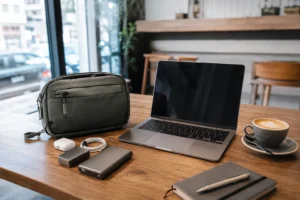
- Who it is for: Digital nomads or travelers carrying a laptop, tablet, and phone who want to eliminate a “nest” of individual bricks.
- The Winning Feature: It uses Gallium Nitride (GaN) technology to stay small while delivering enough power to charge a MacBook Pro and an iPhone at top speeds simultaneously.
- The Honest Trade-off: It is heavy. It requires a dedicated “figure-8” power cable (included), which adds bulk to your tech pouch.
- The Alternative: If you are only charging a phone and a pair of headphones, buy the Anker 735 Nano II. It’s the size of a golf ball and half the price.
Lived Knowledge Signal: When your tech fails in a place like Tbilisi or Medellín, don’t look for “tourist electronics” shops. Seek out “Computer Repair” districts—like the area around Tran Hung Dao in Hanoi. I once replaced a MacBook charger there for $30 in under an hour; the “official” mall wanted $120 and a three-day wait.
The Comfort Layer: Clothing and Organization Essentials
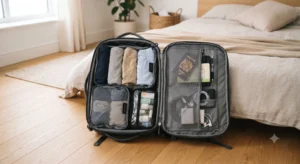
Most people overpack clothes because they don’t trust their organization. This is the essential travel gear that creates space where none existed.
Peak Design Packing Cubes (Medium: $39)
- Who it is for: Travelers who want to fit 10 days of clothes into a 30L bag.
- The Winning Feature: The secondary compression zipper. Unlike cheap mesh cubes, these actually shrink the volume of your clothes by about 25%.
- The Honest Trade-off: The material is very thin (70D nylon). While durable, it feels “crinkly” and doesn’t provide any structure to a soft-sided bag.
- The Alternative: Eagle Creek Isolate cubes are lighter, though they lack the effective compression of the Peak Design model.
The Safety and Health Kit: What Most People Forget
I spent a night in a Lisbon pharmacy because I didn’t pack a simple $5 blister kit. Don’t be that person.
- Matador FlatPak Soap Bar Case ($14): Most soap dishes leak slime into your bag. This one uses “Dry-Through” technology. You put a wet bar of soap in, and it dries through the fabric. It is a game-changer for avoiding the “damp gym bag” smell.
- HeroClip ($20): It’s a carabiner with a rotating hook. It sounds gimmicky until you’re in a public restroom in a train station with no door hooks and a wet floor. It keeps your $200 backpack off the ground.
Budgeting for Quality: Where to Save and Where to Splurge
You do not need a $400 hardshell jacket for a summer trip to Italy. You do, however, need a high-quality power bank.
- Splurge on the Bag: A $50 bag will have a zipper failure at the worst possible time. A $250 bag has a lifetime warranty.
- Save on “Travel” Clothing: You don’t need zip-off pants. Wear your most comfortable, breathable synthetics or merino wool blends from brands you already trust.
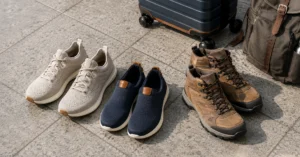
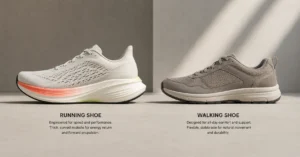
- Splurge on Shoes: (Verify at [official source] — rules change without notice). If you are walking 20,000 steps a day in Tokyo, your $20 fashion sneakers will give you shin splints by day three.
The Checklist: A Sample Pack for 14 Days
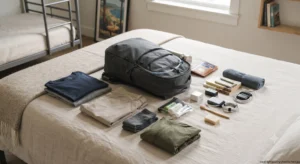
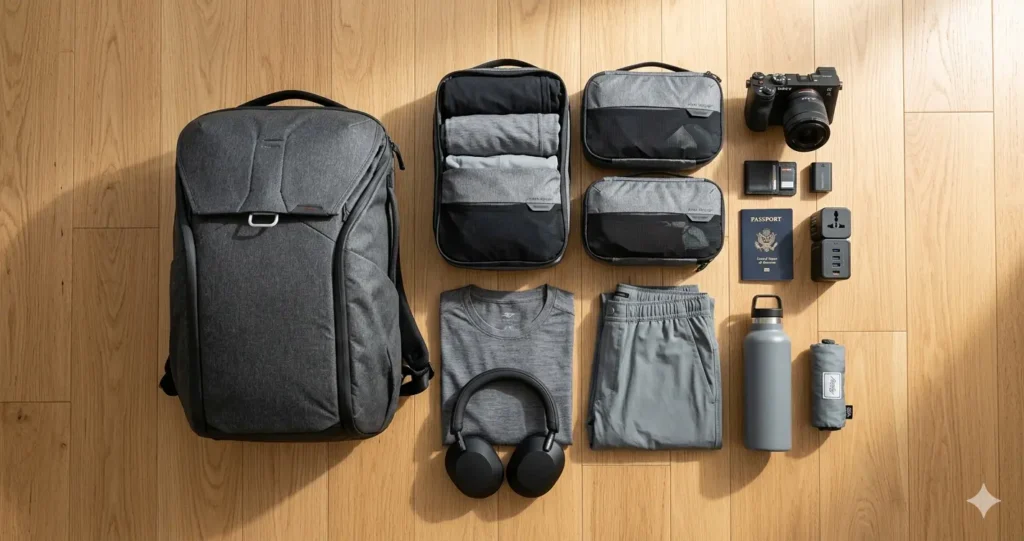
This travel equipment guide is useless without a practical application. Here is what fits in a 30L compliant pack:
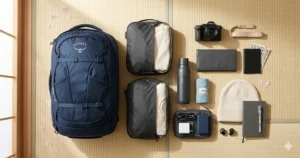
- 1 Main Pack (30L)
- 1 Tech Pouch (Charger, cables, power bank)
- 2 Medium Packing Cubes (5 shirts, 1 pair trousers, 1 pair shorts, 7 pairs socks/underwear)
- 1 Toiletry Kit (Solid soaps, toothbrush, basic meds)
- 1 Small Daypack (Collapsible)
Pro Tips for Long-Term Gear Maintenance
- Never wash your backpack in a machine: It destroys the waterproofing (DWR) coating. Use a damp cloth and mild soap.
- Air out your packing cubes: Every 3–4 days, unzip everything in your hotel room for an hour to prevent moisture buildup.
- Tape your cables: Use a small piece of colored electrical tape to mark your chargers. In hostels, every white Apple brick looks identical.
Frequently Asked Questions
Is it better to travel with a backpack or a suitcase?
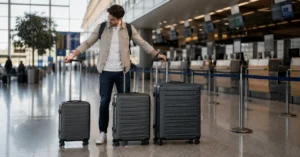
For most first-timers, a 35-45L backpack offers more mobility on cobblestones and stairs. Use a suitcase only if you have physical limitations or are staying in a single luxury resort with porterage. Carrying your own gear makes you faster and more independent in transit.
How much should I spend on a travel backpack?
Expect to pay between $180 and $300 for a durable, ergonomically sound pack. Budget options under $100 often lack the harness system required to carry weight comfortably for more than 20 minutes, leading to back pain that can sideline your trip.
Do I need a voltage converter for international travel?
Most modern electronics are dual-voltage (110V-240V). You likely only need a plug adapter, not a heavy converter, unless you are bringing high-heat appliances like hair dryers, which we recommend leaving at home. Check the “Input” label on your device for “100-240V.”
Can I bring a power bank on a plane?
Yes, but it must be in your carry-on luggage, never in checked bags. Most airlines limit the capacity to 100Wh (approximately 27,000mAh). Always verify the specific airline’s current regulations before flying, as lithium-ion rules are strictly enforced at security.
What is the most common gear mistake first-timers make?
Overpacking “just in case” items is the primary error. If you haven’t used an item in your daily life in the last six months, you won’t use it on a two-week trip. Every extra kilogram represents energy lost while navigating a new city.