Your third suitcase handle broke on the way to baggage claim. Again. That’s when you realized the $300 “luxury” bag you bought for its looks couldn’t handle three cobblestone streets and a single international flight.
Here’s what most luggage guides won’t tell you: the best travel bags aren’t about brand prestige or Instagram aesthetics. They’re about matching capacity, material, and carry style to how you actually travel. The 40-liter backpack that’s perfect for Southeast Asia hostels will destroy your back on a European business trip. The hardshell spinner that glides through JFK will crack on a gravel road in Patagonia.
This guide assumes you’re buying for function first. You need specific data—denier ratings, liter capacity, actual weight, warranty terms—not marketing copy. You’re a first-time buyer who needs orientation without condescension. Every term gets explained. Every recommendation includes the trade-off.
What you’ll get: The four bag types that matter, material durability data that survives year three, price tier reality checks, and the specific mistakes that kill good bags before their second birthday.
Quick Facts: Bag Type by Trip Length and Style
| Trip Type | Duration | Bag Type | Capacity | Weight Limit | Best For |
|---|---|---|---|---|---|
| Weekend getaway | 1-3 nights | Weekender/Carry-on | 30-45L | Under 7kg | Quick trips, no checked bags |
| Standard vacation | 4-7 nights | Carry-on suitcase | 35-45L | 7-10kg | Single destination, hotels |
| Multi-city trip | 7-14 nights | Travel backpack | 40-50L | 10-15kg | Mobility, varied terrain |
| Extended travel | 14+ nights | Large duffel + daypack | 60-90L | 15-23kg | Maximum capacity needs |
| Business travel | 2-5 nights | Slim carry-on | 30-40L | 5-8kg | Suits, laptops, polish |
Capacity based on 2025 airline standards. Always verify with your carrier—budget airlines enforce stricter limits.
The Four Bag Types That Actually Matter
Stop scrolling through 47 “best of” lists. You need one of these four. Everything else is a variation on a theme.
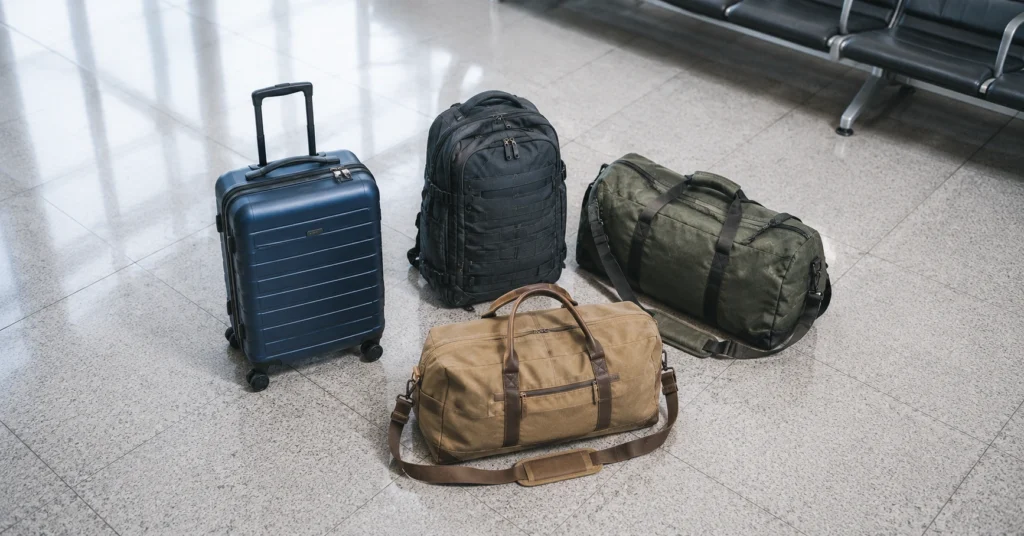
Carry-On Suitcases: The 22-Inch Workhorse
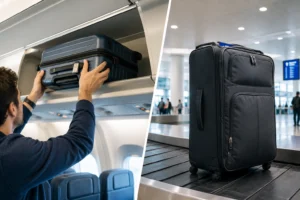
The carry-on spinner dominates for a reason: it works for 70% of trips. Standard dimensions are 22 × 14 × 9 inches (56 × 36 × 23 cm), though European carriers often limit you to 21.5 inches.
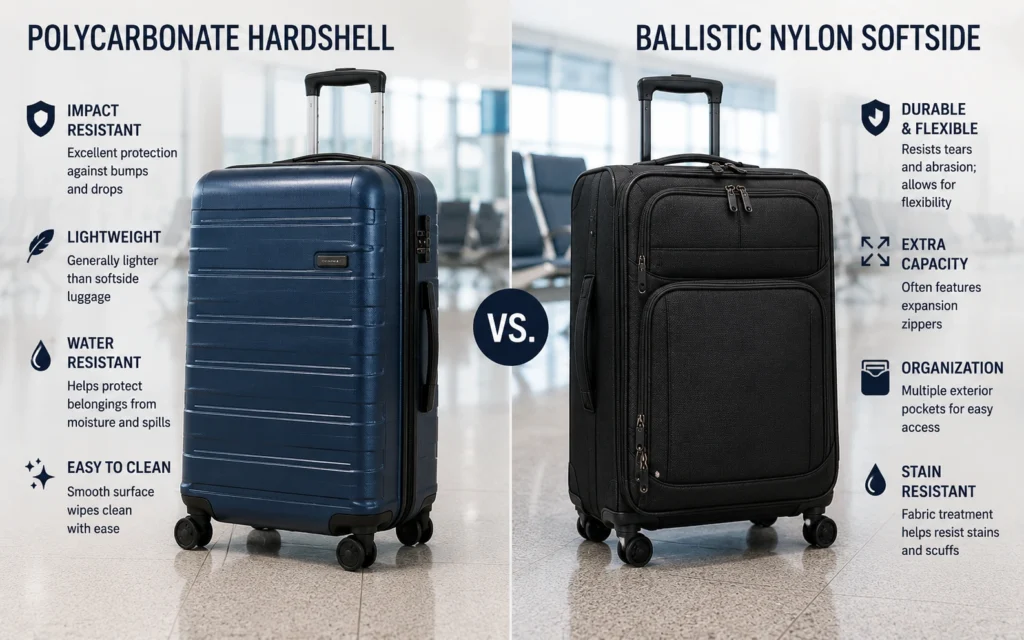
Material choice splits two ways. Polycarbonate hardshells weigh 6-8 pounds (2.7-3.6 kg) and protect fragile items, but they crack under pressure and scratch immediately. Ballistic nylon softsides weigh 5-7 pounds (2.3-3.2 kg), expand when you need capacity, and hide wear better—but they offer zero protection for electronics or souvenirs.
The wheels matter more than the brand. Look for 360-degree spinner wheels with sealed bearings. Cheap plastic wheels fail after 15-20 flights. Quality wheels—like those from Hinomoto or Japanese manufacturers—last 50+ flights. Test the wheel rotation before buying. If it doesn’t spin freely with a light push, walk away.
Carry-ons fail on cobblestones, gravel, and uneven pavement. The wheels chatter, the handle wobbles, and you’ll end up carrying it anyway. If your destination has medieval streets or dirt roads, skip the spinner.
Travel Backpacks: Mobility Over Polish
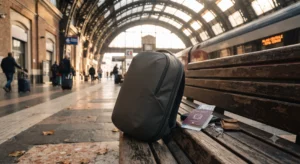
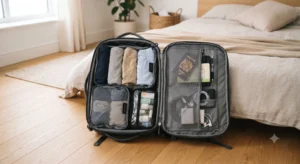
Travel backpacks aren’t the daypacks you carried in college. These are 40-50 liter panels that open like suitcases, not top-loading sacks. They distribute weight across hips and shoulders, leaving your hands free for coffee, phones, and navigating.
Key specs: 40-50L capacity, 3-5 pounds (1.4-2.3 kg) empty weight, hip belt with load lifters, sternum strap, lockable zippers. The panel-loading design matters—you shouldn’t have to unpack everything to reach your socks.
Material is typically 400-900D nylon or polyester. Higher denier means more durability but more weight. A 900D pack survives rough handling but weighs a pound more than a 400D version. For most travelers, 600-800D hits the sweet spot.
The trade-off: Backpacks look less polished than suitcases. You’ll arrive sweaty if you’re walking more than 20 minutes. Airport security requires removing laptops and liquids. But they’re unbeatable for stairs, public transit, and destinations without elevators.
Duffel Bags: Maximum Capacity, Minimum Structure
Duffels are the utility players. No wheels, no frame, no structure—just a big sack that holds everything. They’re light (2-4 pounds / 0.9-1.8 kg), packable, and cheap.
Use cases: road trips where you’re never carrying it far, gym bags, emergency overflow when your main bag fails, adventure travel where durability trumps organization.
The problem: duffels have no organization. Everything lives in one compartment. You’ll dig for your passport. They sag when half-full. Shoulder straps dig in after 10 minutes of carrying. And they offer zero protection for fragile items.
When they work: You’re renting a car. You’re staying in one place. You need maximum capacity at minimum weight and cost.
When they fail: You’re navigating airports, train stations, or multiple hotels. You need organization. You’re carrying anything breakable.
Weekender Bags: The Two-Night Sweet Spot
Weekenders are the Goldilocks solution for 1-3 night trips. 30-45 liters. Structured enough to look professional, soft enough to squeeze under seats. Usually made from canvas, leather, or nylon.
They’re what you grab when you don’t want to think about packing. Toss in a change of clothes, toiletries, and go. No wheels to break, no zippers to fail, no weight penalties.
The limitation: They’re not for longer trips. You’ll overpack and strain the handles. They offer minimal organization. And they’re awkward to carry for more than 15 minutes.
Material and Durability: What Holds Up After Year Three
Most luggage fails between years two and four. Not from airline abuse—from material fatigue, zipper failure, and handle mechanism breakdown. Here’s what actually lasts.
Fabric Denier Ratings Explained
Denier measures fiber thickness. Higher numbers mean thicker, more durable fabric—but also more weight.
- 300-400D: Lightweight, packable, fails after 20-30 trips
- 600-800D: The sweet spot for most travelers. Survives 50+ trips
- 900-1200D: Expedition-grade. Heavy but nearly indestructible
- 1680D ballistic nylon: Military-grade. Used by premium brands. Expensive.
The reality: You don’t need 1680D unless you’re checking bags on rough airlines weekly. 600-800D handles 3-5 trips per year for a decade.
Zipper Quality: The Silent Killer
YKK zippers are the industry standard for a reason. They’re reliable, repairable, and widely available. Cheap no-name zippers fail after 30-40 cycles.
Look for:
- YKK branding stamped on the pull
- #8 or #10 size (larger numbers = stronger)
- Coil zippers for flexibility, tooth zippers for strength
- Lockable pulls for security
The test: Run the zipper 10 times before buying. It should move smoothly without catching. If it snags in the store, it’ll fail in transit.
Handle and Wheel Mechanisms
Telescoping handles fail at the locking mechanism. After 50-75 extensions, the buttons wear out and the handle collapses mid-walk. Quality handles use aluminum or reinforced polycarbonate. Cheap ones use hollow plastic that cracks.
Wheel bearings should be sealed. Open bearings collect hair, dust, and debris, then seize. Sealed bearings last 5-10x longer.
Warranty Reality Check
“Lifetime warranty” doesn’t mean what you think. Most exclude:
- Airline damage (the #1 cause of failure)
- Normal wear and tear
- Cosmetic damage
- Wheels and handles (the parts that actually fail)
Read the warranty before buying. Brands like Osprey and Patagonia offer “all-mighty guarantees” that cover everything. Samsonite and Travelpro offer limited warranties that exclude the weak points.
Price Tiers: What You’re Actually Paying For
Budget Tier: $50-150
What you get: Basic materials (300-600D polyester), generic zippers, plastic wheels, minimal organization, 1-2 year lifespan with regular use.
Best for: Infrequent travelers (1-2 trips per year), students, emergency backup bags, trips where you don’t care if the bag gets destroyed.
The trade-off: You’ll replace it every 2-3 years. The wheels will wobble. The zippers will catch. But it works for occasional use.
Mid-Range Tier: $150-350
What you get: 600-900D materials, YKK zippers, quality wheels (often Hinomoto or equivalent), better organization, 5-7 year lifespan, decent warranty.
Best for: Regular travelers (3-5 trips per year), people who want reliability without luxury pricing, carry-on bags that see frequent use.
The sweet spot: This is where 80% of travelers should shop. You’re paying for durability, not brand prestige.
Premium Tier: $350-800+
What you get: 1000D+ materials or premium polycarbonate, aircraft-grade aluminum frames, top-tier wheels and handles, lifetime warranties, brand prestige.
Best for: Weekly travelers, business travelers who need polish, people who want “buy it for life,” checked bags that take abuse.
The honest truth: Diminishing returns kick in hard after $350. A $600 bag isn’t twice as good as a $300 bag. You’re paying for materials, warranty, and brand. If you travel monthly, it’s worth it. If you travel twice a year, it’s not.
The Mistakes That Kill Good Bags (And How to Avoid Them)
Mistake #1: Buying for Your Dream Trip, Not Your Actual Trips
You’re planning one week in Iceland, so you buy a 90-liter expedition duffel. Then you use it for weekend trips to visit family, where it’s comically oversized and heavy.
Buy for the 80% use case, not the 20% exception. If you take five weekend trips and one big adventure per year, buy for the weekends and rent the expedition gear.
Mistake #2: Ignoring Weight Limits
That beautiful hardshell weighs 11 pounds empty. Budget airlines have 15-pound carry-on limits. You’ve just burned 73% of your weight allowance on the bag itself.
Always check the empty weight before buying. Lightweight materials cost more but save you from overweight fees.
Mistake #3: Overpacking “Just in Case”
You pack for every scenario. The bag strains at the seams. The zipper fails. The handle breaks under the weight.
Pack for 80% of scenarios. Buy the other 20% when you arrive. Your bag—and your back—will thank you.
Mistake #4: Never Testing Before a Big Trip
You buy a new bag and take it on your two-week European vacation. The handle breaks on day three. The zipper fails on day five. You’re stranded with a broken bag and no backup.
Test new bags on a weekend trip first. Work out the kinks, verify the size, ensure the zippers don’t catch. Don’t discover failures 3,000 miles from home.
Specific Recommendations by Use Case
For Weekend Warriors (1-3 nights): Look for: 30-40L weekender or slim carry-on, under 5 pounds, simple organization Price range: $80-200 Material: 600D nylon or canvas Avoid: Over-engineered bags with 47 compartments you’ll never use
For Standard Vacations (4-7 nights): Look for: 22-inch carry-on spinner or 40L travel backpack, 6-8 pounds, YKK zippers Price range: $150-300 Material: 800D nylon or polycarbonate Avoid: Checked bags unless you’re bringing ski equipment or diving gear
For Multi-City Trips (7-14 nights): Look for: 45-50L travel backpack with hip belt, panel loading, under 5 pounds empty Price range: $200-400 Material: 600-900D nylon Avoid: Suitcases with wheels—you’ll be carrying it up stairs and over cobblestones
For Extended Travel (14+ nights): Look for: 60-70L backpack or checked suitcase + 20L daypack, durable construction Price range: $250-500 Material: 900D+ nylon or reinforced polycarbonate Avoid: Single-bag solutions unless you’re minimalist packing
For Business Travel: Look for: Slim carry-on with laptop compartment, professional appearance, under 7 pounds Price range: $200-400 Material: Ballistic nylon or premium polycarbonate Avoid: Backpacks unless your workplace is casual
Frequently Asked Questions About Best Travel Bags
What size carry-on works for most airlines?
Standard carry-on dimensions are 22 × 14 × 9 inches (56 × 36 × 23 cm). This fits most US and international carriers. However, European budget airlines like Ryanair and EasyJet often limit you to 21.5 inches. Always verify with your specific carrier before flying—budget airlines charge $50-100 for gate-checking oversized bags.
Is a backpack or suitcase better for travel?
Backpacks win for mobility—stairs, public transit, uneven terrain, and hands-free movement. Suitcases win for organization, professional appearance, and protecting fragile items. Choose based on your destination: backpacks for Asia, Europe’s old cities, and adventure travel. Suitcases for business trips, resorts, and destinations with smooth pavement and elevators.
How much should I spend on a good travel bag?
Most travelers should spend $150-300 for a mid-range bag that lasts 5-7 years with regular use. This gets you quality materials (600-900D), reliable zippers (YKK), and decent wheels. Spending over $350 offers diminishing returns unless you travel weekly or need a lifetime warranty. Spending under $100 means replacing the bag every 2-3 years.
What’s the difference between hardside and softside luggage?
Hardside luggage (polycarbonate or ABS plastic) protects fragile items, resists water, and looks polished. But it’s heavier, cracks under pressure, and doesn’t expand. Softside luggage (nylon or polyester) is lighter, expandable, and hides wear better. But it offers zero protection for breakables and looks less professional. Choose hardside for electronics and souvenirs. Choose softside for maximum capacity and durability.
How do I make my travel bag last longer?
Never overpack beyond the zipper’s capacity. Clean the bag after each trip—wipe down wheels, remove debris from zippers, air out the interior. Store it in a cool, dry place stuffed with paper to maintain shape. Use a luggage tag with a cover to prevent strap snagging. Repair minor issues immediately—a loose stitch becomes a tear if ignored. And never check a bag unless you have to; overhead bins are gentler than baggage handling systems.
Continue Exploring
- Complete Travel Gear Checklist: Once you’ve chosen your bag, you need to know what goes inside it. This comprehensive gear guide covers packing cubes, toiletry bags, tech organizers, and the accessories that make your bag actually function.
- Packing Cubes: Do They Actually Work?: Packing cubes promise organization and space savings. We tested seven brands over 50+ trips to find which ones compress, which ones tear, and which ones are worth the money.