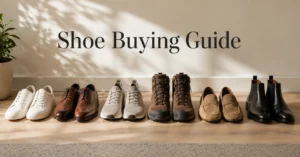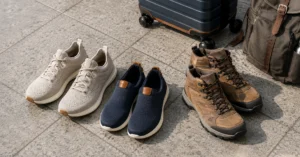
Buying athletic shoes by look alone is an expensive mistake that your joints will pay for within three kilometres. Walk into any major retail store, and you are confronted with walls of mesh, foam, and neon rubber, all carrying vague labels like “cushioned support” or “engineered performance.” If you are preparing for a trip that involves walking fifteen kilometres a day across European cobblestones, or if you are starting a new morning fitness routine, picking the wrong category means blisters, calf strain, and wasted money.
The core truth is simple: runners can never wear walking shoes, but walkers can frequently benefit from running shoes. This footwear guide will dissect the exact physical engineering behind these two categories so you can spend your budget on a pair that protects your feet.
The Mechanics of Footwear: What This Choice Rewards and What It Punishes
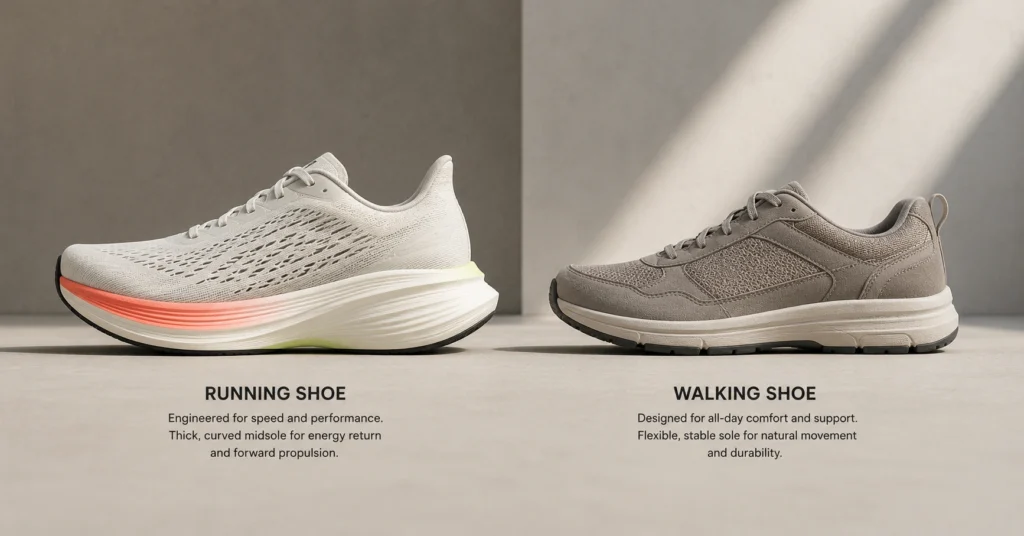
Direct Answer Block: Running shoes are designed to handle high-impact, vertical forces, featuring massive heel cushioning and thick midsoles to absorb up to three times your body weight. Walking shoes are built for a rolling, heel-to-toe stride, requiring greater flexibility through the ball of the foot and a much lower heel profile. If you run in walking shoes, you risk shin splints; if you walk long distances in rigid running shoes, you can alter your gait and cause premature lower back fatigue.
Your body moves completely differently depending on your speed. When you walk, your weight rolls through a continuous, fluid motion—your heel hits the ground first, your arch rolls slightly inward, and your foot pushes off cleanly at the toes. At any given moment during a walk, one of your feet is firmly touching the ground, meaning the impact force is relatively low but constant.
Running changes the physical equation entirely. A runner moves forward via a series of short, explosive jumps, completely leaving the ground with both feet during every single stride. When your foot slams down, your body absorbs a massive shock wave. Running gear is engineered to handle that intense, repetitive, vertical pounding. If you wear an un-cushioned walking shoe for a jog, your knees and shins absorb that raw impact, which often results in structural stress fractures.
Conversely, dedicated walking models are engineered for a low-impact, horizontal weight transfer. They do not need thick towers of foam beneath the heel because you are never falling from mid-air. What they do require is a sole that moves with your foot rather than fighting against it. If you choose a stiff, unyielding shoe for a walking holiday, your foot muscle is forced to work twice as hard just to bend the sole with every single step.
Running Shoes vs Walking Shoes: The Quick Breakdown Table
The structural elements of your footwear dictate how your muscles activate. Before exploring the individual components, look at this direct engineering comparison between the two styles.
| Structural Feature | Running Shoes | Walking Shoes | Best For | Limitation | Verdict |
| Midsole Cushioning | Thick EVA or Polyurethane Foam | Moderate, even foam distribution | High-impact running and heavy heel-strikers | Reduces ground feel; can feel unstable when standing still | Essential for jogging; optional but highly comfortable for walking. |
| Sole Flexibility | Rigid forefoot or integrated carbon plates | High flexibility through the ball of the foot | Natural heel-to-toe walking gaits | Cannot support explosive running impacts | Avoid completely if your routine includes any jogging. |
| Heel Drop Height | High (8mm to 12mm variance) | Low or neutral (0mm to 6mm variance) | Forward momentum and Achilles tendon relief | Can cause walkers to strike the ground prematurely | Walkers should aim for lower drops to maintain a natural stride. |
| Upper Construction | Lightweight, highly breathable open mesh | Sturdier leather, synthetic knit, or nylon | Temperature regulation during intense workouts | Less structural protection against rain or trail debris | Choose mesh for hot climates; choose structured synthetic for wet city streets. |
Core Construction: How Running and Walking Gear Differ Fundamentally
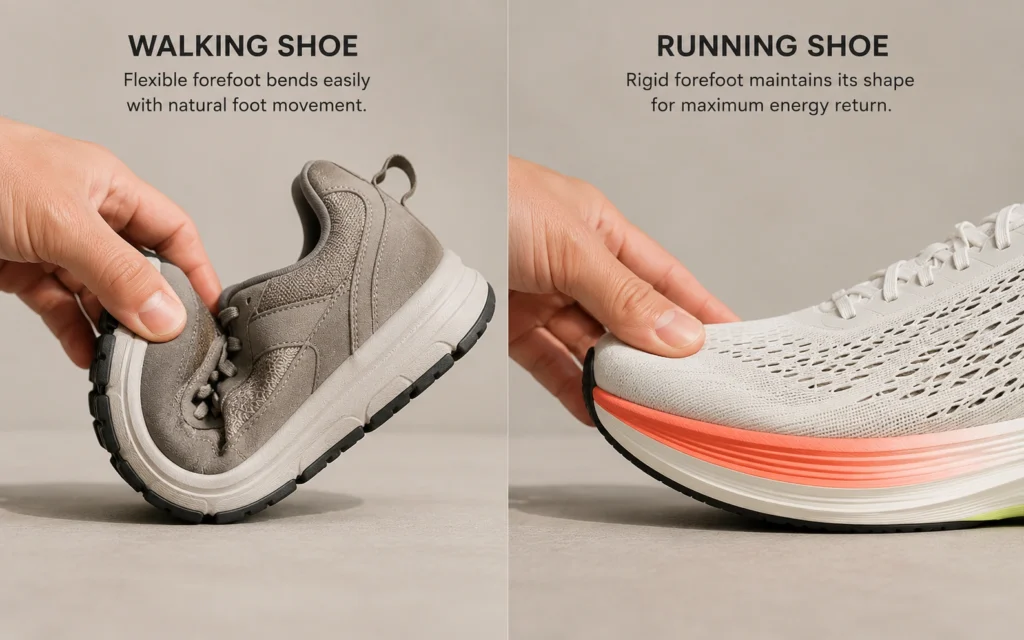
Midsole cushioning forms the actual foundation of athletic footwear. In running models, this layer consists of specialized, gas-infused foams designed to bounce back immediately after being compressed by a heavy stride. This creates a high stack height—the measurement of how much material sits between your foot and the pavement. Walkers do not need this massive layer of insulation. In fact, too much soft foam can make a walker feel unstable, forcing your ankles to constantly make tiny, exhausting micro-adjustments just to stay upright on uneven sidewalks.
Sole flexibility is the next critical differentiator. If you grab a high-quality walking shoe and bend it, the toe area should easily curve upwards into a sharp arc. This allows your foot to execute its natural rolling motion across the ground. Running shoes are deliberately designed to resist this type of bending. They often feature rigid plastic shanks or stiff carbon-fiber plates embedded inside the sole to snap the shoe back into shape, acting like a spring to propel the runner forward. If you take that rigid structure on a slow, five-kilometre city tour, your arches will likely ache before you finish the first hour.
[Visual Test: Take your shoe and bend the toe upward. A running shoe resists or bends only at the midfoot; a dedicated walking shoe curves easily at the ball of the foot.]
Then look at the heel drop, which is the difference in height between the heel cushion and the toe cushion. Running shoes frequently use a steep angle, elevating your heel up to twelve millimetres above your toes to protect your Achilles tendon when landing. Walking shoes sit much closer to the earth, usually featuring a drop of six millimetres or less. This flat profile prevents your heel from catching on the concrete early, ensuring a smooth transition from the moment your foot makes contact until you push off with your toes.
How to Choose Your Pair Based on Your Actual Daily Foot Motion
You must analyze your specific daily usage before tapping your credit card. Do not buy a technical running shoe because you think it looks more athletic or impressive. If your main activity consists of walking the dog, navigating airport terminals, or standing on hard museum floors for four hours, a walking shoe—or a highly flexible, low-drop running shoe—is your correct choice. These activities reward structural flexibility and wide toe boxes that allow your feet to naturally expand over hours of standing.
If your routine involves an unpredictable mix of intervals—such as walking for ten minutes, jogging for five, and sprinting up a hill—you must default to a running shoe. A walking shoe simply cannot cross over into running without risking injury to your lower limbs. The inverse transition is much easier. Millions of fitness enthusiasts successfully use running shoes as their everyday walking gear because they prefer the plush, cloud-like sensation of thick midsole foam.
Be aware of the distinct weight trade-off. Running shoes use ultra-thin materials to shed every single gram, which makes them feel weightless but leaves them vulnerable to tearing on sharp rocks or soaking through during sudden rainstorms. Walking shoes regularly utilize heavier, more durable synthetic fabrics or treated leathers. These materials add weight to your feet, but they survive scraping against stone curbs and keep your socks dry during unexpected downpours.
Real Investment Tiers: What You Get for Your Money
Good footwear is an investment in joint health, but you do not need to spend top-tier money unless your training volume demands it. Use these shoe buying tips to understand the exact price tiers (2025–2026 rates — verify before travel).
Budget Tier: €60 to €90
In this price bracket, you are purchasing basic compression-molded EVA foam soles and standard nylon uppers. These shoes work perfectly fine for light weekend strolls or three-kilometre neighborhood walks. However, the foam used here is less resilient; it will pack down permanently after roughly 300 kilometres of use, losing its protective qualities. The seams are usually glued rather than stitched, meaning they will split early if subjected to heavy rain or muddy trails.
Mid-Range Tier: €100 to €150
This is the sweet spot for the vast majority of buyers. Here, you receive advanced proprietary foams—like Brooks’ DNA Loft or Asics’ FlyteFoam—which maintain their springiness for up to 800 kilometres. The uppers use engineered knit fabrics that stretch to accommodate your foot shape without causing friction blisters. You also get targeted rubber outsoles on the bottom of the shoe, which provide genuine grip on wet asphalt rather than sliding around like cheap plastic.
Worth-the-Splurge Tier: €160 to €220+
Paying more than €160 is only necessary if you are training for a marathon or packing for an extreme multi-week trek. This tier delivers ultra-premium features like Pebax foam, integrated carbon stability plates, and completely waterproof Gore-Tex membranes. The weight drops significantly, often falling under 250 grams per shoe. Unless you need this specialized technical performance, the extra cost is largely a waste of money for casual users.
Common Fitting Faults and Exactly How to Overcome Them
The single biggest mistake first-time buyers make is choosing their standard casual shoe size. When you walk or run for more than thirty minutes, blood pumps into your lower extremities, causing your feet to swell up to half a full size larger. If your toes are touching the very front of the shoe while you are standing in a fitting room, that pair is too small. When you are out on the road, your toes will slide forward and jam into the front wall, leading to bruised, black toenails. Always ensure there is a full thumb’s width of empty space between your longest toe and the tip of the shoe.
[Fitting Rule: Always try on footwear in the late afternoon or evening. Your feet naturally expand throughout the day, which gives you a more accurate representation of your true active size.]
Another frequent error is ignoring your foot width and volumetric shape. Brands like Nike and Adidas generally construct their shoes around a narrow, sleek shoe mold. If you have a wide forefoot, your pinky toe will rub against the outer mesh, causing painful friction burns within a week. Brands like New Balance, Brooks, and Altra deliberately offer dedicated wide widths (2E and 4E) or feature naturally wide, foot-shaped toe boxes. Never assume a tight shoe will stretch out over time; modern synthetic athletic shoes do not break in or expand the way traditional leather boots do.
Finally, do not buy a shoe based entirely on the advice of an online influencer or a friend. Every human body possesses a unique alignment of ankles, knees, and hips. A shoe that feels comfortable for someone else might cause you shin pain within twenty minutes. Go to a dedicated running store, step on their treadmill, and let an expert analyze your actual gait to see if your ankle rolls inward or outward under pressure.
The Exact Models We Tested and Recommend
We spent weeks testing current footwear options on city pavement, gravel paths, and treadmill surfaces to see how they perform in real-world conditions. These specific models provide reliable choices for your footwear guide checklist.
Brooks Ghost 16 (Running Category)
- Price: €140 (2025–2026 rates — verify before travel)
- Material: Engineered air mesh upper with nitrogen-infused DNA Loft v3 foam midsole.
- Real-World Feel: This is the ultimate crossover shoe. While designed as a neutral daily running shoe, its thick heel cushioning and stable base make it a phenomenal long-distance walking option. It features a traditional 12mm heel drop, which immediately takes the pressure off tight calves during long days on your feet. It is not sleek or fashionable, but it simply works.
New Balance 840 v6 (Walking Category)
- Price: €130 (2025–2026 rates — verify before travel)
- Material: Durable synthetic upper with a compression-molded Abzorb foam midsole.
- Real-World Feel: Unlike flimsy fashion sneakers, this is a dedicated walking shoe built for serious structural support. The sole is wide, flat, and remarkably stable, preventing your ankles from rolling on brick paths. The forefoot bends effortlessly, allowing for a clean heel-to-toe stride. It is significantly heavier than a running shoe, but the sheer durability of the sole makes up for the weight.
Altra Lone Peak 8 (Trail Crossover Category)
- Price: €150 (2025–2026 rates — verify before travel)
- Material: Ripstop nylon upper with a MaxTrac grippy rubber outsole and zero-drop foam platform.
- Real-World Feel: If your travels include dirt paths, cobblestones, and slippery historical stairs, this shoe handles it all. It uses a zero-drop design, meaning your heel and toe sit at the exact same height above the ground. The toe box is cut wide like a human foot, allowing your toes to spread out naturally. Do not buy this if you plan to jog long distances on hard concrete, but for rugged walking tours, it is unmatched.
Frequently Asked Questions About Running Shoes vs Walking Shoes
Can I use running shoes for my daily fitness walks?
Yes, you can wear running shoes for walking. Running shoes provide substantial impact absorption and premium materials that protect your joints during long fitness walks, though they typically feature a higher heel stack that changes your natural walking stride.
What happens if I jog in specific walking shoes?
Jogging in dedicated walking shoes increases your risk of injury because walking shoes lack the necessary deep midsole cushioning required to absorb three times your body weight during running impacts. The stiffer soles can cause shin splints and joint fatigue within a few blocks.
How often do I need to replace my everyday footwear?
You must replace active footwear every 500 to 800 kilometres, or roughly every six to nine months of regular use. The internal EVA or polyurethane foam degrades and loses its shock absorption capabilities long before the outer rubber sole shows visible holes.
Continue Exploring
- If you want to continue optimizing your gear choices, read our complete guide to selecting fabrics and apparel weights for long-term travel. Learn how to build a functional travel wardrobe around your active footwear.
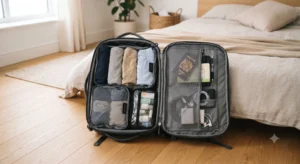
- For those planning to pack these shoes into a single carry-on bag, check out our structural breakdown of maximum-capacity travel luggage options. Discover our tested luggage recommendations for storing heavy walking shoes without sacrificing space.