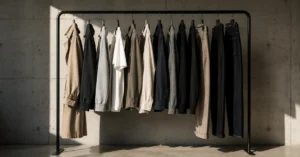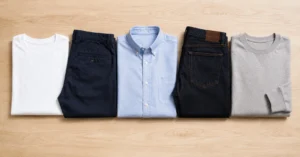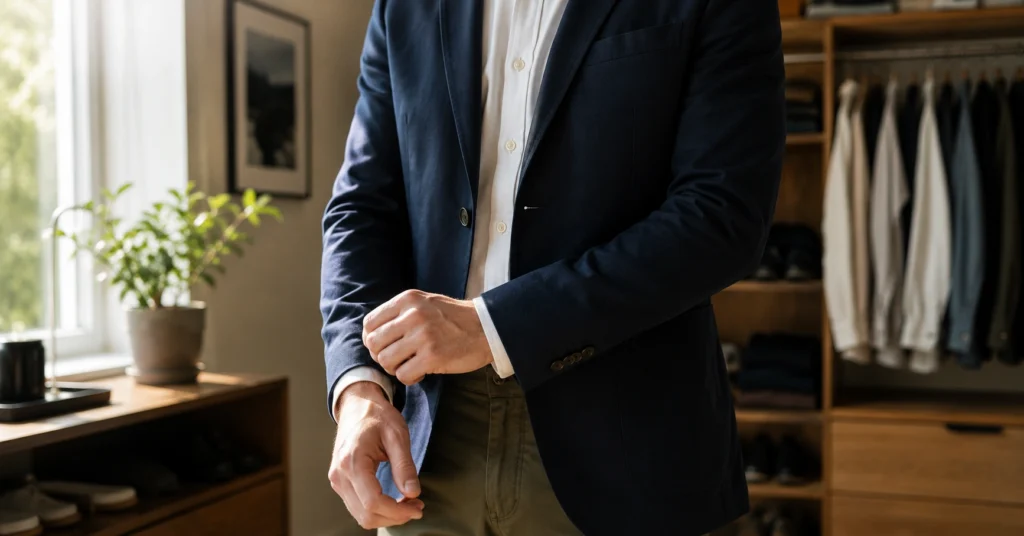
The HR handbook says “business casual.” Your manager wears a blazer over a plain t-shirt. Your new hire wears raw selvedge denim and calls it “smart casual.” You are standing in your closet at 7:15 AM, holding a navy unstructured blazer in one hand and a pair of olive chinos in the other, wondering if the combination makes you look like a substitute teacher or a junior analyst.
Business casual in 2026 is not a fixed dress code. It is a daily negotiation.
This business casual guide breaks down the exact fabrics, fits, and price points you need to navigate that negotiation. You will learn what the terms actually mean, how to avoid looking like you read about the dress code five minutes ago, and exactly where to spend your money.
The Direct Answer: Business casual means tailored separates that bridge formal suiting and weekend wear. The uniform consists of structured blazers, tailored chinos or dress trousers, crisp cotton button-downs or fine-gauge knits, and leather loafers or minimalist sneakers. No ties. No full matching suits. No athletic wear.
Quick Facts: The Business Casual Baseline
- Core Pieces: Blazer, chinos, button-down shirt, knit polo, leather shoes.
- Fabric Standard: 100% cotton, wool, or linen blends. Avoid visible synthetics.
- Fit Profile: Tailored but not tight. Trousers should have a slight break at the shoe.
- Care Requirement: Dry clean blazers quarterly. Wash chinos and shirts in cold water.
- Starter Budget: $400 (budget) to $1,200 (mid-range) for a complete five-piece rotation.
What Business Casual Actually Means in 2026 (And What It Doesn’t)
Most people assume business casual means “casual clothes that look nice.” This is the exact wrong way to approach it. Business casual actually means “formal clothes with the stiffness removed.”
When you wear a worsted wool suit, the fabric does the work for you. It holds a sharp crease, reflects light uniformly, and signals authority. When you remove the matching trousers and replace them with cotton chinos, you lose that structural authority. You have to replace it with fit and fabric quality.
A cotton-linen blend blazer paired with tailored trousers is business casual. A faded polo shirt paired with shorts is weekend wear. The dividing line is intention. Every piece in a business casual outfit must look like it was chosen to be worn in a professional environment, even if it is comfortable enough to wear on a Sunday.
The confusion often peaks when comparing smart casual vs business casual. Smart casual allows premium denim, high-quality t-shirts, and clean sneakers without a jacket. Business casual requires a collar, a structured shoulder (even if unlined), and trousers that drape rather than cling. If you are unsure which one your office demands, default to business casual. It is always easier to take off a blazer and unbutton a collar than it is to explain why you are underdressed.
The Core Uniform: Fabric, Fit, and Function Explained
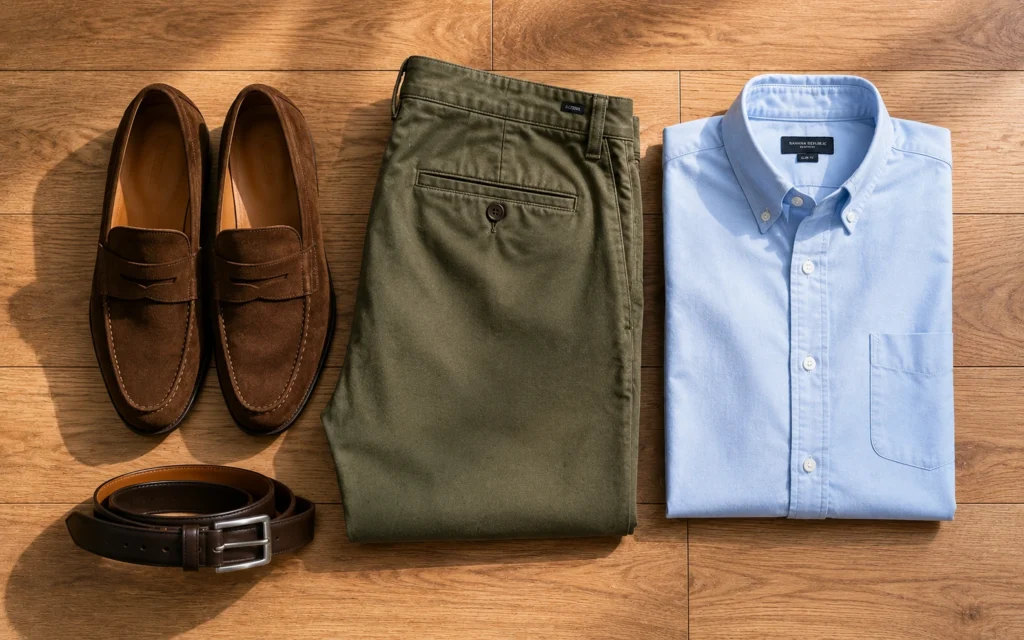
You cannot build a functional office wear rotation by guessing at materials. The fabric dictates how the garment behaves after eight hours in an office chair.
The Shirts: Poplin vs. Oxford For warmer months or air-conditioned offices, buy 100% cotton poplin. It is lightweight, breathable, and irons to a sharp finish. For winter, or if you run cold, switch to cotton Oxford cloth. It is heavier, slightly textured, and inherently more casual. Avoid anything labeled “wrinkle-free” if it feels plasticky; the chemical coating degrades after ten washes and traps heat. Look for two-ply cotton constructions. The “ply” refers to how many yarns are twisted together before weaving. Two-ply resists tearing and holds a better shape than single-ply.
The Trousers: The Elastane Question Pure cotton chinos look fantastic when you buy them and terrible after three hours of sitting. The fix is a 2% elastane blend. A 98% cotton / 2% elastane fabric gives you the matte finish and breathability of cotton with enough mechanical stretch to recover its shape when you stand up. Avoid trousers with more than 3% elastane. They start to look like athletic wear and lose the crisp drape required for the office.
The Shoes: Leather vs. Suede Leather loafers (penny or tassel) are the anchor of the business casual shoe rotation. They handle rain, resist scuffs, and polish up easily. Suede chukka boots or suede loafers look better with chinos than smooth leather does, but they are a liability if you commute in wet weather. If you walk more than a mile a day, skip the loafers entirely and buy a minimalist leather sneaker with a thin, non-marking rubber sole.
Care and Maintenance Do not dry clean your shirts. The chemicals break down the cotton fibers and leave a chemical odor. Wash them cold, hang them to dry, and iron them while slightly damp. Blazers only need dry cleaning when they smell or have a visible stain. Between cleanings, hang them in a steamy bathroom for twenty minutes to release wrinkles.
What It Actually Costs: Three Tiers for a Starter Wardrobe
Building a five-piece rotation (one blazer, two shirts, two trousers, one pair of shoes) costs real money. Here is what you actually pay in 2026, broken down by tier.
(2026 pricing — verify before purchase)
| Tier | Price Range | Best For | Limitation | Verdict |
|---|---|---|---|---|
| Budget | $300 – $450 | First job, strict budget, rapid weight changes. | Fabrics pill quickly. Fits require tailoring. | Buy only if necessary. Replace within 18 months. |
| Mid-Range | $600 – $900 | Daily office wear, best balance of cost and durability. | Still requires occasional tailoring for perfect fit. | The sweet spot. Buy your core rotation here. |
| Worth-the-Splurge | $1,200 – $1,800 | Client-facing roles, long-term investment pieces. | Diminishing returns on basic items like chinos. | Buy the blazer and shoes here. Skip the shirts. |
The Budget Tier ($300 – $450) Retailers like Uniqlo and H&M Premium dominate this space. You can get a perfectly acceptable navy blazer for $80 and chinos for $40. The limitation is the fabric. The cotton is often shorter-staple, meaning it pills under the arms and fades at the knees after a few months. The fits are also heavily standardized. You will likely need to spend an extra $30 at a local tailor to hem the trousers and take in the shirt waist.
The Mid-Range Tier ($600 – $900) This is where J.Crew, Banana Republic, and Spier & Mackay operate. The cotton is longer-staple, the stitching is tighter, and the hardware (buttons, zippers) will not break. A $120 pair of chinos from this tier will outlast three $40 pairs from the budget tier. The fits are more nuanced, offering tapered, slim-straight, and classic options. This is where you should build the foundation of your wardrobe.
The Worth-the-Splurge Tier ($1,200 – $1,800) Todd Snyder, Suitsupply, and Drake’s live here. The blazers feature half-canvas or full-canvas construction, meaning the chest piece is stitched, not glued. This allows the wool to mold to your body over time. The shoes use Goodyear welting, meaning the sole can be replaced by a cobbler for $60 instead of throwing the shoe away when the sole wears through. Buy your outerwear and footwear at this tier. Buy your shirts and trousers at the mid-tier.
The Five Mistakes That Make You Look Like You’re Guessing
Even with the right clothes, execution matters. These are the specific errors that signal you do not understand the dress code.
1. The “Tech Bro” Fleece Vest Wearing a quilted fleece vest over a button-down shirt does not make you look innovative. It makes you look like you are waiting for a venture capital meeting in 2014. If you need a layer, wear a fine-gauge merino wool V-neck or a structured cardigan.
2. Ironing the Crease into Chinos Dress trousers require a sharp front crease. Chinos do not. If you iron a hard crease into a pair of cotton chinos, you instantly downgrade them to cheap office slacks. Press them flat, but let the fabric fall naturally.
3. Shoes That Are Too Formal Black cap-toe Oxford shoes are designed to be worn with a dark worsted wool suit. Wearing them with olive chinos and a light blue shirt creates a severe visual disconnect. The shoes are shouting “boardroom” while the clothes are whispering “Friday.” Switch to brown brogues, penny loafers, or clean leather sneakers.
4. The Linen Blazer Commute An unstructured 100% linen blazer looks great in the mirror but wrinkles catastrophically during a 40-minute commute, making you look like you slept in it. Linen is for weekend events or offices where you drive directly into a private garage. For daily wear, buy a cotton-silk-linen blend instead. The silk adds enough structure to hold a press, while the cotton prevents the deep creasing pure linen guarantees.
5. The Collar Gap When you button your shirt to the second button, the collar points should lie flat against your chest. If they flare out away from your neck (the “collar gap”), the shirt does not fit your neck shape. This happens when you buy off-the-rack shirts with a collar spread designed for a wide tie knot. Since you are not wearing a tie, look for shirts with a button-down collar or a spread collar that sits high on the neck.
The Exact Pieces to Buy First (And What to Skip)
If you are starting from zero, do not buy everything at once. Build the rotation in this exact order.
Buy First: The Navy Unstructured Blazer This is the engine of the business casual outfit. It elevates a t-shirt and pairs with every color of trouser you own. Buy it in navy. Buy it in an unstructured cotton or wool blend. Do not buy it with shoulder pads.
Buy Second: Two Pairs of Chinos (Olive and Grey) Skip the khaki color for now. Khaki shows every stain and often washes out your complexion. Olive and charcoal grey hide dirt, pair easily with navy and white, and look more modern.
Buy Third: The White and Light Blue Shirts Buy one white Oxford and one light blue poplin. These are the workhorses. They go with the blazer, they go with the chinos, and they go with dark denim if the dress code relaxes.
What to Skip: Patterned Shirts and Loafers (Initially) Do not buy gingham, windowpane, or heavily striped shirts until your solid foundation is built. Patterns limit how many combinations you can make. Also, skip the suede loafers for your first pair of shoes. Buy smooth brown leather first. It is more versatile and handles bad weather without ruining the material.
Buy the mid-tier chinos. The budget ones lose their shape after three washes, and you will not notice the quality jump on the $200 pair until your fifth year of wearing them.
Frequently Asked Questions About Business Casual
Can I wear jeans in a business casual office?
Yes, but only if they are dark, undistressed, and tailored. Pair them with a structured blazer and leather shoes to elevate the look. Avoid light washes, rips, or baggy fits entirely. If your office allows dark denim, it is leaning toward smart casual.
What is the difference between smart casual vs business casual?
Business casual requires tailored separates like chinos and blazers, anchoring the outfit in professional wear. Smart casual is more relaxed, allowing premium denim, high-quality t-shirts, and minimalist sneakers without a jacket. When in doubt, dress one level more formal than the invitation implies.
Do I need to wear a belt with business casual trousers?
If your trousers have belt loops and your shirt is tucked in, yes. Match the leather color of your belt to your shoes. If you wear trousers with side-adjusters or suspenders, a belt is unnecessary and visually cluttered.
Continue Exploring
- Building a wardrobe is only half the equation; knowing how to maintain it ensures your investment lasts. For a comprehensive breakdown of how to evaluate garment construction, understand fabric weights, and negotiate tailoring alterations, read our complete fashion buying guide. It covers the exact checkpoints you need to use when evaluating any clothing purchase, from shirts to outerwear.