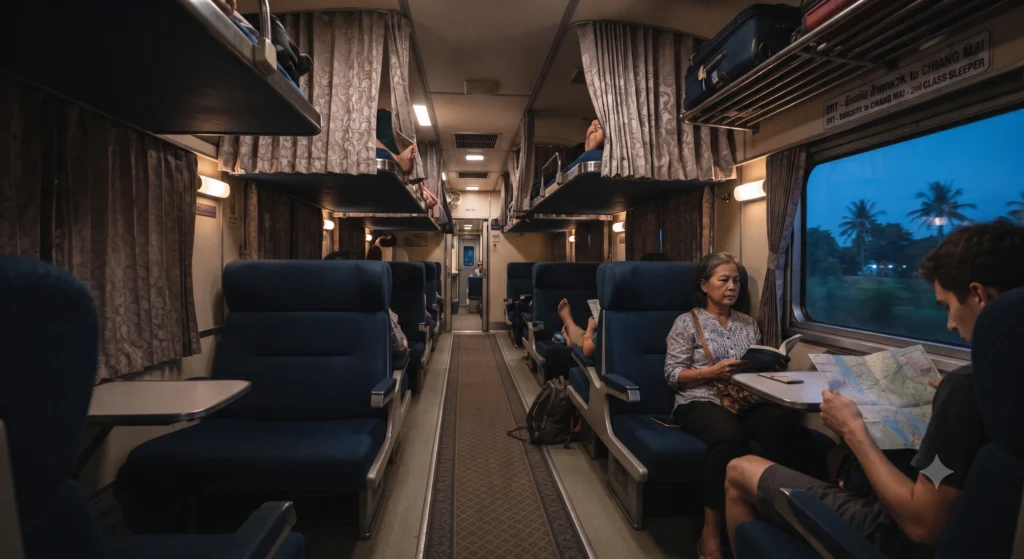
There is a romantic notion that taking train trips across Thailand is the ultimate way to see the country. You imagine sipping cold drinks while palm trees drift past your window, falling asleep to the rhythmic click-clack of the tracks, and pulling into Chiang Mai or Surat Thani refreshed and ready to explore.
The reality? Sometimes it is exactly that. Other times, it is an icy 14-hour air-conditioned freezer chest, an unscheduled two-hour delay on a siding, or a frantic sprint to the wrong terminal because you went to Bangkok’s historic station instead of the new rail hub.
Train travel in Thailand is rarely about raw efficiency. If your vacation is strictly seven days long and you need to maximize every hour, taking domestic flights on low-cost carriers will almost always make more sense. But if you have time, want to cut down on domestic flight carbon, save on a night’s accommodation, and experience a ground-level view of Thai countryside life, rail travel offers exceptional value.
Here is what you actually need to know before booking your ticket.
Quick Verdict: Are Thailand Train Trips Worth It?
The Short Answer: Yes—provided you pick the right route and the right carriage class.
The flagship overnight sleeper routes (Bangkok to Chiang Mai and Bangkok to Surat Thani) on the newer Chinese-built Special Express trains are comfortable, clean, and incredible value. Regional heritage runs like the Kanchanaburi Death Railway deliver remarkable scenery and deep history for just a few dollars.
Who Should Go: Slow travellers, budget planners wanting to combine travel with a night’s stay, couples, and anyone who prefers scenic landscapes over airport security queues.
Who Should Skip: Anyone on a trip shorter than 7 days, travellers who cannot sleep outside a stationary bed, and people with strict, non-negotiable transfer schedules.
The Biggest Trade-off: Time and punctuality. While long-distance lines have improved with double-tracking projects, delays of 30 to 90 minutes remain common.
Quick Facts Block
| Decision Factor | Practical Reality |
|---|---|
| Best Routes | Northern Line (Bangkok to Chiang Mai) & Western Line (Kanchanaburi / Death Railway) |
| Main Departure Hub | Krung Thep Aphiwat Central Terminal, Bangkok (for long-distance express routes) |
| Budget Expectation | $25–$35 USD (2nd Class AC Sleeper) / $3–$8 USD (3rd Class Regional) |
| Booking Window | Opens 30 days in advance via official SRT D-Ticket portal; lower berths sell out fast |
| Key Inconvenience | Air-conditioned sleeper carriages are kept freezing cold overnight; bring a warm hoodie |
What Thailand Rail Travel Is Actually Like
Taking a long-distance train in Thailand feels markedly different from riding high-speed rail in Japan or Western Europe. The State Railway of Thailand (SRT) operates at a relaxed pace. Maximum speeds on most lines hover around 80–100 km/h (50–60 mph).
Inside a Special Express 2nd Class sleeper carriage before night conversion.. Source: Aga on the run
The Carriage Classes Decoded
Navigating ticket choices can be confusing for first-time visitors. Here is how the three main options break down:
- 1st Class AC Private Sleeper: You get a private lockable 2-berth compartment with a sink and individual touchscreen monitor. If you are travelling solo and do not buy both seats, you will be paired with a stranger of the same gender. It is comfortable, but ticket availability is low and prices rival budget airfare.
- 2nd Class AC Sleeper (The Sweet Spot): This is an open-plan carriage with pairs of facing seats along a central aisle. Around 7:00 PM or 8:00 PM, a train attendant comes through and magically converts every pair of seats into stacked upper and lower sleeping berths complete with fresh sheets, a pillow, and a privacy curtain.
- Lower Berth vs. Upper Berth: Always book the lower berth if available. It is wider, has a window to look out of when waking up, and avoids climbing a narrow metal ladder. Lower berths cost roughly 100 THB ($3 USD) more, but sell out weeks ahead of upper berths.
- 3rd Class Fan Carriage: Wooden or vinyl-padded bench seats with open windows and overhead fans. Unbeatable for short 2-to-3-hour daytime trips alongside locals and monks, but brutal for anything longer due to heat, noise, and dust.
Crucial Station Warning: Long-distance express trains to Chiang Mai, Nong Khai, Hat Yai, and Surat Thani depart from Krung Thep Aphiwat Central Terminal (formerly Bang Sue Grand Station) in northern Bangkok. Do not go to the historic Hua Lamphong Station in Chinatown for these express sleepers, or you will miss your train.
The Key Routes: What Is Worth Doing
1. The Northern Line: Bangkok to Chiang Mai (12–13 Hours)
This is Thailand’s flagship rail experience. Train No. 9 (departing Bangkok around 6:40 PM) and Train No. 10 (returning from Chiang Mai) feature modern Red CNR carriage stock.
- Why It Is Worth It: You board in Bangkok in the evening, enjoy the sunset over suburban plains, sleep through the central flatlands, and wake up around 6:00 AM climbing through dense jungle mist and pine-covered hills near Khun Tan mountain tunnel.
- What to Expect: Clean bio-toilets, individual charging outlets, and a quiet atmosphere.
2. The Death Railway Line: Bangkok (Thon Buri) to Nam Tok (4.5 Hours)
Built during World War II under brutal Japanese military occupation, this line carries immense historical weight alongside dramatic topography. Crossing the wooden Krasae Cave Viaduct clinging to the cliff face above the Kwai Noi River.. Source: Thai Pass
- Why It Is Worth It: The journey hugs steep river cliffs and crosses the famous wooden Krasae Cave Viaduct (Wampo Viaduct), constructed by prisoners of war and Asian forced labourers. Tickets cost around 100 THB ($3 USD) for 3rd class, making it one of the most memorable budget journeys in Asia.
- Practical Tip: Sit on the left side of the train when heading from Kanchanaburi toward Nam Tok for the best river and cliff views over the wooden trestles.
3. The Market Line: Mae Klong Railway Market
For a unique day trip, the short commuter branch to Mae Klong takes you right through the famous umbrella market (Talad Rom).
Market stalls retract within inches of the train as it crawls into Mae Klong Station.. Source: Wikipedia
- The Experience: Vendors pull back their canvas awnings and produce baskets with inches to spare as the slow-moving diesel train rumbles down the center street track.
What to Skip and What to Do Instead
- SKIP: Day-time seated express trains to Chiang Mai. Sitting upright in a second-class seat for 11 to 12 hours deprives you of a full daylight vacation day in either Bangkok or Chiang Mai.
- Better Alternative: Book the overnight Train No. 9 Special Express CNR. You sleep through the monotonous central plains and wake up to the scenic mountain portion at dawn.
- SKIP: Buying food exclusively from the train dining car. Onboard dining car meals are pre-packaged, relatively bland, and overpriced compared to street standards.
- Better Alternative: Pack your own dinner from Bangkok street food stalls or station vendors before boarding. Grab cold sticky rice, roasted chicken, or bakery items to enjoy at your seat.
- SKIP: Overpaying for 1st Class Private Compartments. Unless you are travelling as a couple wanting complete isolation, paying double for 1st class offers minimal extra comfort over 2nd class sleepers.
- Better Alternative: Choose 2nd Class AC Lower Berth. The privacy curtain gives you a cozy cocoon, the bed size is almost identical, and the carriage atmosphere is friendly and social.
What It Really Costs
Rail travel in Thailand is gentle on the budget. Here is an honest breakdown of what you can expect to spend per person for a typical long-distance journey:
- Budget Style (3rd Class Regional): $3–$8 USD (100–250 THB). Includes non-AC wooden bench seating, open windows, and buying platform hawker snacks. Best suited for short day trips under 4 hours (e.g., Bangkok to Ayutthaya or Kanchanaburi).
- Comfortable Style (2nd Class AC Sleeper): $25–$35 USD (800–1,100 THB). Includes modern air-conditioned berths with clean bedding, luggage storage space under seats, and a comfortable night’s sleep.
- Premium Style (1st Class AC Private Sleeper): $45–$60 USD (1,500–1,900 THB). Includes private lockable two-berth room, personal washbasin, and private touchscreen display.
Final Recommendation: Should You Book?
If you are visiting Thailand for 10 days or longer, booking at least one overnight sleeper train (especially the Bangkok to Chiang Mai route) is a memorable, cost-effective, and practical choice. It saves you a hotel night and drops you directly into city centers without airport transfers.
However, if your total vacation is under 7 days, skip the rails and book domestic flights on regional carriers. The extra 10 to 12 hours saved on transit will be far more valuable for your limited time.
FAQ
Which Bangkok station do long-distance sleeper trains depart from?
All long-distance express and special express trains to Chiang Mai, Surat Thani, Nong Khai, and Hat Yai depart from Krung Thep Aphiwat Central Terminal in northern Bangkok. Short regional lines (like the train to Kanchanaburi/Death Railway) depart from Thon Buri Station, while select suburban trains still use old Hua Lamphong.
Is the 2nd Class sleeper train in Thailand safe for solo female travellers?
Yes. Second-class carriages are well-lit, open-plan, and continuously patrolled by State Railway of Thailand staff and train attendants. Additionally, SRT offers women-and-children-only carriages on major Special Express routes (such as Train No. 9 to Chiang Mai), which can be selected during booking.
How far in advance should I book Thailand train tickets?
Bookings open 30 days prior to departure. Lower berths on popular sleeper express routes (like Bangkok to Chiang Mai or Surat Thani) often sell out within the first few days of opening, especially during high season (November to February) and peak holidays like Songkran in April.
Are there luggage weight limits on Thai trains?
While official rules specify limits (typically 30–40 kg depending on class), luggage is rarely weighed at stations. There is generous floor space under the lower berths in 2nd class sleeper carriages and overhead racks for standard suitcases and large backpacks.