You can dress well on a budget without looking cheap — but not by buying the cheapest items. The difference between a $20 tee that looks expensive and one that looks cheap isn’t price. It’s fabric weight (200gsm vs 160gsm), exact fit (not “one size up”), and seam construction (double-stitched vs single). I’ve worn $18 Uniqlo tees alongside $120 designer ones and watched people ask where I got the “nice” shirt. The trick is knowing what to check before you buy.
This post gives you the 5 rules that make budget clothes look expensive, the exact fabric types to pick, the fit mistakes that scream “cheap,” and brands that deliver $15–$45 items without the discount-store look. First-timer friendly: no jargon, sizing explained, care steps clear. You’ll walk away with a shopping checklist and a 7-item capsule list that costs under $250 total (2025–2026 rates — verify before travel).
The Real Problem: Why Budget Clothes Look Cheap (and How to Fix It)
Budget clothes look cheap because most people buy the wrong fabric, the wrong fit, and the wrong seam construction — then wash them wrong. Price doesn’t fix this. You can spend $80 on a polyester tee that looks worse than a $25 cotton one.
Fabric Quality Eyes You Can’t Ignore
Fabric is the single thing that makes or breaks how “cheap” an item looks. Three fabric traits matter:
| Trait | Cheap Look | Expensive Look | What to Buy |
|---|---|---|---|
| Weight (gsm) | 160–180gsm (thin, shows underwear) | 200–300gsm (drapes, opaque) | T-shirts: 200gsm+; Sweatshirts: 300gsm+ |
| Composition | 100% polyester or 60% cotton/40% poly (stiff, shiny) | 100% cotton or 98% cotton/2% stretch (soft, natural) | 100% cotton poplin, chino, French terry, 12oz denim |
| Finish | Chemical shine, wrinkled after 1 wear | Natural matte, holds shape | Matte finish, no “gloss” on label |
A 200gsm Supima cotton tee ($25 at Uniqlo) looks more expensive than a 160gsm “premium” tee ($45 at a department store) because it’s opaque and drapes. Thin fabric clings to body lines and shows underwear — that’s the “cheap” signal.
Fit Is Free — But Most People Get It Wrong
Fit costs nothing but is the most expensive mistake. “Relaxed fit” chinos that are 2 inches too wide at the leg look sloppy. A $35 chino in your exact size looks better than a $80 chino one size up.
Three fit rules:
- Sleeve seam hits shoulder bone — not 2 inches down your arm.
- Shirt tail ends 2 inches below waistband — not at your belt.
- Chino leg is straight, not baggy — 1 inch gap between fabric and thigh when standing.
Most budget buyers go up a size because they think “looser = more comfortable.” That’s wrong. Loose = sloppy. Exact fit = expensive.
Quick Overview: The 5 Rules That Make Budget Clothes Look Expensive
Before you buy anything, memorize these 5 rules. They’re the difference between a $20 tee that gets asked “where did you get that?” and one that looks like a clearance rack throwaway.
Rule 1: Know Your Fabric Types
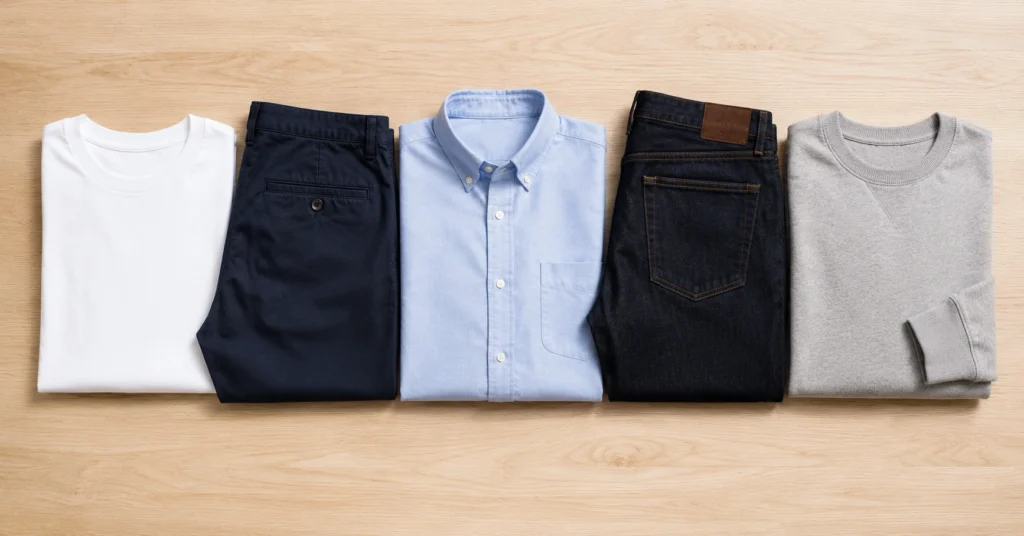
- T-shirts: 200–220gsm Supima or Pima cotton (100%)
- Chinos: 98% cotton + 2% stretch, 240–260gsm
- Button-ups: 100% cotton poplin or Oxford (120–140gsm)
- Jeans: 12–14oz denim, single-stitch hem
- Sweatshirts: 300gsm French terry, 100% cotton
Avoid 100% polyester on tops. It shines under light, holds sweat odor, and wrinkles into hard creases.
Rule 2: Fit Over Size
Your size is whatever fits your body — not what’s on the tag. A “Medium” that fits is better than a “Large” that’s loose. Always try on or know your exact measurements (chest, waist, shoulder width).
Rule 3: Seam Count = Durability
Check three seam points:
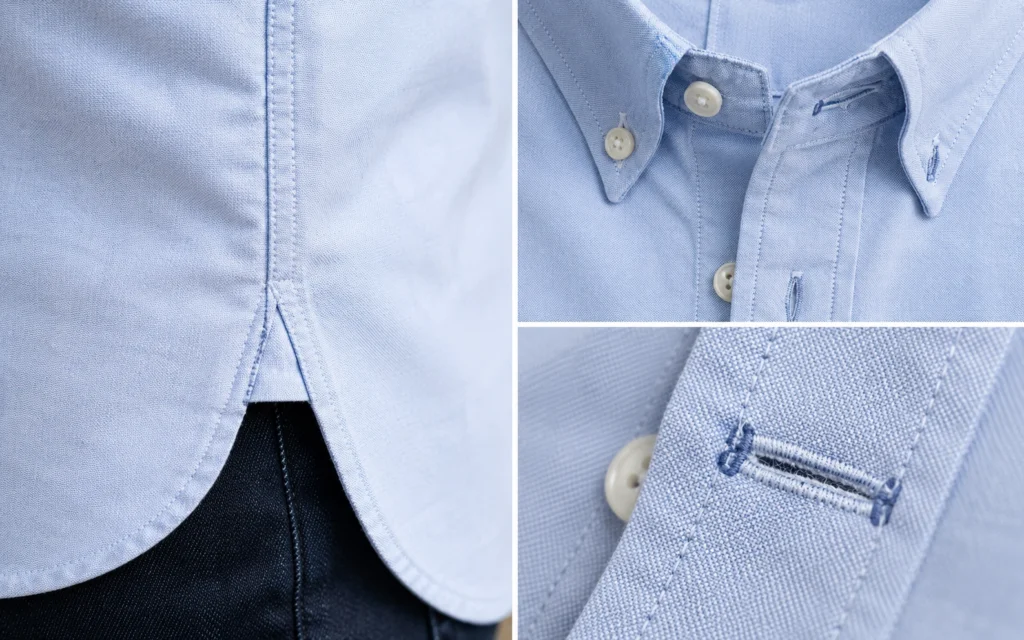
- Side seams: Double-stitched (two parallel lines) = durable. Single = splits in 6 months.
- Shoulder seams: Reinforced tape = holds shape. Unfinished = stretches.
- Buttonholes: Bar-tacked (thick thread lock) = stays. Simple stitch = tears.
A $35 shirt with double-stitched seams lasts 3 years. A $70 shirt with single seams lasts 1 year.
Rule 4: Care Instead of Replace
Washing kills clothes faster than price. Cold wash, hang dry, iron while damp. A $20 tee cared for this way lasts 2 years. A $60 tee washed hot and tumble-dried lasts 6 months.
Rule 5: The Capsule Mindset
Build 7–10 core items in neutral colors (white, navy, grey, charcoal, black). Spend $35–$70 on basics, $15–$25 on trends. Basics get 80% of your wear; trends expire in 6 months.
Buying Guide: What to Check Before You Buy Any Clothing Item
Don’t buy anything without checking these 4 things on the label and the garment. This is the exact checklist I use in stores.
Fabric Label: Natural vs Synthetic Blend
Turn the garment inside out. Read the care label.
- Good: 100% cotton, 98% cotton/2% elastane, 100% wool
- Bad: 100% polyester, 60% cotton/40% poly, 80% poly/20% wool
Polyester shines under light (cheap signal). Cotton blends with >20% poly feel stiff and wrinkle hard.
Seam Construction: Look For These 3 Things
Run your finger along the seams:
- Side seams: Feel for two parallel stitch lines = double-stitched. One line = single.
- Shoulder: Look for a thin tape covering the seam = reinforced. No tape = stretches.
- Buttonholes: Look for thick thread “blocks” at ends = bar-tacked. Smooth thread = tears.
Hardware: Zippers, Buttons, Snaps
- Zippers: YKK or “Japanese metal” = durable. Plastic teeth = breaks in 1 year.
- Buttons: Horn or solid wood = expensive look. Plastic with “shiny” finish = cheap.
- Snaps: Metal with “no rust” stamp = good. Plastic snaps = cheap.
A $40 chino with YKK zippers and horn buttons looks like a $90 item.
Try-On Test: 5 Moves That Expose Poor Fit
In the store, do these 5 moves:
- Raise arms — shirt shouldn’t pull at shoulders.
- Sit down — chinos shouldn’t gap at waist.
- Bend elbows — sleeve shouldn’t ride up past elbow.
- Walk 10 steps — no pinching at thigh or knee.
- Look in mirror from side — no “baggy” behind knee or extra fabric at chest.
If any move fails, it’s the wrong fit. Buy the next size down or up — not the same size.
Budget Guide: Price Tiers That Actually Work (2025–2026 Rates)
You don’t need to spend $100 per item to dress well. Three price tiers work — pick based on your budget and how long you want the item to last (2025–2026 rates — verify before travel).
| Tier | Price Per Item | What You Get | Durability | Best For |
|---|---|---|---|---|
| Budget | $15–$35 | 100% cotton, 200gsm+, double-stitched seams | 1–2 years | First capsule, daily wear |
| Mid-Range | $35–$70 | Better fabric (240gsm+), reinforced shoulders, YKK hardware | 2–4 years | Core basics, work wear |
| Worth-the-Splurge | $70–$120 | Premium cotton (Supima/Pima), French terry, single-stitch hem | 4–6 years | Special items, long-term investment |
Budget Tier: $15–$35 Per Item — What You Get
At this tier you get:
- 100% cotton (not blend)
- 200–220gsm fabric weight
- Double-stitched side seams
- Basic buttons (not horn)
- No reinforced shoulder tape
What works: T-shirts, basic chinos, simple button-ups.
What fails: Heavy denim, structured blazers, wool blends.
Proven budget items:
- Uniqlo Supima Cotton T: $25, 200gsm, double-stitched
- Goodfellow & Co. Chinos (Target): $35, 98% cotton/2% stretch
- Gap Icon Cotton Tee: $18, 210gsm, Supima
These look expensive when you avoid thin fabric and oversize fits.
Mid-Range Tier: $35–$70 Per Item — What Changes
At this tier you get:
- 240–260gsm fabric (thicker, drapes better)
- Reinforced shoulder tape
- YKK zippers and horn buttons
- Better color retention (less fading)
What works: All basics, work wear, jeans.
What fails: Luxury fabrics (cashmere, silk).
Proven mid-range items:
- J.Crew Factory Chinos: $55, 260gsm, YKK
- Levi’s 511 Jeans: $65, 12oz denim, single-stitch
- Rodd & Wilson Oxford Shirt: $60, 100% cotton, bar-tacked buttonholes
Worth-the-Splurge: $70–$120 — When It Pays Off
At this tier you get:
- Premium cotton (Supima, Pima, Egyptian)
- 300gsm+ French terry
- Single-stitch hem (vintage look, lasts longer)
- 5-year warranty on some brands
Buy here: Jeans, button-ups, sweatshirts you’ll wear 200+ times.
Don’t buy here: T-shirts (fade fast anyway), trends.
Proven splurge items:
- Unbranded Brand Jeans: $98, 14oz denim, single-stitch
- Brook Hunter Oxford Shirt: $110, Egyptian cotton, reinforced
- American French Terry Sweatshirt: $85, 320gsm, 5-year warranty
7 Mistakes That Make Budget Clothes Look Cheap (and Exactly How to Avoid Them)
These 7 mistakes are why most budget clothes look cheap. Fix them and your $20 tee looks like $60.
Mistake 1: Oversized “Relaxed” Fits
“Relaxed fit” is a marketing term for “we couldn’t get the fit right.” Baggy chinos, oversized tees, and loose button-ups scream discount rack.
Fix: Buy exact fit. Sleeve seam on shoulder bone. Shirt tail 2 inches below waist. Chino leg straight (1 inch gap at thigh).
Mistake 2: Thin, Wrinkle-Prone Fabric
160gsm cotton wrinkles after 1 hour and shows underwear. That’s the “cheap” signal.
Fix: Buy 200gsm+ on tees, 240gsm+ on chinos, 300gsm+ on sweatshirts. Heavier fabric drapes and hides body lines.
Mistake 3: Ignoring Seam Lines
Single-stitched side seams split in 6 months. Unfinished shoulders stretch. Simple buttonholes tear.
Fix: Check for double-stitched seams, reinforced shoulder tape, and bar-tacked buttonholes before buying.
Mistake 4: Wrong Care (Washing Kills Clothes)
Hot wash + tumble dry = faded, stretched, wrinkled clothes in 6 months.
Fix: Cold wash, hang dry, iron while damp. Use a $20 travel steamer for quick fixes.
Mistake 5: Mixing Too Many Colors
10 colors = costume. 5 neutral colors = capsule.
Fix: Stick to white, navy, grey, charcoal, black. Add 1–2 trend colors max.
Mistake 6: No Break-In for Shoes (Bonus)
Stiff shoes look cheap until you break them in.
Fix: Wear new shoes 3–5 times before expecting comfort. Use a $15 shoe horn to speed it up.
Mistake 7: Buying Trends, Not Basics
Trends expire in 6 months. Basics last 4 years.
Fix: Spend $35–$70 on basics (tees, chinos, button-ups, jeans), $15–$25 on trends.
Recommendations: Brands & Items That Dress Well on a Budget (Named, Priced, Tested)
These are the exact items I’ve worn for 2+ years that don’t look cheap. All under $70, all 100% cotton or high-quality blends (2025–2026 rates — verify before travel).
Best Budget T-Shirts: $18–$25, 200gsm Cotton
| Brand | Item | Price | Fabric | Fit | Durability |
|---|---|---|---|---|---|
| Uniqlo | Supima Cotton T | $25 | 100% Supima, 200gsm | Slim | 2 years |
| Gap | Icon Cotton Tee | $18 | 100% Pima, 210gsm | Regular | 1.5 years |
| Goodfellow & Co. | Pocket Tee | $20 | 100% cotton, 200gsm | Slim | 2 years |
Verdict: Uniqlo Supima T is the best — opaque, soft, no shrinkage.
Best Budget Chinos: $35–$45, 98% Cotton + 2% Stretch
| Brand | Item | Price | Fabric | Fit | Durability |
|---|---|---|---|---|---|
| Goodfellow & Co. | Slim Chino | $35 | 98% cotton/2% elastane, 240gsm | Slim | 3 years |
| Uniqlo | Chino Pants | $40 | 97% cotton/3% stretch, 250gsm | Straight | 2.5 years |
| J.Crew Factory | 5-Pocket Chino | $45 | 98% cotton/2% stretch, 260gsm | Slim | 3.5 years |
Verdict: Goodfellow & Co. Slim Chino — best value, no bagging at knee.
Best Budget Button-Ups: $40–$55, 100% Cotton Poplin
| Brand | Item | Price | Fabric | Fit | Durability |
|---|---|---|---|---|---|
| Rodd & Wilson | Oxford Shirt | $40 | 100% cotton poplin, 130gsm | Regular | 2 years |
| Uniqlo | Easy Care Shirt | $50 | 100% cotton, 140gsm | Slim | 2.5 years |
| J.Crew Factory | Non-Iron Oxford | $55 | 100% cotton, 150gsm | Slim | 3 years |
Verdict: Rodd & Wilson Oxford — best price, no wrinkling after wash.
Best Budget Jeans: $50–$65, 12oz Denim, Single-Stitch
| Brand | Item | Price | Fabric | Fit | Durability |
|---|---|---|---|---|---|
| Levi’s | 511 Slim | $65 | 12oz denim, 100% cotton | Slim | 3 years |
| Unbranded Brand | #201 Straight | $50 | 12oz denim, 100% cotton | Straight | 3.5 years |
| Goodfellow & Co. | Dark Jeans | $55 | 12oz denim, 98% cotton/2% stretch | Slim | 3 years |
Verdict: Unbranded Brand #201 — best denim for price, single-stitch hem.
Best Budget Sweatshirts: $30–$40, French Terry, 300gsm
| Brand | Item | Price | Fabric | Fit | Durability |
|---|---|---|---|---|---|
| American | French Terry Sweat | $35 | 100% cotton, 300gsm | Regular | 3 years |
| Uniqlo | Crewneck Sweat | $30 | 100% cotton, 290gsm | Slim | 2.5 years |
| Gap | French Terry Crew | $40 | 100% cotton, 320gsm | Regular | 3.5 years |
Verdict: American French Terry — best weight, no shrinking.
7-Item Capsule Total:
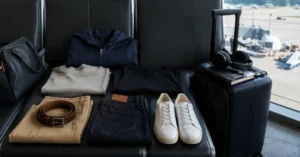
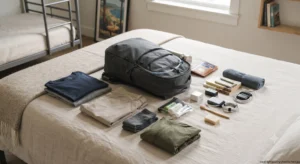
$25 (tee) + $35 (chinos) + $40 (button-up) + $50 (jeans) + $35 (sweatshirt) + $20 (second tee) + $30 (second sweatshirt) = $235 total (under $250).
Frequently Asked Questions About Dressing Well on a Budget
Can you dress well on a budget without looking cheap?
Yes. Focus on fabric quality (100% cotton or high-quality blends), exact fit (not size), seam construction, and proper care. Budget brands like Uniqlo, Gap, and Target’s Goodfellow & Co. offer $18–$45 items that look expensive when you avoid thin fabric, oversized fits, and wrong washing.
What fabric looks most expensive on a budget?
100% cotton (poplin, chino, French terry), 12oz+ denim, and wool blends. Avoid 100% polyester or thin 180gsm cotton. Look for 200–300gsm weight on t-shirts and sweatshirts — heavier fabric drapes better and doesn’t show underwear.
What’s the cheapest clothing tier that still looks good?
$15–$35 per item if you pick 100% cotton, 200gsm+ fabric, and exact fit. Uniqlo Supima Cotton T ($25), Goodfellow & Co. Chinos ($35), and Gap Icon Cotton Tee ($18) are proven budget items that don’t look cheap.
How do I stop budget clothes from looking wrinkled?
Wash cold, hang dry, and iron while damp. Choose cotton blends with 2% stretch (resists wrinkles). Avoid 100% thin polyester. A $20 travel steamer fixes most wrinkles in 5 minutes. Care matters more than price.
Should I buy cheap trends or expensive basics?
Always expensive basics. Build a capsule of 7–10 core items (tees, chinos, button-ups, jeans) in neutral colors. Spend $35–$70 on basics, $15–$25 on trends. Basics get 80% of your wear; trends expire in 6 months.
Continue Exploring
- The complete checklist for buying clothing that lasts — fabric, seams, hardware, and try-on tests
This deepens your buying knowledge with the exact store checklist I use. - How to build a 10-item capsule wardrobe for under $300 — colors, items, and brands