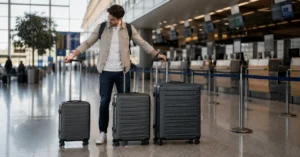
An effective travel packing list must limit your gear to what you can carry comfortably by yourself for 20 minutes on a steep incline. A bad checklist turns you into a walking logistics nightmare, paying extra fees at the gate and dragging a 25-kilogram trunk over old cobblestones.
This master guide delivers an exact, tested breakdown of what to pack for travel based on real miles, sharp weight realities, and zero fluff. If you follow this system, you will fit everything needed into a single carry-on bag, keep your transit fluid, and stop wasting cash on premium baggage allowances.
The Master Travel Packing Weight & Item Allocation
This baseline framework shows exactly how to distribute your weight inside a standard 40-liter carry-on bag. If your clothing pile exceeds these limits, you are overpacking.
| Gear Category | Target Weight | Item Count Maximum | Core Function | Verdict |
| The Base Apparel | 3.5 kg | 5 Tops / 3 Bottoms / 6 Undergarments | 5-day rotational capsule wardrobe | Non-negotiable. Wash clothes on day 6. |
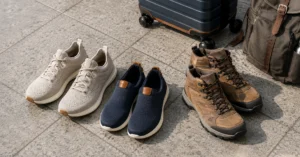
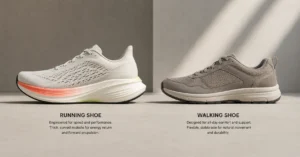
| Footwear | 1.2 kg | 2 Pairs total (1 worn, 1 packed) | 1 multi-mile walking shoe, 1 casual option | Pack the lighter pair; wear the heavy one. |
| The Tech Kit | 1.8 kg | 1 Laptop or Tablet / 1 Phone / Cables / Power bank | Mobile office and power management | Keep in an easily accessible tech pouch. |
| Toiletries & Liquids | 0.8 kg | 1 TSA-compliant 1L transparent pouch | 100ml liquid limits maxed for basic hygiene | Use solid bars where possible to cut liquids. |
| Logistics & Paperwork | 0.2 kg | Passport, hard copies, pen, local currency | Emergency access backups | Keep on your person or in the bag’s top pocket. |
What This Master Checklist Rewards — And What It Punishes If You Arrive Overpacked
Your travel packing list functions as your operational insurance policy. This system rewards total physical mobility and speed, allowing you to walk straight out of the airport terminal while others wait 45 minutes at the baggage carousel. It punishes the desire to prepare for every abstract “what-if” scenario by forcing you to drag useless weight through transit links.
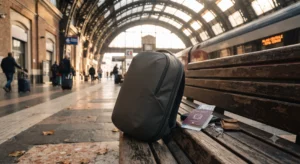
On a wet Tuesday night at 11pm in the Edinburgh Waverley station, nobody cares if you have a third backup cocktail dress. You will care deeply that your rolling bag weighs 22 kilograms as you haul it up three flights of concrete stairs to your flat. The reality of travel is that 80 percent of your comfort comes from 20 percent of your gear.
If you fail to prune your apparel down to a strict 5-day rotation before leaving home, you are choosing to pay an average of $60 per flight in check-in fees (2025–2026 rates — verify before travel) just to carry dirty shirts across continents.
The core principle of a functional packing checklist travel system is modularity. You do not change your bag or your core electronics when transitioning from an urban weekend in Tokyo to a beach trip in Costa Rica. You simply swap the internal apparel modules while keeping the base weight completely unchanged.
The Base Blueprint: What to Pack for Travel on Every Single Trip
Every functional travel packing list starts with an unalterable core of high-utility items. You must pack these specific elements regardless of your destination, weather forecast, or trip length.
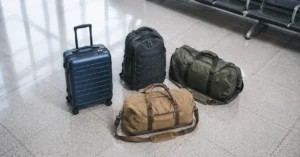
- The Core Luggage: A maximum 40-liter travel backpack or an international-sized hardshell roller measuring no more than 55 x 35 x 23 centimeters.
- The Power System: One 10,000mAh external power bank with Power Delivery (PD), paired with one universal international wall adapter featuring at least two USB-C ports.
- The Currency Architecture: A dedicated travel wallet containing two fee-free debit cards and approximately $100 in crisp, local physical currency for cash-only transport nodes.
When card terminals abroad offer to process transactions in your home currency instead of the local currency, always select the local currency. This trick is called Dynamic Currency Conversion (DCC). It sounds like a helpful service, but it actually forces a hidden, terrible exchange rate that adds an extra 3% to 8% to your bill every single time you press accept.
It is an legal scam run by foreign merchant terminals to skim margin from unsuspecting visitors. Always decline the conversion on the screen. Pay in the local currency of the country you are standing in, and let your dedicated travel card handle the mid-market rate swap internally.
How Your Gear Setup Shifts Between Concrete Cities and Wild Terrain
Your gear list must pivot drastically based on infrastructure quality and local payment systems. Urban environments demand sleek profiles and digital security, while rural destinations require physical ruggedness and analog survival backups.
[Urban Destinations] ──► Needs: Tap-to-pay, RFID blocking, minimalist profile, hardshell rollers.
[Rural Destinations] ──► Needs: Physical cash storage, water-resistant nylon backpacks, heavy-duty walking treads.
In highly urbanized zones like Central Tokyo or Manhattan, your primary challenges are tight spaces and crowds. A hardshell spinner suitcase functions beautifully on smooth train station floors but fails completely on the unpaved paths of rural Southeast Asia. For city travel, prioritize a lightweight daypack that fits flat against your chest in packed subway cars to deter pickpockets.
When you step into cash-dominant regions or terrain with poor infrastructure — such as the small islands of Indonesia or remote mountain villages in Peru — your packing checklist travel requirements change. You must swap the rolling bag for a durable, front-loading backpack with padded hip belts.
Cobblestones, mud, and broken stairs will destroy plastic spinner wheels in under ten minutes of continuous walking. In these zones, cash still dominates daily life; you need a secondary cash pouch hidden away from your main wallet to hold larger sums of local bills securely.
Five Discrete Steps to Packing Your Carry-On Suitcase Efficiently
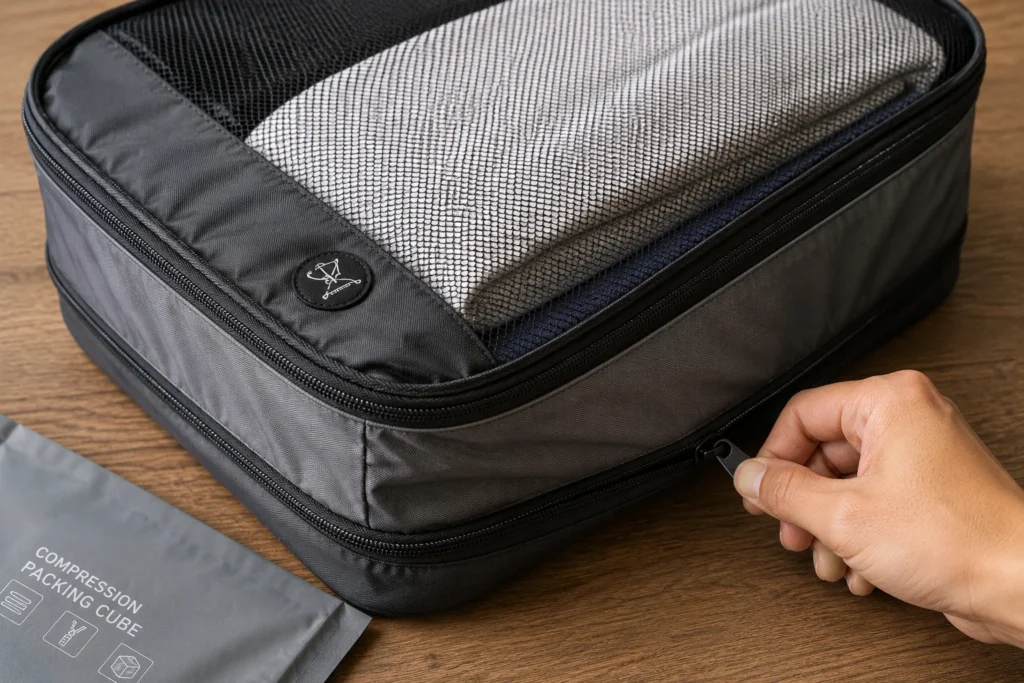
This procedure ensures your bag fits international carry-on dimensions and remains perfectly organized throughout your journey. Follow these chronological actions to maximize internal volume.
1.Lay out all planned items on a flat surface:5 min.
Place every garment, electronic device, and toiletry container onto a flat bed or table before anything goes inside the bag to audit total volume visually.
2.Apply the rule of halves to your clothing pile:3 min.
Physically remove exactly half of the shirts, trousers, and extra layers you initially selected, leaving a strict maximum of five tops and three bottoms.
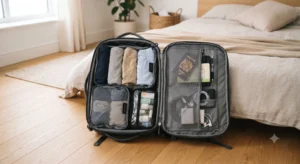
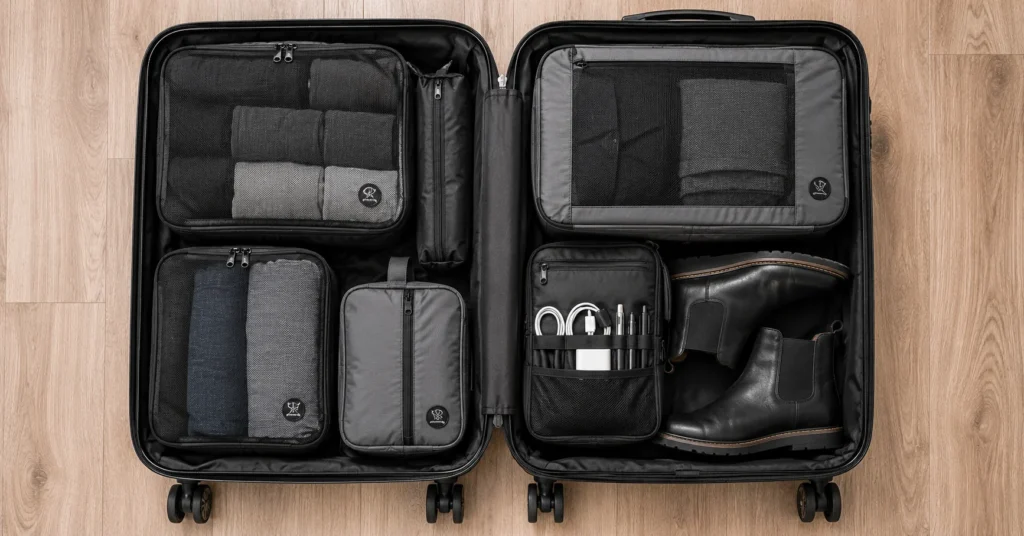
3.Group your remaining clothes into mesh compression cubes:5 min.
Roll soft knit fabrics like t-shirts and underwear tightly, fold structured garments flat, place them into individual packing cubes, and zip the compression tracks.
4.Pack your heaviest footwear and tech gear near the wheels:4 min.
Position your packed secondary shoes, heavy chargers, and dense utility items at the very base of the suitcase to maintain a low center of gravity.
5.Slide your liquid toiletry bag into the top external pocket:3 min.
Place your clear, TSA-compliant 1-liter liquids pouch into the quickest-access pocket of your luggage so you can remove it at security in under five seconds.
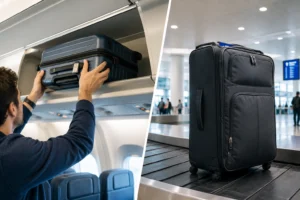
Keep your packed suitcase weight below 7 kilograms if you plan to fly on ultra-low-cost European or Asian carriers. Airlines like Ryanair and AirAsia regularly weigh carry-on luggage at the boarding gate and will charge up to $70 on the spot if you exceed their limits.
What to Remove from Your Suitcase Right Now to Save Space and Weight
You must remove heavy cotton bath towels, full-sized liquid bottles, and multiple pairs of denim jeans from your travel packing list immediately. These items represent dead weight that can be easily replaced by lighter alternatives or acquired cheaply at your destination.
- Full-Sized Toiletries: Leave the 300ml shampoo bottles at home. They will be confiscated at airport security checkpoints globally due to standard liquid restrictions. Use solid shampoo bars or buy small liquids when you arrive.
- Heavy Cotton Hoodies: A single thick fleece or cotton sweatshirt consumes nearly 25 percent of a standard carry-on’s internal volume. Swap it for an ultra-light packable down jacket that compresses into the size of a soda can.
- More Than One Book: Physical novels are heavy, unyielding blocks of paper. Bring a single e-reader or utilize your smartphone screen instead to save up to two kilograms of weight.
If you are looking for deep strategies on how to organize these components into your broader itinerary, check our comprehensive map on how to use our trip planning tools to systematize your pre-trip routine from finances to gear selection.
Frequently Asked Questions About Travel Packing Lists
How do I make a travel packing list that prevents overpacking?
Build your checklist around a strict 5-day clothing rotation, regardless of a trip’s length. Plan to wash clothes on day six using local laundromats or hotel sinks. This cap keeps your gear within a 40-liter carry-on limit and prevents the physical burden of hauling excess luggage.
What is the best way to compress clothes for travel?
Use double-zipper mesh compression cubes rather than vacuum bags. Roll your soft knit items like t-shirts and undergarments, fold structured items like button-downs, and zip the outer ring of the cube to mechanically expel excess air without needing a vacuum pump.
Should I roll or fold my clothes when packing a suitcase?
Use both methods tactically based on the fabric. Roll synthetic fabrics, t-shirts, jeans, and socks to eliminate empty air pockets. Fold linen shirts, structured blazers, and heavy cotton trousers flat along the top of your packing cubes to minimize severe fabric wrinkling.
Continue Exploring
- travel planning guide — Read our core blueprint to master booking windows, budget tracking, and early transit coordination before your bag is even zipped.
- what to pack for travel — Bookmark this exact layout to use as a live, interactive reference line the next time you clear out your closet for a trip.