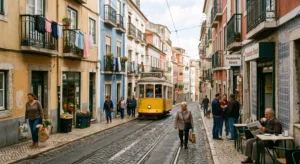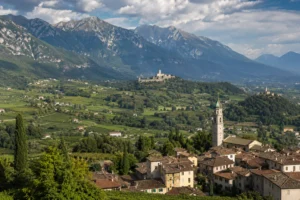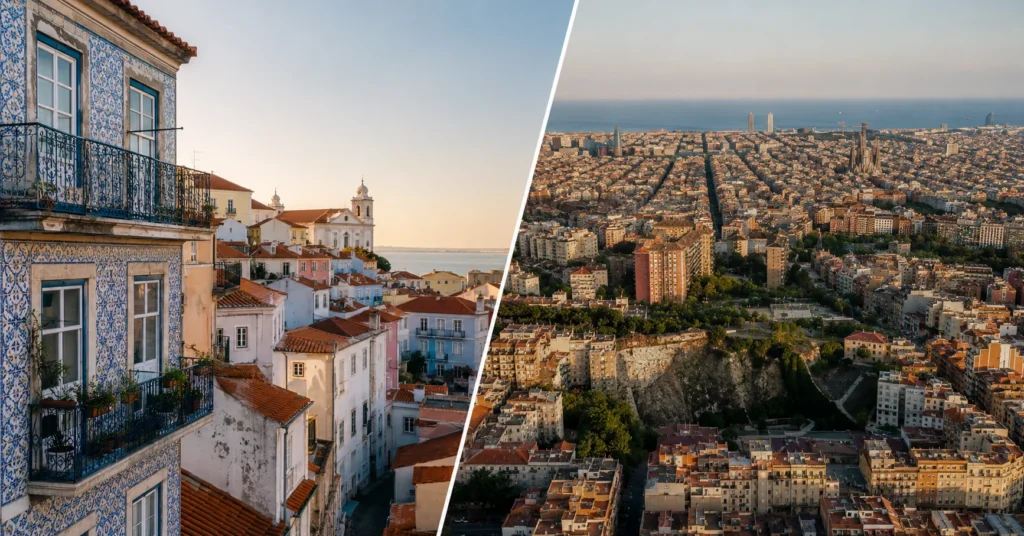
countries get the same question from first-time visitors to Iberia: which one? The honest answer is that they’re different enough that “which is better” is the wrong frame — and similar enough in geography that most people can only afford to pick one. This post exists to make that choice easier. Not by declaring a winner, but by matching each country to the traveller it actually suits.
One caveat first. Portugal and Spain share a peninsula. They do not share a price point, a pace, a food culture, or a travel style. Treating them as interchangeable — smaller Spain vs larger Portugal — is how people end up disappointed by the one they chose. Here’s the actual comparison.
Quick Verdict: Which Country Wins — and for Whom
Portugal wins for: first-timers who want a contained, coherent, affordable trip with genuine depth in a small footprint. Seven to ten days, two cities, no overwhelm.
Spain wins for: first-timers who want range — multiple climates, distinct regional cultures, Baroque and Moorish architecture, and the kind of variety that requires at least twelve days to do honestly.
Neither is the wrong answer. But they suit different trips, different budgets, and different types of travellers. The rest of this post explains precisely which type you are.
What Each Country Actually Is (Before You Pick One)
Portugal is compact — roughly the size of Indiana — and structured around two cities worth your serious time: Lisbon and Porto. Lisbon is hilly, melancholy in the best way, with tiled facades and a food scene that’s genuinely evolved beyond bacalhau.
Porto is smaller, rougher around the edges, and earns its reputation for being the more honest version of the two. The Algarve exists if you want a beach week, but it’s a different trip entirely — sun and sand, not culture.
Spain is a continent in a country. Andalucía (Seville, Granada, Córdoba) has almost nothing in common with Catalonia (Barcelona), which has almost nothing in common with Castile (Madrid), which has almost nothing in common with the Basque Country (San Sebastián).
The food is regional. The architecture is regional. The language, in parts, is regional. A single week in Spain means picking one of those worlds, not experiencing the whole thing.
The Differences That Change the Decision
| Factor | Portugal | Spain |
|---|---|---|
| Daily cost (mid-range) | $90–$120/day | $130–$160/day (cities) |
| Trip length needed | 7–10 days for a complete trip | 12–14 days minimum for real range |
| English widely spoken | Yes — Lisbon and Porto especially | Variable — stronger in Barcelona and Madrid |
| Crowd pressure | Moderate (Sintra is a genuine problem in July) | High in Barcelona and peak Andalucía |
| Regional diversity | Low — two distinct cities, similar culture | Very high — effectively multiple countries |
| Food culture depth | Strong — distinct from Spain, underrated | Exceptional — and radically different by region |
| Rail network quality | Limited between cities | Excellent — AVE high-speed covers most routes |
| Best shoulder months | March–April, October | April–May, September–October |
Four differences matter most. Cost: Portugal runs roughly 25% cheaper across accommodation, food, and transport. Size: Portugal can be done well in a week; Spain can’t. Rail: Spain’s AVE high-speed network is one of the best in Europe and makes multi-city travel genuinely fast — Portugal’s inter-city rail is slower and less frequent. Diversity: if regional contrast is the point of the trip, Spain isn’t the better choice, it’s the only choice.
Choose Portugal If You Are This Traveller
You have seven to ten days. You want to arrive, settle into two cities, eat well without budgeting like you’re in Paris, and leave with a genuine sense of having understood a place rather than processed it. You’d rather walk Alfama before 9am when the streets are quiet and the neighbourhood belongs to the people who live there, than spend the same morning queuing into a museum.
Portugal suits people who want coherence. The country has a specific atmosphere — unhurried, honest, faintly melancholic without being gloomy — and that atmosphere stays consistent from Lisbon’s Mouraria to Porto’s Ribeira. You’re not being asked to recalibrate every time you cross a regional border.
Porto, specifically, is the better first city. It’s smaller, less polished for tourist consumption, and the food costs less with no corresponding drop in quality. A francesinha at Café Santiago costs around €13 and will reorganise your understanding of what a sandwich can be. Plan Porto first, then Lisbon. The order matters — ending in Lisbon gives you the more dynamic city as the trip’s final impression.
The honest negative: Sintra in July is not the experience most people expect. The queues for Pena Palace run 45 minutes or longer, the village is dense with day-trippers, and the narrow roads fill up by 10am. Go in March or November, on a weekday, before 9am. It’s a completely different visit. For our full breakdown on planning Portugal, the Portugal travel guide covers every region, every cost tier, and when to go by month.
Choose Spain If You Are This Traveller
You have twelve days or more. You want contrast — Moorish architecture in Granada, pintxos in San Sebastián’s Parte Vieja at 7pm, the Prado on a Tuesday morning before the tour groups arrive. You’re willing to do more research because the reward is a trip with genuine range. You’re fine spending more per day because Spain’s mid-range is still honest value relative to Paris or Amsterdam.
Spain suits people who want to earn their trip. The country is generous with the prepared traveller and punishing with the unprepared one. Booking the Alhambra in Granada without advance notice — at least six to eight weeks ahead in peak season — means you don’t see the Alhambra. That’s not an exaggeration. The tickets sell out. Showing up on the day does not work.
Barcelona and Madrid are both worth serious time, but they’re not the same city and they shouldn’t be treated as Spain’s interchangeable “main cities.” Barcelona is coastal, Catalan, architecturally extraordinary with Gaudí’s work, and very crowded in the Gothic Quarter in summer. Madrid is inland, drier, and built around a world-class art triangle — Prado, Reina Sofía, Thyssen-Bornemisza — that takes two or three full days to do properly. Pick one as your base and day-trip from it, rather than trying to do both in three days each.
For a complete regional breakdown, the Spain travel guide covers how to build a first trip around one region done well versus trying to cover the whole country and seeing none of it properly.
Portugal vs Spain Cost Comparison: What a Week Actually Costs
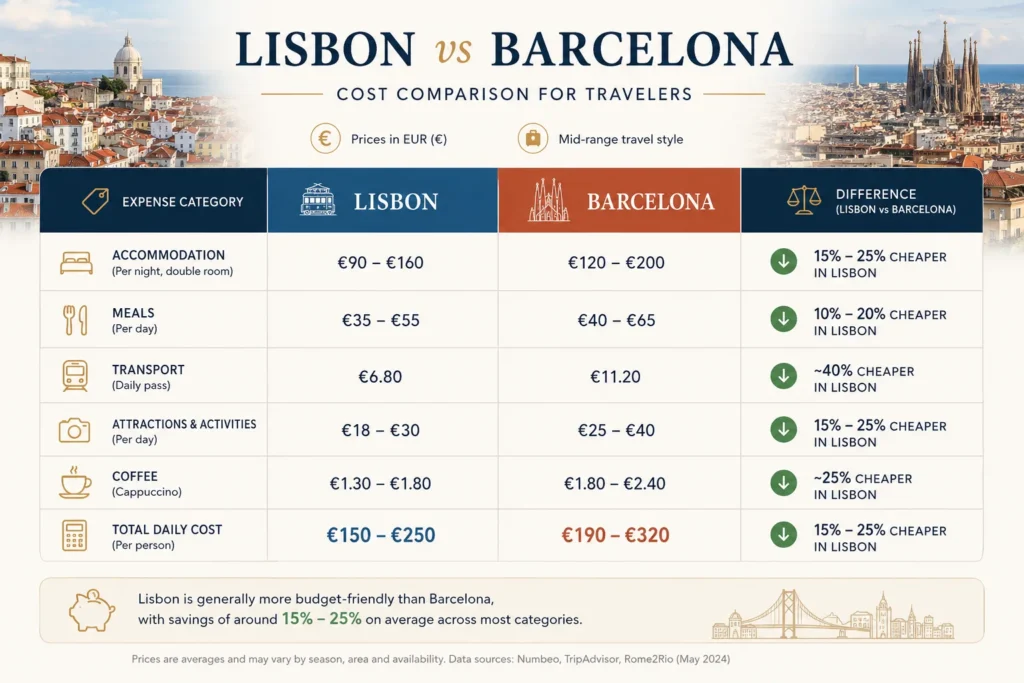
These are real daily totals, not aspirational minimums. Based on a solo traveller, mid-range, with accommodation in the main cities.
| Tier | Portugal (7 days) | Spain (7 days) |
|---|---|---|
| Budget | $600–$700 total | $800–$950 total |
| Mid-range | $900–$1,100 total | $1,200–$1,500 total |
| Worth-the-splurge | $1,500–$2,000 total | $2,000–$2,800 total |
The gap at mid-range is real: roughly $300–$400 per person per week. That’s a meaningful difference for a two-week trip shared between a couple. Where the money goes: accommodation in Lisbon runs €80–€130/night for a solid mid-range hotel; equivalent quality in Barcelona runs €130–€200/night.
Food is where Portugal’s advantage compounds — a full dinner with wine in Porto’s Ribeira costs €20–€30 per person. The same quality meal in Madrid’s Centro runs €35–€50.
Final Recommendation: A Direct Answer, No Equivocation
First trip to Iberia, seven to ten days: go to Portugal. It’s cheaper, more manageable, and rewards the traveller who goes slowly in a way Spain can’t when you’re trying to cover it quickly.
First trip to Iberia, twelve or more days, with a tolerance for more planning: go to Spain. Pick one region — Andalucía or the combination of Madrid and Barcelona — and do it properly rather than trying to see everything.
Doing both: genuinely feasible over two weeks. Lisbon to Seville by Flixbus or ALSA takes around 3.5 hours and costs €15–35. That’s a real, practical opening to seeing both countries without flying between them. Build the itinerary around that crossing rather than treating the two countries as separate trips bolted together.
The one thing not worth debating: don’t try to do both countries in seven days. You’ll see the surface of each and understand neither.
Frequently Asked Questions About Portugal vs Spain
Is Portugal cheaper than Spain?
Yes, by roughly 20–30% at comparable quality levels. Lisbon and Porto average $90–$120/day mid-range. Madrid and Barcelona run $130–$160/day. The gap narrows in Spain’s smaller cities — Seville and Valencia are closer to Portuguese price levels than to Barcelona’s. (2025–2026 rates — verify before travel)
Which is better for first-time visitors — Portugal or Spain?
It depends on time available, not preference. Portugal is smaller, easier to navigate, and cheaper. Spain has more variety across architecture, landscape, and food cultures, but requires more planning to see that variety honestly. Seven to ten days: Portugal. Twelve or more days: Spain.
Can you visit both Portugal and Spain in one trip?
Yes. Lisbon to Seville by bus takes roughly 3.5 hours with Flixbus or ALSA and costs €15–35. Lisbon to Madrid is a 2.5-hour flight or a 9-hour overnight bus. Two weeks across Lisbon, Porto, Seville, and Madrid is realistic and well-paced. (2025–2026 rates — verify before travel)
Is Spain more crowded than Portugal?
In absolute terms, yes — Spain receives roughly 85 million tourists annually, Portugal around 30 million. That said, Portugal isn’t uniformly quiet in peak season. Sintra in July is genuinely crowded, and Lisbon’s Alfama fills up fast. The difference is that in Portugal the crowds concentrate in fewer places, which makes them easier to avoid.
Continue Exploring
- Portugal travel guide — Every region, every cost tier, and the exact months that make the difference between Portugal at its best and Portugal at its most overrun.
- Spain travel guide — How to build a first trip around one Spanish region done properly, rather than five done badly.