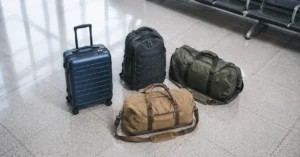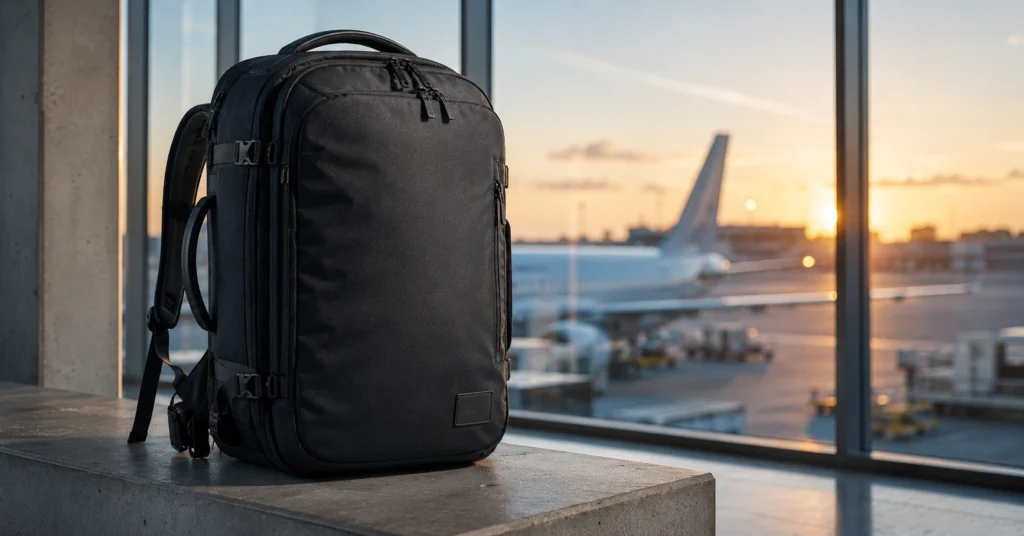
Buying the wrong travel bag is an expensive mistake that forces you to choose between paying unexpected budget-airline gate fees or visiting a chiropractor halfway through your trip. If your goal is to fit everything into a single overhead bin and avoid the baggage carousel entirely, the best travel backpack is one that matches your specific packing style rather than the one with the highest online rating.
For absolute carrying comfort on long walking routes, individual frame sheets make the Osprey Farpoint 40 the safest purchase, while digital nomads requiring heavy tech compartmentalization will find the premium Aer Travel Pack 3 or Peak Design 45L worth the extra investment.
| Tool / Option | Cost | Best For | Limitation | Who Should Use It |
| Osprey Farpoint 40 | ¥29,000 / $200 | Long-distance walking and heavy weight distribution | Sparse internal tech pocketing | Budgets under $200 and travelers prioritizing physical back support |
| Aer Travel Pack 3 | ¥36,000 / $249 | Dedicated tech organization and urban commuting | Lacks an integrated hip belt out of the box | Digital nomads carrying multiple devices and chargers |
| Peak Design Travel 45L | ¥43,500 / $300 | Modular packing cubes and camera gear protection | Heavy empty weight (4.5 lbs) before packing | Organized packers willing to pay a premium for build quality |
Introduction: The One-Bag Reality You Only Learn at the Gate
The best travel backpack does not look like a hiking pack, nor does it look like a bloated school bag. It is a purpose-built piece of carry-on engineering designed to maximize the strict 55 x 35 x 23 cm dimensions imposed by international airlines. A proper travel pack functions like a soft-sided suitcase on your spine, allowing you to walk straight past the 45-minute airport check-in queues and slip onto local transit without banging a roller bag over cobblestones.
Choosing between these top options comes down to an honest assessment of how much weight your body can comfortably carry. On my first major cross-border trip through Southeast Asia, I carried a cheap, frameless pack stuffed with 12 kilos of gear. By hour two of navigating the concrete walkways of Bangkok’s rail system, the shoulder straps had cut off the circulation to my fingers.
That painful lesson proved that sophisticated fabrics mean nothing if the bag lacks a rigid internal suspension system to transfer the load directly onto your hips.
Quick Overview: The True Math Behind Carry-On Volumes
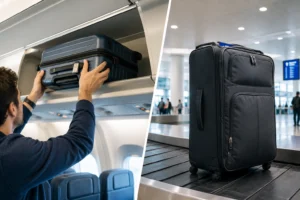
A standard 35L to 45L travel backpack gives you exactly enough space to pack for an indefinite trip if you adhere to a strict modular washing cycle. The math: a 40-liter bag comfortably holds one large packing cube for clothing, one medium cube for layers, a dedicated toiletry kit, and your laptop setup. Anything larger than 45 liters will automatically violate the overhead bin limits of low-cost regional carriers like Ryanair, AirAsia, or Jetstar, subjecting you to instant $70 gate-checking fines (2025–2026 rates — verify before travel).
The real trade-off between the industry giants lies in the empty weight of the bags themselves. The Peak Design 45L tips the scales at a hefty 4.5 pounds when completely empty, which immediately eats up a massive portion of the standard 15-pound (7 kg) carry-on limit enforced by strict Asian and European airlines. In contrast, the Osprey Farpoint 40 enters the ring at 3.3 pounds, handing you an extra pound of actual gear capacity before you even zip it closed.
Top Things to Do: How to Test and Load a Clamshell Pack
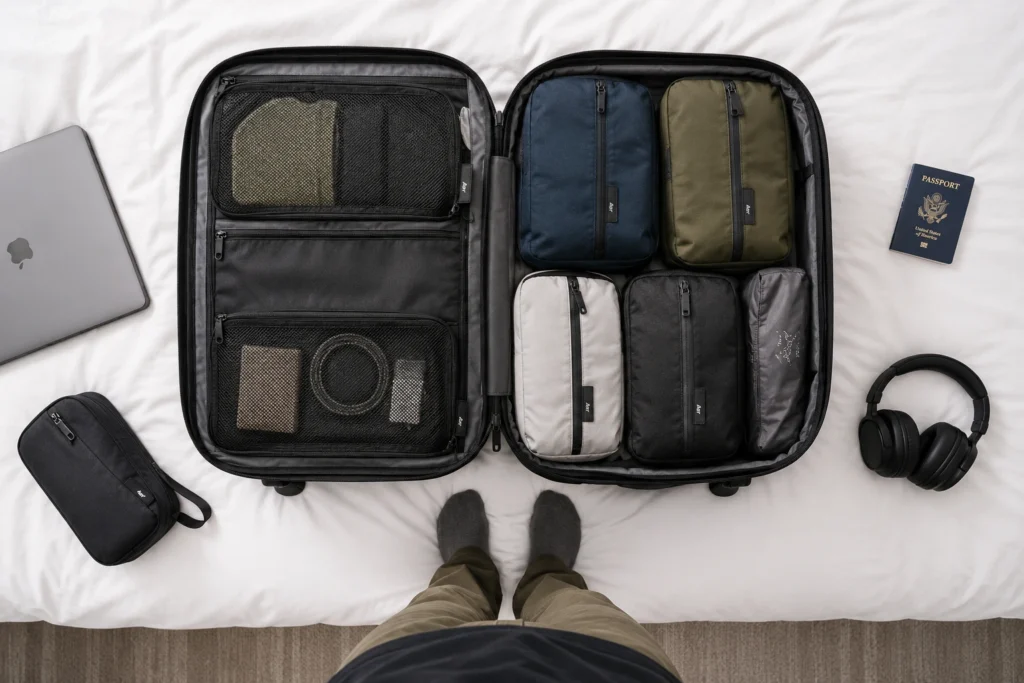
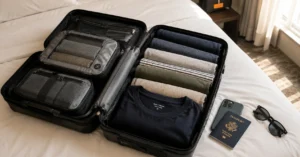
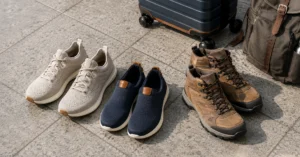
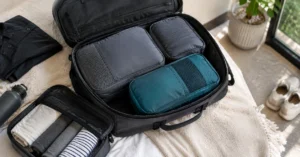
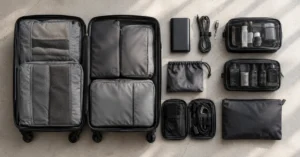
Loading your travel pack correctly requires a full clamshell opening that lays completely flat on a bed like an open book. Avoid top-loading rucksacks entirely; they force you to excavate your entire wardrobe just to retrieve a fresh pair of socks at the bottom of the main compartment. When setting up a new pack, place your heaviest items—like an extra pair of shoes or your tech pouch—in the dead center of the bag, pulled tight against the back panel.
[Visual Guide: Ideal Weight Distribution]
+------------------------------------+
|   Light Items (Jacket, Rain Shell) | -> Top of Bag
+------------------------------------+
|   HEAVY ITEMS (Shoes, Tech Pouch)  | -> Center (Flushed to Spine)
+------------------------------------+
|   Medium Items (Packing Cubes)     | -> Bottom of Bag
+------------------------------------+
The compression straps must be cranked down to their absolute limits once the bag is packed. This is not just about making the bag look smaller; it pulls the center of gravity closer to your shoulder blades, preventing the pack from pulling you backward as you walk. On a rainy morning sprint across Tokyo Station to catch an express train, a loose, uncompressed pack will swing erratically, ruining your balance on wet tiles.
Where to Stay: Where to Store Your Straps to Avoid Damage
The suspension harness of your backpack must be fully stowable behind a zippered panel if you are ever forced to check the bag. Airplane baggage carousels and cargo holds are intentionally hostile environments for loose fabric. A single exposed shoulder strap or dangling hip belt buckle can easily get snagged in the industrial sorting tracks, resulting in a ripped harness or a shattered plastic clip that destroys the utility of the bag for the rest of your trip.
Osprey handles this brilliantly with a dedicated zip-away fabric flap that encapsulates the entire backpack harness in under 15 seconds. The Aer Travel Pack 3 uses a different approach, allowing you to tuck the shoulder straps flat into the back cushion, though it lacks a full protective barrier.
If you are using your pack as an everyday commuter bag from a fixed hostel or hotel base, keeping the straps deployed is fine, but the moment you step up to an airplane gate or a long-distance bus cargo hold, pack the harness away cleanly.
Getting Around: Weight Distribution and the Hip Belt Imperative
A load-bearing hip belt is an absolute requirement for any travel pack loaded beyond 15 pounds. The human shoulders were never designed to support 20 pounds of gear for hours at a time; your pelvis should bear roughly 80 percent of that weight. The Osprey Farpoint features a thick, highly padded hip belt attached directly to a perimeter LightWire alloy frame that channels the weight downward into your lower body effortlessly.
Weight Distribution Reality:
Osprey Farpoint:   [20% Shoulders] <=====> [80% Hips via Alloy Frame]
Aer Travel Pack 3: [50% Shoulders] <=====> [50% Hips (Belt Sold Separately)]
The Aer Travel Pack 3 charges you an additional fee to buy a removable hip belt separately, which is a frustrating compromise for a bag that costs $249 out of the gate. Without that belt installed, a fully packed Aer relies entirely on your upper back and shoulders. If your itinerary involves walking less than twenty minutes from a European train station straight to your room, you can survive without it, but any walking tour or transit delay will quickly make you regret the omission.
Budget Guide: Real World Costs of the One-Bag Investment
Investing in a premium travel backpack requires a high upfront financial outlay that pays for itself by eliminating checked baggage fees over time. Checked luggage fees on a single transatlantic return flight routinely run between $75 and $150, meaning a solid carry-on pack can break even after just two flights. Do not purchase cheap knockoff packs online; the primary failure point is almost always the zippers, and a burst main zipper at a crowded terminal lounge is a nightmare that cannot be easily fixed with duct tape.
Look specifically for heavy-duty YKK #10 RC zippers and water-resistant external coatings like 1680D Cordura ballistic nylon or X-Pac fabrics. These industrial-grade materials can be dragged across airport asphalt or shoved beneath chicken-bus seats without showing a single fray. The replacement warranty should also factor into your budget calculations; Osprey’s “All Mighty Guarantee” covers functional damage to the pack for its entire lifetime, completely free of charge.
Sample Itinerary: Packing the Perfect 7-Day Clothing Matrix
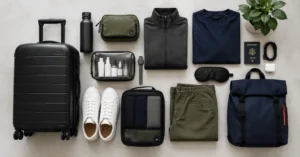
Packing light requires abandoning the “just in case” mindset and embracing a rigid, repeating modular gear matrix. You do not need seven distinct shirts and seven pairs of heavy trousers for a week-long journey. Instead, you pack for a rolling three-day cycle: one outfit on your body, one drying on a line, and one clean outfit folded flat inside your main packing cube.
The Standard TravelDiaryy Pack Matrix:
┌───────────────────────────┬───────────────────────────┐
│ Clothing Layer            │ Quantity & Material       │
├─────────────────────────  ┼───────────────────────────┤
│ Merino Wool T-Shirts      │ 3x (Odor resistant)       │
│ Travel Trousers / Shorts  │ 2x (Synthetic nylon)      │
│ Moisture-Wicking Socks    │ 4x (Blister protection)   │
│ Packable Rain Shell       │ 1x (Gore-Tex / Pertex)    │
└───────────────────────────┴───────────────────────────┘
Avoid bringing heavy denim or thick cotton sweatshirts because they take up massive amounts of physical volume and take over 24 hours to air-dry inside a poorly ventilated hotel bathroom. Stick to synthetic nylon blends or lightweight merino wool that can be quickly washed in a bathroom sink using local bar soap and hung up to dry completely before your morning checkout.
Pro Tips: The Inflexible Reality of International Transit Fees
Always decline the transaction whenever a foreign card terminal or ticket kiosk offers to bill you in your home currency instead of the local currency while buying transit tickets abroad. This deceptive process is known as Dynamic Currency Conversion (DCC), and it functions as a hidden markup system that routinely adds 3% to 8% to your final purchase price.
Whether you are paying for an entry ticket at a train counter or buying a localized daypack online, always choose to be billed in the local currency to let your own travel card handle the conversion at the true market rate.
For deeper insights into avoiding predatory financial traps and mastering your automated travel budget abroad, read our comprehensive travel planning guide to structure your finances safely before departure.
Frequently Asked Questions About Travel Backpacks
Can a 40L travel backpack fit under the seat as a personal item?
No, a fully packed 40-liter backpack will not fit underneath a standard airline seat and must be stored in the overhead bins. If you want a dedicated bag that passes as a free personal item on ultra-low-cost carriers, you must drop down to a maximum volume of 26 to 30 liters.
Why do some travel backpacks lack built-in water bottle pockets?
Sleek, urban-focused packs often omit or downsize external water bottle pockets to maintain a clean, aerodynamic silhouette that will not snag on subway doors or overhead bin edges. If you carry a wide insulated flask, look specifically for bags with expanding mesh side panels like the Osprey Farpoint.
Is a dedicated laptop compartment necessary for one-bag travel?
A dedicated, externally accessible laptop compartment is vital if you travel with electronics, as it allows you to pull your device out at airport security without opening your main clothes compartment. Ensure the sleeve features a suspended bottom layout so your laptop never hits the floor directly when you set the bag down.
Continue Exploring
- wise vs revolut the honest travel card showdown Discover which international multi-currency debit card keeps your money safe without hidden weekend conversion fees.
- the complete packing cube layout system Learn the exact step-by-step rolling method to compress a full winter wardrobe into a single 35L carry-on footprint.