The first time I packed a “serious” travel medical kit, it weighed almost 1.4kg. I carried trauma shears through Portugal, a triangular bandage through Vietnam, and enough gauze to run a small clinic in Lisbon. What I actually used over six weeks: two ibuprofen, one blister patch, and rehydration salts after a questionable shrimp skewer in Bangkok.
That’s the problem with most travel first aid advice. It prepares you for a wilderness rescue instead of the things that actually happen on normal trips — blisters, stomach issues, headaches, minor cuts, motion sickness, and the cold you pick up three flights into a long itinerary.
The best travel first aid kit is the one that survives your packing cuts. Small enough to stay in your bag. Complete enough to solve real problems. And organised enough that you can find paracetamol at 2am without emptying your backpack onto an airport floor in Doha.
Quick Verdict: Which Travel First Aid Kit Makes Sense for Your Trip?
| Product | Price | Best For | Key Limitation | Verdict |
|---|---|---|---|---|
| Adventure Medical Kits Ultralight .7 | $34.99 (2025–2026 pricing — verify before purchase) | Carry-on travellers doing 1–3 week trips | Weak medication section | Best overall balance |
| MyMedic MyFAK Mini | $79.95 (2025–2026 pricing — verify before purchase) | Road trips, remote hiking, adventure travel | Heavy for flights | Best for remote destinations |
| Surviveware Small First Aid Kit | $59.99 (2025–2026 pricing — verify before purchase) | Families and checked-bag travel | Bulky inside small backpacks | Best organisation |
| DIY Zip Pouch Setup | $20–45 depending on contents (2025–2026 pricing — verify before purchase) | Frequent travellers who know their needs | Requires maintenance | The smartest long-term option |
If you fly with one carry-on and spend most of your trip in cities, buy smaller than your instincts tell you. Most travellers need medication management more than emergency response gear.
And honestly? The single most useful item in my kit across 40+ countries has been blister treatment. Not bandages. Not antiseptic. Compeed blister patches saved a miserable walking day in Kyoto after new shoes turned Fushimi Inari into a limp-by-step experience.
Why Most Pre-Built Travel Medical Kits Fail in Real Travel
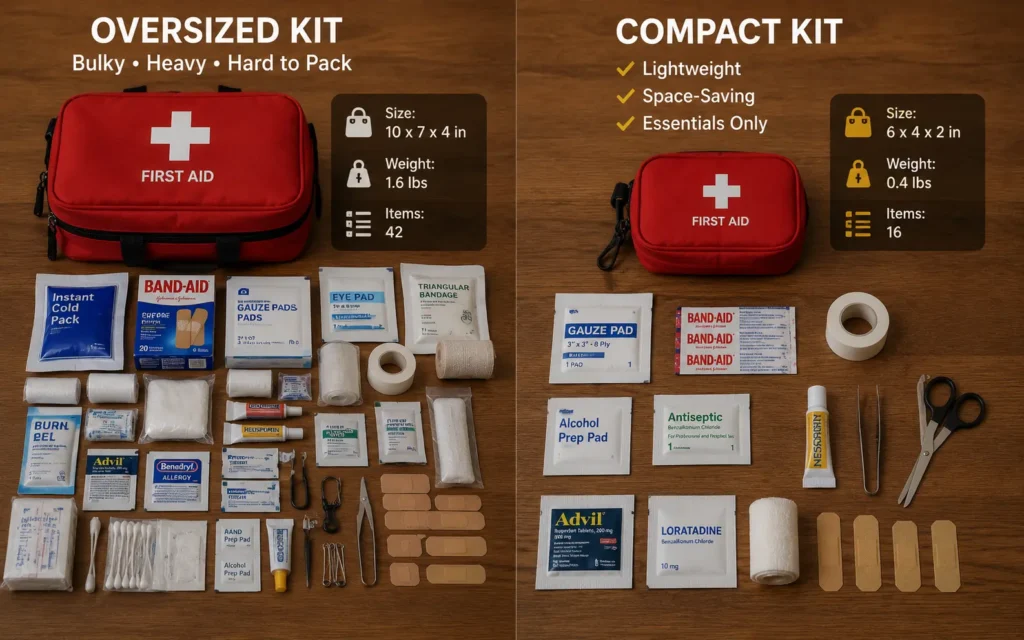
Most commercial kits are designed to look complete on a product page.
That means dozens of adhesive bandages, giant red pouches, and survival-tool extras that sound reassuring until you try fitting them into a 28-litre carry-on already holding chargers, layers, and a laptop. The worst offenders add things you’ll never realistically use in normal travel: CPR masks, emergency blankets, finger splints.
But they leave out the things people actually ask hostel reception for:
- Anti-diarrhoea tablets
- Electrolyte sachets
- Blister treatment
- Cold medication
- Motion sickness tablets
The disconnect becomes obvious around day four of a real trip. You stop packing for hypothetical disasters and start packing for friction. The headache after a red-eye. The stomach bug after street seafood. The ankle rub from walking 19,000 steps through Rome because Google Maps said “22 minutes” and forgot about hills.
A compact travel medical kit fixes inconvenience quickly. That’s the real job.
The Kits Worth Carrying — And the Ones That Waste Space
Adventure Medical Kits Ultralight .7
Price: $34.99 (2025–2026 pricing — verify before purchase)
Weight: 213g
Best for: Solo travellers doing carry-on-only trips across Europe or Asia.
This is the kit I’d hand most people without overthinking it. It disappears into a backpack organiser, survives rough handling, and includes the basics without pretending you’re crossing the Andes unsupported.
The specific feature that earns its place: the internal compartment layout actually works while moving. You can grab blister treatment or bandages without unpacking the entire pouch onto an airport bench.
Trade-off? The medication section is thin. You’ll need to add your own painkillers, anti-diarrhoea tablets, antihistamines, and anything prescription-related.
If you’re trekking remotely in Nepal or Patagonia, buy the MyMedic instead. The Ultralight .7 is built for normal travel, not isolation.
MyMedic MyFAK Mini
Price: $79.95 (2025–2026 pricing — verify before purchase)
Weight: 635g
Best for: Adventure travellers, road trips, remote hiking routes.
This thing borders on overkill for city travel. Which is exactly why it works so well once you’re somewhere genuinely inconvenient.
The trauma-focused layout makes sense in environments where help isn’t close. Compression wraps, bleeding control supplies, and proper organisation matter more when your nearest pharmacy is two hours away by boat.
The trade-off is obvious the second you pick it up. Heavy. Bulky. And frustrating inside smaller carry-ons.
I carried a larger trauma kit through Japan once because I thought “better prepared” automatically meant “better traveller.” By Osaka, I was leaving it in hotel rooms during day trips because I was tired of carrying the weight. A first aid kit you stop carrying stops being useful.
If your trip is mostly cities with reliable pharmacies, the DIY pouch beats this easily.
Surviveware Small First Aid Kit
Price: $59.99 (2025–2026 pricing — verify before purchase)
Weight: 480g
Best for: Families, checked-bag travellers, longer multi-country trips.
This is the most organised option here. Every compartment is labelled clearly enough that another person can find what they need without asking you where things are.
That matters more than people think. Especially when someone feels awful at 1am in a hotel room and you’re trying to locate antihistamines half-asleep.
Its limitation is size efficiency. The pouch shape wastes space inside smaller bags, particularly travel backpacks with curved packing layouts.
If organisation matters more than compactness, this is the better kit. If you’re flying budget airlines through Europe with strict baggage limits, it becomes annoying surprisingly quickly.
Build Your Own Pouch Instead
Price: $20–45 depending on contents (2025–2026 pricing — verify before purchase)
Weight: Usually 150–350g
Best for: Frequent travellers who already know their patterns.
This is where most experienced travellers eventually land.
Because after enough trips, you stop packing generic fears and start packing your actual problems. Mine:
- Motion sickness on mountain roads
- Blisters from heat
- Neck tension after overnight flights
- Dehydration headaches
So my pouch now contains almost no bandages and an embarrassing number of electrolyte sachets.
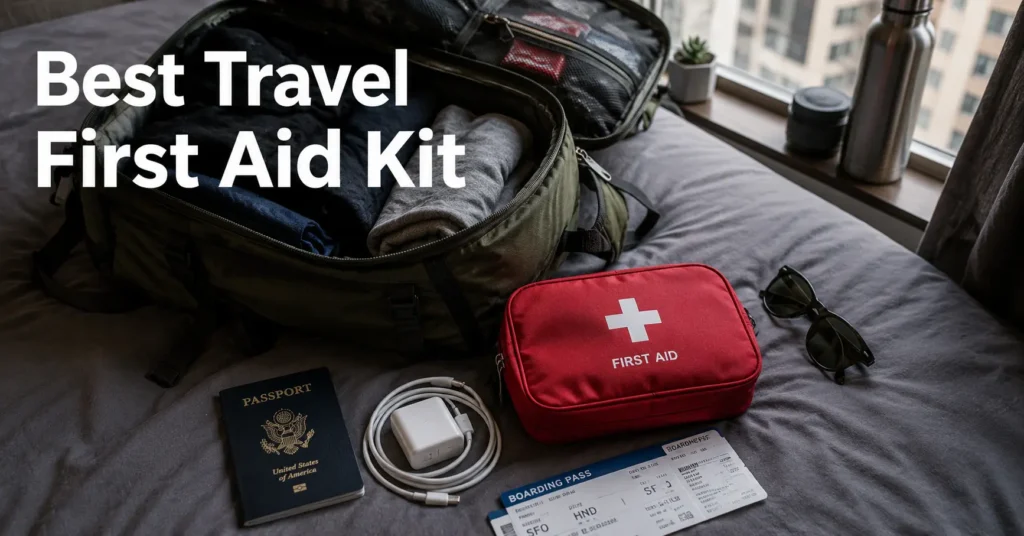
The best setup I’ve used is a small transparent zip organiser with:
- Compeed blister patches
- Ibuprofen
- Loperamide
- Electrolytes
- Antihistamines
- Alcohol wipes
- Tweezers
- Small tape roll
- Prescription medication copies
And that’s basically it.
best travel gear for carry-on travel works particularly well alongside a compact first aid setup because every unnecessary item you remove creates room for the gear you actually touch every day.
What Actually Belongs in a Travel First Aid Kit
For normal international travel, this covers 95% of situations:
| Item | Why It Matters | Approx Weight |
|---|---|---|
| Blister patches | Walking damage is constant | 18g |
| Ibuprofen/paracetamol | Flights, headaches, muscle pain | 25g |
| Anti-diarrhoea tablets | Self-explanatory after certain food markets | 12g |
| Electrolyte sachets | Dehydration recovery | 30g |
| Antihistamines | Allergies and bites | 10g |
| Alcohol wipes | Minor cuts and cleaning | 15g |
| Small bandages | Actual small injuries | 22g |
| Tweezers | Splinters, ticks, glass | 17g |
Total useful weight: roughly 150–220g.
That’s the number most travellers should pay attention to. Not how “complete” the kit looks online.
The One Mistake Almost Everyone Makes With First Aid for Travel
People pack for emergencies they statistically won’t face and ignore the problems guaranteed to happen.
You are dramatically more likely to need:
- Electrolytes after food poisoning
- Pain relief after a 13-hour flight
- Blister care after walking 24,000 steps in Tokyo
Than you are to need trauma shears.
And pharmacies exist almost everywhere. Even in places people describe dramatically online. I replaced half my travel medication kit in Hanoi in under 17 minutes after leaving mine in Da Nang. The pharmacy staff translated dosage instructions through Google Translate, labelled everything clearly, and charged less than €9 total.
The exception is remote travel. Patagonia. Multi-day trekking routes. Certain safari circuits. Islands with limited medical infrastructure. That’s where larger kits start making sense.
City travel is different.
Which Kit Fits Your Travel Style?
Choose the Adventure Medical kit if:
- You travel carry-on only
- You mostly stay in cities
- You want low weight and simplicity
Choose the MyMedic if:
- You hike remotely
- You road-trip often
- Medical help won’t be nearby
Choose Surviveware if:
- You’re travelling with kids
- Organisation matters more than weight
- You check luggage regularly
Build your own if:
- You travel multiple times a year
- You already know your patterns
- You hate carrying unused gear
The strongest setup for most people is honestly hybrid: buy a small pre-built kit once, remove half the contents, then customise from there.
Cost Comparison: Real Prices vs Real Utility
| Setup | Typical Cost | What Changes | Worth It? |
|---|---|---|---|
| Cheap Amazon kit | $12–20 | Mostly extra bandages | Usually no |
| Mid-range travel kit | $35–60 | Better organisation and durability | Yes |
| Premium trauma-focused kit | $80–140 | Remote travel capability | Only for adventure trips |
| DIY custom pouch | $20–45 | Highest efficiency | Best long-term |
The sweet spot sits around $35–60 for most travellers.
Above that, you start paying for scenarios most people never encounter.
Final Recommendation: Buy Smaller Than You Think
The best travel first aid kit is usually the smallest one that still solves real problems quickly.
That’s the uncomfortable truth gear companies don’t love because compact kits photograph less dramatically than giant tactical pouches with molle webbing and trauma scissors clipped everywhere.
For most trips:
- Smaller wins
- Lighter wins
- Simpler wins
- Medication beats equipment
And the best first aid kit I’ve travelled with still fits inside the same pouch as my charging cables.
That’s probably the correct size.
Frequently Asked Questions About the Best Travel First Aid Kit
What is the best travel first aid kit for carry-on travel?
The Adventure Medical Kits Ultralight .7 hits the best balance for most travellers. It weighs 213g, fits easily into small backpacks, and covers the injuries people actually get while travelling.
Should you buy a pre-built travel medical kit or make your own?
Frequent travellers usually end up building their own. Pre-built kits are useful starting points, but most include too many bandages and not enough medication or blister treatment.
Can you bring a first aid kit in hand luggage?
Yes. Tablets, tweezers, blister patches, and standard medical supplies are normally allowed in carry-on bags. Liquids and gels still follow airline liquid restrictions. (Verify at official source — rules change without notice)
What medication should always go in a travel first aid kit?
Pain relief, antihistamines, anti-diarrhoea medication, electrolyte sachets, and any personal prescription medication matter more than bulky emergency gear for most trips
Continue Exploring
- best travel gear for carry-on travel breaks down the gear that actually earns space in a one-bag setup — and the expensive items that usually don’t.
- travel gear essentials for long-term trips covers the packing systems and organisation strategies that stop small travel problems becoming trip-wide annoyances.