San Francisco will charm you and frustrate you — sometimes in the same block. The fog that rolls over Twin Peaks at 8am isn’t just a photo op; it’s a 15°F (8°C) temperature drop that catches first-timers in shorts off guard.
This san francisco travel guide cuts through the postcard version to deliver what you actually need: neighborhood picks that match your budget, transit times that account for real traffic, and costs tagged with (2025–2026 rates — verify before travel). You’ll leave knowing exactly where to stay, what’s worth your limited time, and which “must-see” to skip without regret.
Quick Facts: First-Timer Essentials → Best time to visit: May or September (60–70°F / 15–21°C, fewer crowds than summer) → Minimum stay: 4 days to cover core neighborhoods without rushing → Essential booking window: Alcatraz tours sell out 3–4 weeks ahead — book at alcatrazcruises.com → Daily budget tiers: Budget $100–150, Mid-range $200–350, Premium $400+ (2025–2026 rates — verify before travel) → Transport reality: Cable cars are $8/ride; Muni day pass $5; rideshares fill gaps but surge 2–3x during commute hours
Bookmark this section. These are the non-negotiables that prevent first-timer mistakes — the booking windows, the weather reality, the budget floor.
What San Francisco rewards — and what it punishes if you arrive unprepared
San Francisco rewards curiosity and punishes rigid itineraries. The city’s microclimates mean you can be in sunshine in the Mission and fog-drenched in the Sunset within a 20-minute ride on the N-Judah — pack layers, always. What catches first-timers: assuming “downtown” is walkable to everything. It isn’t.
Fisherman’s Wharf to the Mission is 3.2 miles (5.1km), but with hills and traffic, that’s 25 minutes by rideshare, not the 12 Google Maps suggests for empty roads. Come with a neighborhood focus, not a checklist.
The experiences worth building the trip around — named and specific
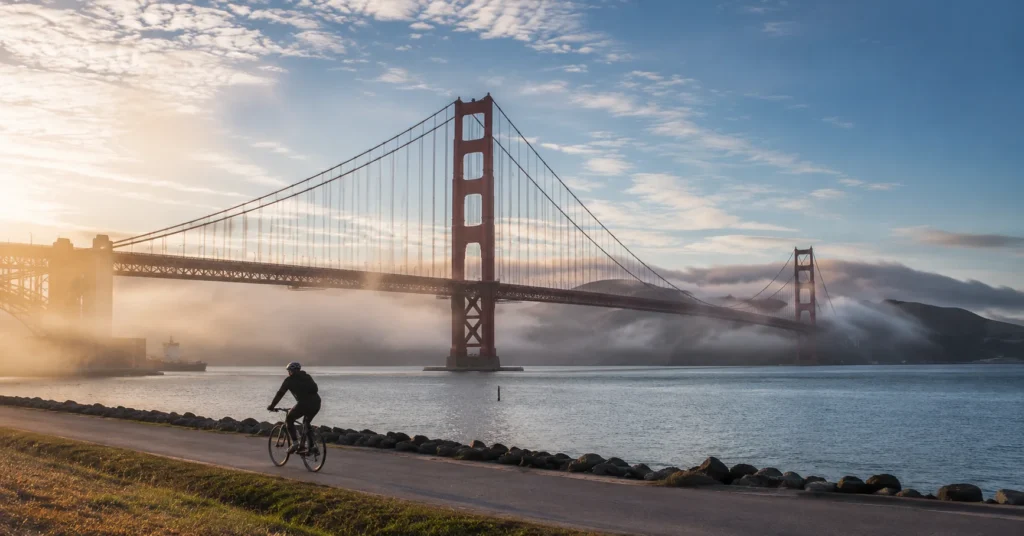
Skip the generic “top 10” and focus on three experiences that define San Francisco without the crush. First: walk the Golden Gate Bridge at 7am from the Crissy Field side — you’ll have the first mile mostly to yourself before the tour buses arrive at the Vista Point parking lot at 9am. Second: ride the 38-Geary bus across town at rush hour to feel the city’s scale (it’s 6.2 miles / 10km end-to-end, takes 45 minutes with traffic — a reality check no guidebook gives).
Third: eat a mission burrito at La Taqueria (no rice, just carnitas, beans, salsa — $12.50 in 2025) and understand why the debate over “best burrito” is a local religion. Each of these costs little but teaches you how the city actually works.
Where to stay: named zones + real prices (2025–2026 rates)
Stay in Union Square only if you prioritize walkability to cable cars and don’t mind paying for it: expect $220–$380/night for a clean 3-star room (2025–2026 rates — verify before travel). Better value: the SoMa district near 4th Street. You’ll pay $180–$290/night for similar quality, be a 10-minute walk to BART, and avoid the Union Square foot-traffic chaos after dark.
For first-timers who want postcard views without the Nob Hill price tag, try the Embarcadero near Pier 39 — but book early; waterfront rooms under $250/night vanish 6+ weeks out in peak season.
Getting around: named options + costs (traffic-adjusted)
San Francisco’s hills and one-way streets make walking deceptive — a “10-minute walk” can be 25 minutes with elevation gain. Your best bet: a Muni day pass at $5 (2025–2026 rates — verify before travel) for unlimited buses and light rail, plus occasional rideshares for late nights or steep climbs.
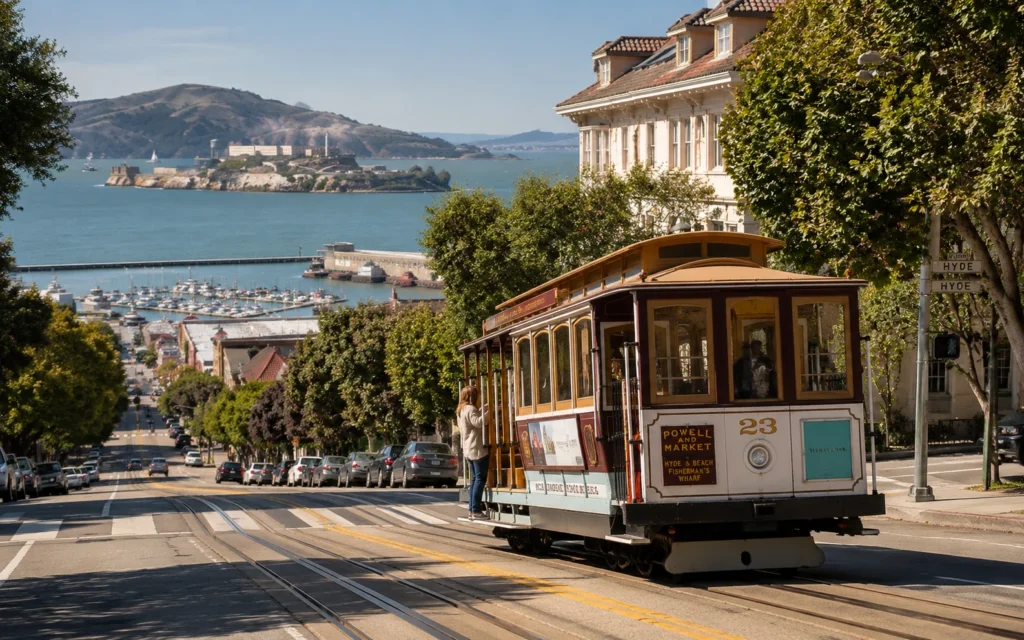
Cable cars cost $8/ride and are worth one experience (the Powell-Hyde line has the best views), but don’t rely on them for daily transit — the queues at turnaround points can exceed 45 minutes in summer. Driving? Only if you’re leaving the city. Street parking in tourist zones has 2-hour limits and $7/hour meters; hotel parking adds $45–$65/night in “convenience fees” that blow budgets open. (Schedules change — confirm before travel)
What it actually costs: three tiers
Budget tier ($100–150/day): hostel dorm or budget motel in SoMa ($60–90/night), street food and taquerias ($12–18/meal), Muni pass + walking, free attractions (Golden Gate Park, waterfront walks). Mid-range tier ($200–350/day): 3-star hotel in Union Square or SoMa ($180–290/night), sit-down meals in the Mission or North Beach ($25–40/meal), occasional rideshare, one paid attraction daily (Alcatraz $45, cable car rides).
Premium tier ($400+/day): boutique hotel with bay view ($350+/night), full-service dining in Fisherman’s Wharf or Marina ($50–80/meal), private car service or premium rental, guided experiences. All costs: (2025–2026 rates — verify before travel). The hidden budget-killer? Resort fees and parking — always ask before booking.
A realistic first-timer day structure
Day 1 example: Arrive by 10am, drop bags at SoMa hotel. Walk to Ferry Building (12 minutes, flat) for lunch at the Saturday market or weekday vendors. Afternoon: ride the F-Market streetcar to Fisherman’s Wharf (22 minutes with stops), see the sea lions, then walk 15 minutes to Ghirardelli Square.
Evening: take the Powell-Hyde cable car back toward Union Square (allow 35 minutes with queue), dinner in North Beach. Key timing: leave Fisherman’s Wharf by 4pm to avoid the tour-bus exodus that clogs Beach Street. This structure works because it groups geographically close stops and uses transit that matches the terrain — not a checklist sprint.
What to skip — and what to do instead
Skip the Madame Tussauds wax museum on Fisherman’s Wharf ($34.99 entry in 2025). It’s a generic attraction that could be in any tourist city, and the 45-minute queue in summer is time stolen from experiences that only exist here. Do this instead: walk the 0.8-mile (1.3km) path from Pier 39 to Fort Point under the Golden Gate Bridge.
It’s free, takes 25 minutes at a stroll, and ends with a view of the bridge’s underside that reorganizes your sense of scale — no ticket, no queue, just the Pacific wind and the sound of the water.
Frequently Asked Questions About San Francisco for First-Timers
How many days do I need in San Francisco?
Four days minimum. This covers the core neighborhoods (Union Square, Mission, Fisherman’s Wharf, Golden Gate Park) without rushing. Add a fifth day if you want a half-day trip to Sausalito or Muir Woods. Less than four days means choosing between depth and coverage — and you’ll regret the trade-off.
Is San Francisco safe for first-time visitors?
Yes, with neighborhood awareness. Stick to well-lit, populated areas after dark — Union Square, Embarcadero, North Beach are fine. Avoid the Tenderloin and parts of SoMa late at night if you’re unfamiliar. Keep valuables out of sight in cars; break-ins at tourist parking spots are common. Trust your instincts and you’ll be fine.
What’s the best way to get from SFO to downtown?
BART is fastest and cheapest: $10.20 one-way to Powell Street Station, 30 minutes with no traffic variables. Rideshares cost $35–55 and take 25–45 minutes depending on traffic — avoid during weekday commute hours (7–9am, 4–7pm). Shared shuttles are $20–25 but make multiple stops, adding 15–20 minutes.
Do I need a car in San Francisco?
No — and it’s often a liability. Parking is expensive ($45–65/night at hotels), street spots have tight limits, and hills make walking deceptive. Use Muni, cable cars for the experience, and rideshares for gaps. Only rent a car if you’re doing a day trip outside the city (Napa, Monterey, etc.).
Continue Exploring
- California travel guide — because San Francisco is just one piece of a state that rewards road trips; this guide helps you decide whether to add Big Sur or Napa next.
- essential USA travel tips for international visitors — because if you’re flying in from abroad, this covers the norms (tipping, transit apps, voltage) that US guides assume you know.