Skellig Michael is one of the most magnificent coastal destinations in Western Europe. It is also one of the most logistically frustrating, weather-dependent, and physically demanding day trips you can book on the Irish continent.
Rising 714 feet out of the churning Atlantic Ocean, seven miles off the Iveragh Peninsula in County Kerry, this jagged pyramid of dark sandstone looks less like an island and more like an ancient fortress forgotten by time. Between the 6th and 13th centuries, early Christian monks lived on these sheer cliffs in dry-stone beehive huts, surviving on rainwater, seabird eggs, and fish in near-total isolation.
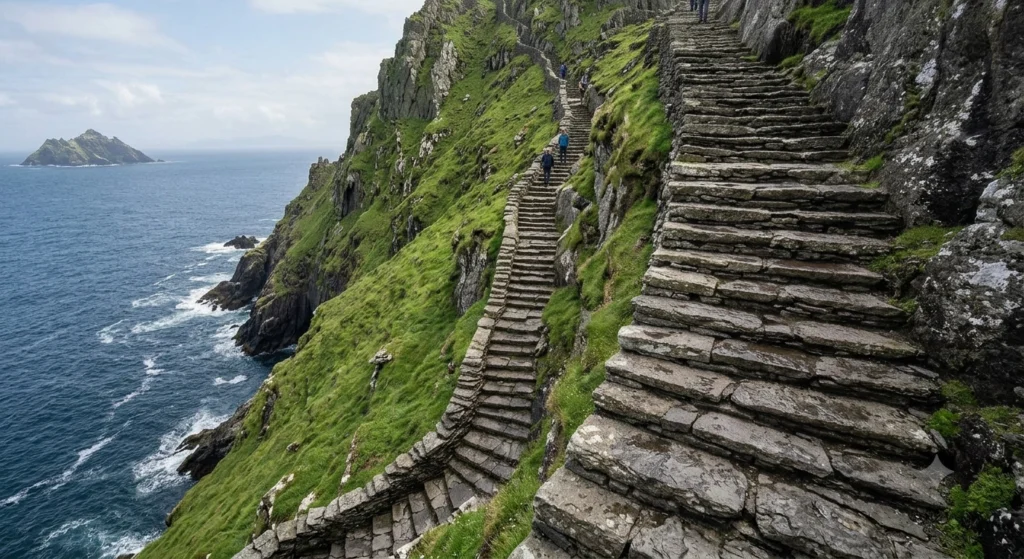
The 600+ hand-carved stone steps up Skellig Michael — steep, unrailed, and unforgiving in wet weather.. Source: Tuatha
Today, the island attracts thousands of travellers drawn by its UNESCO World Heritage status, its medieval history, and its brief fame as Luke Skywalker’s hideaway in Star Wars. But behind the stunning social media photos lies a reality that tourism boards rarely spell out clearly: getting onto Skellig Michael is a gamble.
If you are planning your Ireland itinerary around this island, you need to understand the trade-offs before you hand over your credit card.
Quick Verdict: Is Skellig Michael Worth It?
Yes — but only if you have realistic expectations, a flexible schedule, and sure footing.
Skellig Michael offers a raw, thrilling encounter with history and wild nature that few places in Europe can match. Standing among 1,400-year-old stone beehive huts while thousands of seabirds swoop through the sea mist feels genuinely otherworldly.
However, it is emphatically not for everyone.
- Who should go: Physically fit travellers, history enthusiasts, birdwatchers, and adaptable road-trippers who can absorb a last-minute weather cancellation without ruining their vacation.
- Who should skip: Anyone with severe vertigo, knee or mobility issues, families with children under 12, travellers prone to violent seasickness, or those running a rigid, down-to-the-hour itinerary.
- The Biggest Trade-Off: High cost (€120+ per landing ticket) combined with a 20–30% chance that North Atlantic ocean swells will cancel your boat on the morning of departure.
Quick Decision Guide
| Metric | Details | Editor Note |
|---|---|---|
| Season Window | May 15 – September 30 | Closed completely October through April. |
| Puffin Season | Late May – Late July | Puffins migrate back to open ocean by early August. |
| Ticket Cost | ~€120–€140 (Landing) / ~€50–€70 (Eco-Cruise) | Current rates should be confirmed with licensed operators. |
| Departure Point | Portmagee Marina, County Kerry | Arrive 20–30 minutes prior to scheduled departure. |
| Physical Effort | 600+ steep, uneven stone steps | No handrails, sheer drop-offs, no shelter. |
| Facilities On Site | Minimal basic toilets near dock | No food, no water, no trash bins, no shelter. |
What This Place Is Actually Like
Visiting Skellig Michael feels more like an expedition than a leisurely sightseeing trip.
Your journey begins at the small fishing harbour of Portmagee. The boat ride out takes roughly 45 to 60 minutes across open Atlantic waters. Even on days when the sun is shining, ocean swells can produce rolling pitch and yaw that tests even sea-hardened stomach muscles.
Making landfall is the first hurdle. There is no sheltered marina on Skellig Michael. Boats align against an open concrete slipway where passengers must step off an oscillating deck onto wet, slippery rock. Boat captains and Office of Public Works (OPW) guides assist, but it requires agility and timing.
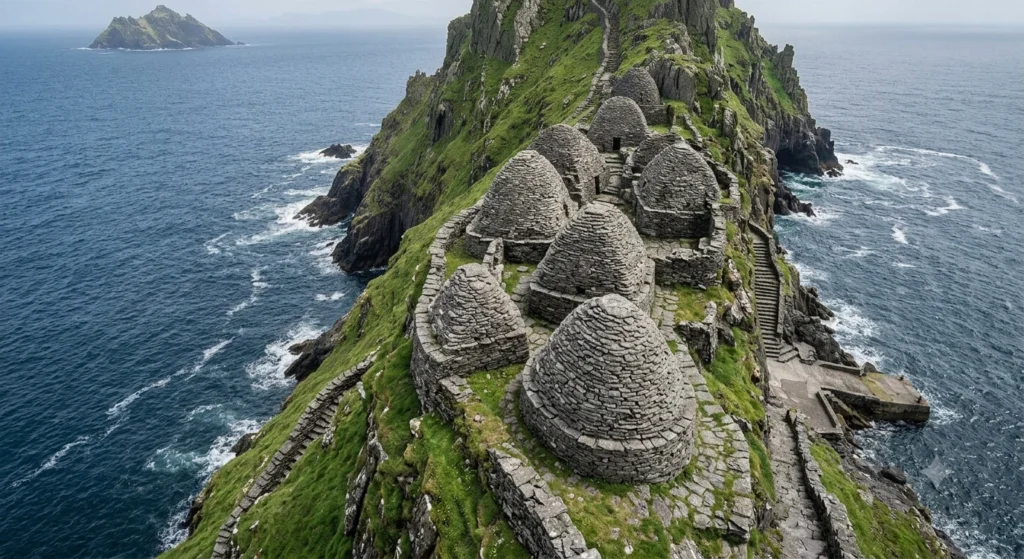
The 6th-century monastic enclosure perched near the summit, built entirely without mortar.. Source: Heritage Ireland
Once ashore, you are met by OPW safety guides who brief you on the climb. From here, you ascend more than 600 hand-hewn stone steps built over a thousand years ago.
- The Climb: The steps are steep, dry-stacked, and varying in height. There are no safety handrails or ropes along the route. On one side is a steep grassy slope or sheer stone wall; on the other, a drop down to the Atlantic ocean below.
- The Congestion: Because all 180 daily landing visitors arrive within a tight morning window, the narrow staircases get congested. You will frequently stop to let descending hikers pass, often while standing on narrow ledges exposed to the wind.
- The Monastery: At the top sits the ancient monastery—six beehive huts, two oratories, and a small cemetery standing intact without a single drop of mortar holding the stones together. The views back across the water to Little Skellig and the Irish mainland are staggering.
Safety Warning: Skellig Michael is a hazardous environment. Two fatal falls occurred on the steps in 2009. If you suffer from severe vertigo or struggle on uneven staircases without handrails, do not attempt the landing climb.
What It Really Costs (And How to Book)
Only 15 boat operators hold official OPW licenses to land passengers on Skellig Michael, capping daily visitors at roughly 180 people. Consequently, tickets are among the hardest to secure in Irish tourism.
Landing Tours (€120 – €140 per person)
- What you get: 1-hour boat ride each way, 2.5 hours on the island to climb to the monastery and explore.
- Booking window: Operators typically open online reservations between November and February for the following summer. High-season tickets (June through August) often sell out within hours or days of release.
- Cancellation policy: If the captain cancels due to weather, you receive a full refund. However, you lose your spot—you cannot simply rebook for the next day, as those boats are already fully booked.
Eco-Boat Cruises (€50 – €70 per person)
- What you get: 1.5 to 2-hour boat trip that circles Skellig Michael and Little Skellig close to the shoreline without disembarking.
- Why choose this: Ideal if landing tickets are sold out, if you have mobility limitations, or if you prefer a shorter trip focused on wildlife and coastal rock formations.
The Reality of Weather Cancellations
Do not build an entire Ireland vacation around Skellig Michael without a backup plan.
The decision to sail rests entirely with individual boat captains and OPW safety officers. A morning can look bright and sunny in Portmagee, but if Atlantic swells exceed 1.5 to 2 metres at the island’s landing rock, the trip is cancelled. Safety rules are non-negotiable.
How to protect your itinerary:
- Base yourself nearby for two nights: Stay in Portmagee, Valentia Island, or nearby Cahersiveen rather than driving in from Killarney at 6:00 AM.
- Book two consecutive days if possible: Some experienced travellers attempt to book landing tickets on back-to-back mornings, intending to cancel or forfeit the second if the first succeeds (check individual operator cancellation policies).
- Have a “Plan B” ready: If your boat is grounded, drive 10 minutes from Portmagee to the Kerry Cliffs. The 1,000-foot sheer drops offer remarkable views across to the Skelligs from the safety of solid ground.
How to Prepare: Essential Gear Checklist
There are no shops, cafes, or shelter on the island. Once you leave Portmagee, you are entirely self-sufficient for 4 to 5 hours.
1.Footwear: Wear high-traction hiking boots:Non-negotiable safety requirement.
Do not wear smooth-soled sneakers, running shoes with worn tread, sandals, or fashion boots. The stone steps become dangerously slick when damp with ocean spray or light rain.
2.Clothing: Layer for wind and rain:Temperatures drop on open water.
Wear a windproof and waterproof outer jacket, warm mid-layers, and long trousers. Even in July, Atlantic sea winds on an open boat ride can be bitterly cold.
3.Seasickness Medication: Take it early:Take 1 hour before boarding.
If you have any history of motion sickness, take an over-the-counter anti-nausea tablet at least 60 minutes before stepping onto the boat. Once you are out past the harbor mouth, it is too late.
4.Snacks & Water: Pack light, pack out trash:Zero waste permitted.
Bring a reusable water bottle and compact, high-energy snacks (nuts, protein bars). Do not bring loose food wrappers that could blow away into bird nesting burrows.
Overrated Choices & Smarter Alternatives
❌ Skip: Day-tripping to Portmagee from Dublin or Galway
Driving 4.5 hours from Dublin to Portmagee for a 9:00 AM departure means waking up at 3:30 AM, only to potentially discover at 8:30 AM that the boat is cancelled due to swell.
- Better Alternative: Make the Ring of Kerry or Dingle Peninsula your base for 2–3 days. If the boat is grounded, you can seamlessly pivot to driving Slea Head, hiking Killarney National Park, or visiting Valentia Island.
❌ Skip: Expecting a “Star Wars Theme Park”
While Star Wars: The Force Awakens and The Last Jedi filmed scenes here, there are no movie displays, set pieces, or costume photo ops. OPW wardens strictly enforce heritage protection.
- Better Alternative: Enjoy the natural and monastic history on the island. If you want Star Wars nostalgia, stop by the Bridge Bar or The Moorings in Portmagee, where cast and crew stayed during filming.
Final Recommendation
Skellig Michael is a rare, wild, and deeply memorable experience—a place that preserves a spirit of isolation that feels increasingly hard to find in modern European travel.
If you are physically capable, comfortable on water, and build enough flexibility into your schedule to handle Ireland’s unpredictable weather, book the ticket. It remains one of the greatest coastal highlights on the planet.
However, if you require creature comforts, dislike ocean travel, or have tight scheduling constraints, do not force it. Ireland’s west coast is packed with extraordinary alternative cliffs, ruined abbeys, and wild drives that won’t leave you stranded at a windy marina.
Frequently Asked Questions
Are there bathrooms on Skellig Michael?
Yes. Basic public toilet facilities are available near the landing dock at the base of the island. However, there are zero rest facilities once you begin climbing the stone steps toward the monastery.
Can children visit Skellig Michael?
Most boat operators do not accept children under 12 years old due to safety concerns. The ascent involves steep, unrailed steps beside precipitous drops. Children must be old enough to understand safety warnings and stay strictly on designated paths.
When is the best month to see puffins on Skellig Michael?
The best window to view nesting puffins is between late May and mid-July. By late July and early August, the puffins begin fledging and heading back out to the open ocean for the remainder of the year.
What happens if my boat tour is cancelled due to bad weather?
If your boat captain cancels the trip due to high swells or heavy weather, you will receive a full refund for your ticket. However, because boats are typically sold out weeks in advance, operators usually cannot reschedule you for the following day.