Many travellers land in Bangkok expecting every street corner to serve life-changing Pad Thai for 50 baht. The reality is somewhat different. You can easily spend two weeks in Thailand eating bland, sugar-heavy noodles cooked for tourists, getting caught out by unexpected spice levels, or spending half your trip nursing an upset stomach from slow-turnover stalls.
Thailand’s food landscape is extraordinary, but it rewards strategy over randomness. Navigating it well means knowing the difference between a high-turnover street stall and a tourist trap, understanding how regional flavors shift from north to south, and recognizing which famous dishes are worth your time and which you can safely skip.
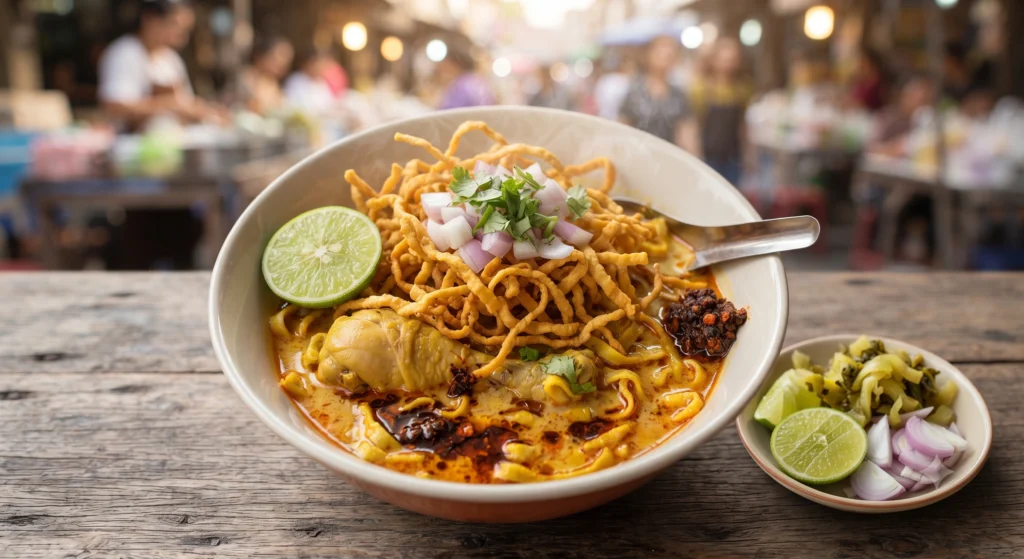
Khao Soi: Northern Thailand’s standout noodle curry. Source: Hot Thai Kitchen
Quick Verdict: Is Thailand’s Food Scene Worth the Hype?
Yes — without question. Thailand remains one of the world’s premier food destinations, offering unmatched flavor complexity at accessible prices. However, enjoying it requires adjusting your expectations:
- Who should go: Adventurous eaters, budget-conscious travellers, and anyone who appreciates vibrant, herbal, complex flavors.
- Who should skip: Travellers with severe airborne peanut allergies, those who cannot tolerate tropical outdoor dining environments, or those expecting quiet, formal service at everyday eateries.
- The biggest trade-off: The best food in Thailand is rarely found in polished, comfortable restaurants; it happens on low plastic stools in open-air shop-houses where heat, noise, and basic sanitation are part of the daily reality.
Quick Facts: Thailand Dining at a Glance
| Factor | Practical Reality |
|---|---|
| Average Street Meal Cost | 50 – 100 THB ($1.50 – $3.00 USD) |
| Casual Restaurant Cost | 200 – 450 THB ($6.00 – $13.00 USD) per person |
| Tipping Etiquette | Not traditional at street stalls; 10% appreciated at sit-down restaurants |
| Water Safety | Never drink tap water. Ice at established stalls is commercially made and safe |
| Payment Method | Cash is mandatory for street stalls/markets; cards accepted at malls & upscale venues |
What Eating in Thailand Is Actually Like
Eating in Thailand is decentralised, fast-paced, and deeply tied to neighborhood culture. Food isn’t confined to formal meal times; locals graze throughout the day.
The Five-Flavor Balance
Unlike Western food where salt or butter dominates, Thai cuisine strikes a precise balance between five taste profiles:
- Sour (lime, tamarind)
- Sweet (palm sugar)
- Salty (fish sauce, shrimp paste)
- Bitter (wild greens, bitter melon)
- Spicy (fresh bird’s eye chilies, dried chili flakes)
When a dish feels “off” to Western palates, it is often because one of these pillars was stripped away—usually the chili heat or sour tamarind, replaced by extra sugar to cater to foreign tastes.
The Street Food vs. Mall Food Court Dynamic
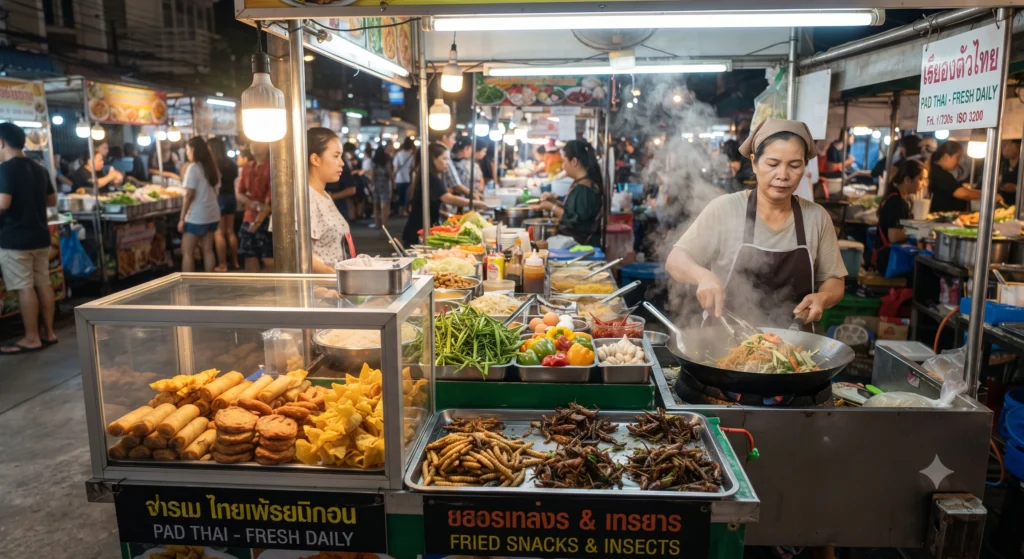
A common mistake among first-timers is assuming street stalls are the only place locals eat. In truth, modern Thais frequently eat at air-conditioned mall food courts (such as Pier 21 at Terminal 21 in Bangkok or Food Hall at Paragon). These courts operate on pre-paid card systems, maintain high hygiene standards, source from popular street vendors, and cost virtually the same as sidewalk stalls.
What Makes It Worth Your Time: Regional Highlights
Thai cuisine is not homogenous. What you eat in Chiang Mai is fundamentally different from what you will be served on an island in the south.
1. The North (Lanna Cuisine)
Northern Thai food relies on mild curries, aromatic herbs, sticky rice, and pork, with far less coconut milk and seafood.
- Must-Try: Khao Soi — a fragrant coconut curry noodle soup topped with crispy deep-fried egg noodles, served with pickled mustard greens, raw red onions, and fresh lime.
- Must-Try: Sai Oua — a grilled pork sausage packed with lemongrass, kaffir lime leaves, galangal, and red curry paste.
2. The Northeast (Isan Cuisine)
Isan food is fiery, herb-heavy, and unpretentious. It relies on sticky rice (Khao Niew), grilled meats, and fermented fish seasoning (Pla Ra).
- Must-Try: Som Tum (Green Papaya Salad) — shredded raw papaya pounded in a mortar with lime, chilies, garlic, fish sauce, and peanuts.
- Must-Try: Larb Moo — minced pork salad tossed with toasted rice powder, lime juice, mint, and dried chilies.
3. Central Thailand (Bangkok & Plains)
Central cuisine is where smooth coconut milk curries, wok stir-fries, and sweet-salty balances dominate.
- Must-Try: Pad Kra Pao — minced pork or chicken stir-fried at high heat with holy basil, garlic, and fresh chilies, served over rice and topped with a crispy-edged fried egg (Khai Dao).
- Must-Try: Tom Yum Goong — hot and sour prawn soup fragrant with galangal, lemongrass, kaffir lime, and chili jam.
4. The South
Southern Thai food is famously pungent, very spicy, and heavily reliant on turmeric, coconut, and fresh seafood.
- Must-Try: Gaeng Som — a sour, turmeric-yellow curry brewed with fish and green papaya. (Caution: extremely spicy).
Must-Try Drinks & Refreshments
Thailand’s tropical climate makes its beverage culture as vital as its food.
Mango Sticky Rice: The ultimate hot-weather sweet treat. Source: Susie Cooks Thai
What to Drink:
- Cha Yen (Thai Iced Tea): Strongly brewed Ceylon tea mixed with condensed milk, evaporated milk, and sugar poured over crushed ice. It is sweet, creamy, and bright orange.
- Nam Lime Soda: Fresh lime juice mixed with soda water and syrup—the ultimate afternoon heat quencher.
- Fresh Young Coconut (Maphrao): Chopped open right in front of you. Natural, hydrating, and untouched by added sugar.
- Chang / Singha / Leo: Local lagers served ice-cold (often with ice in the glass, a standard local practice to combat humidity).
What to Skip vs. What to Do Instead
Navigating Thai menus requires knowing where popular tourist expectations clash with culinary quality.
Pad See Ew: Wok-charred wide noodles that beat generic Pad Thai. Source: RecipeTin Eats
1. Skip: Standard Backpacker Pad Thai
- The Problem: Street carts along tourist strips pre-cook massive mounds of rice noodles, letting them sit until an order comes in. They re-heat them quickly with excess white sugar and bottled tamarind paste, yielding soggy, cloying noodles.
- Do Instead: Order Pad See Ew (wide flat rice noodles stir-fried with dark soy sauce, garlic, Chinese kale, and pork) or seek out specialized Pad Thai shop-houses that cook every batch fresh in a seasoned iron wok.
2. Skip: Damnoen Saduak Floating Market Food
- The Problem: Located 90 minutes outside Bangkok, this market functions primarily as a tourist trap. Food stalls on boats charge inflated prices for average soups prepared under poor sanitary conditions for tour groups.
- Do Instead: Visit Khlong Lat Mayom Floating Market on weekends. It is easily accessible by Grab/taxi from central Bangkok, frequented by local families, and offers excellent grilled river prawns, snakehead fish, and traditional coconut desserts.
3. Skip: Gimmick Deep-Fried Insect Stalls on Khao San Road
- The Problem: Vendors charge tourists 50–100 THB just to take a photograph of fried scorpions on skewers. These scorpions are tough, greasy, and rarely eaten by locals.
- Do Instead: If you are curious about edible insects (an authentic part of Isan rural heritage), visit an Isan fresh market in the late afternoon. Look for vendors selling salted fried crickets (Ching Chok) or silkworms (Rot Duan), which are fried fresh with kaffir lime leaves.
What It Really Costs: Realistic Food Budgets
Thailand caters effortlessly to all budget levels, but knowing what your money buys prevents overpaying.
Budget Level (Street Food & Food Courts)
- Daily Budget: 200 – 350 THB ($6 – $10 USD) per day.
- What You Get: 3 solid street meals (e.g., Pork leg rice, Tom Yum noodles, Pad Kra Pao), a fresh coconut, and an iced coffee.
- Where You Eat: Sidewalk carts, plastic stool stalls, and shopping mall food courts.
Mid-Range Comfort (Shophouses & Casual Sit-Down)
- Daily Budget: 700 – 1,500 THB ($20 – $45 USD) per day.
- What You Get: Air-conditioned dining, fresh seafood dishes, craft beers, and Michelin Bib Gourmand recommended shop-houses.
- Where You Eat: Heritage eateries in Chinatown, riverfront cafes, and established neighborhood restaurants.
Fine Dining & Creative Thai
- Daily Budget: 3,500 – 7,000+ THB ($100 – $200+ USD) per day.
- What You Get: Multi-course tasting menus elevating regional Thai flavors with modern culinary techniques.
- Where You Eat: Renowned Bangkok establishments like Sorn, Le Du, or Paste.
Final Recommendation: How to Approach Your Trip
Thailand’s food scene rewards curious, adaptable travellers who look beyond familiar menu items.
- If you have 5–7 days: Focus on Bangkok. Divide your time between Chinatown (Yaowarat) night market grazing, Charoen Krung heritage shop-houses, and Terminal 21 food court for quick, clean daytime lunches.
- If you have 10–14 days: Combine Bangkok with Chiang Mai (for Khao Soi, herbal sausages, and night markets) and a Southern Island (for spicy coconut curries and freshly grilled whole fish).
- Golden Rule: Never judge a Thai eatery by its decor. The most unremarkable shop-house with stainless steel tables and fluorescent lighting often serves dishes refined over three generations.
FAQ
Is street food in Thailand safe for tourists to eat?
Yes, street food is safe if you choose wisely. Look for busy stalls with high local turnover, where ingredients are cooked fresh over high heat. Avoid dishes that have sat exposed in lukewarm buffets, and ensure your drinks use commercially produced cylindrical ice.
How do I ask for less spicy food in Thailand?
Say “Mai Phet” (not spicy) or “Phet Noi” (a little spicy). Thai dishes naturally contain bird’s eye chilies, so even “a little spicy” may still carry a noticeable kick for travellers unaccustomed to chili heat.
Can vegetarians and vegans easily eat in Thailand?
It is possible, but requires caution. Many dishes that appear vegetarian contain hidden fish sauce (Nam Pla), oyster sauce, or dried shrimp paste. Look for the yellow and red “Jay” (เจ) symbol, which indicates strict Buddhist vegan food, particularly abundant during the annual Vegetarian Festival.
What is the proper way to use utensils in Thailand?
Thais eat most rice dishes using a fork and spoon. Hold the spoon in your right hand and use the fork in your left hand to push food onto the spoon. Chopsticks are generally reserved only for noodle soups.