I used to think travel accessories were mostly airport-shop inventions. Then I spent a week digging through a backpack for charging cables, replacing a lost luggage tag in Madrid, and carrying a passport in a jacket pocket that should never have been trusted.
Most first-time travelers don’t pack too little. They pack the wrong things. The difference between a smooth trip and a frustrating one often comes down to a handful of small items that weigh less than a T-shirt.
This travel accessories guide focuses on what actually earns space in your bag. Not gadgets designed for social media packing videos. Not products that solve problems you’ll never have. Just the travel essentials that improve organization, security, comfort, and convenience when you’re away from home.
Quick Facts: Travel Accessories Worth Buying First
| Accessory | Typical Price | Best For | Limitation | Verdict |
|---|---|---|---|---|
| Packing Cubes | $15–40 | Organization | Adds slight weight | Buy |
| Universal Adapter | $15–50 | International travel | Country compatibility varies | Essential |
| Power Bank | $20–80 | Long travel days | Airline battery restrictions | Essential |
| RFID Wallet | $15–60 | Passport storage | Bulkier than standard wallet | Situational |
| Luggage Tracker | $25–100 | Checked baggage | Battery replacement required | Worth it |
| Compression Bag | $10–30 | Bulky clothing | Wrinkles clothing | Useful |
| Travel Neck Pillow | $20–80 | Long flights | Awkward to carry | Depends |
| Cable Organizer | $10–35 | Tech travelers | Another item to pack | Buy |
Quick Overview: The Accessories Most Travelers Actually Use
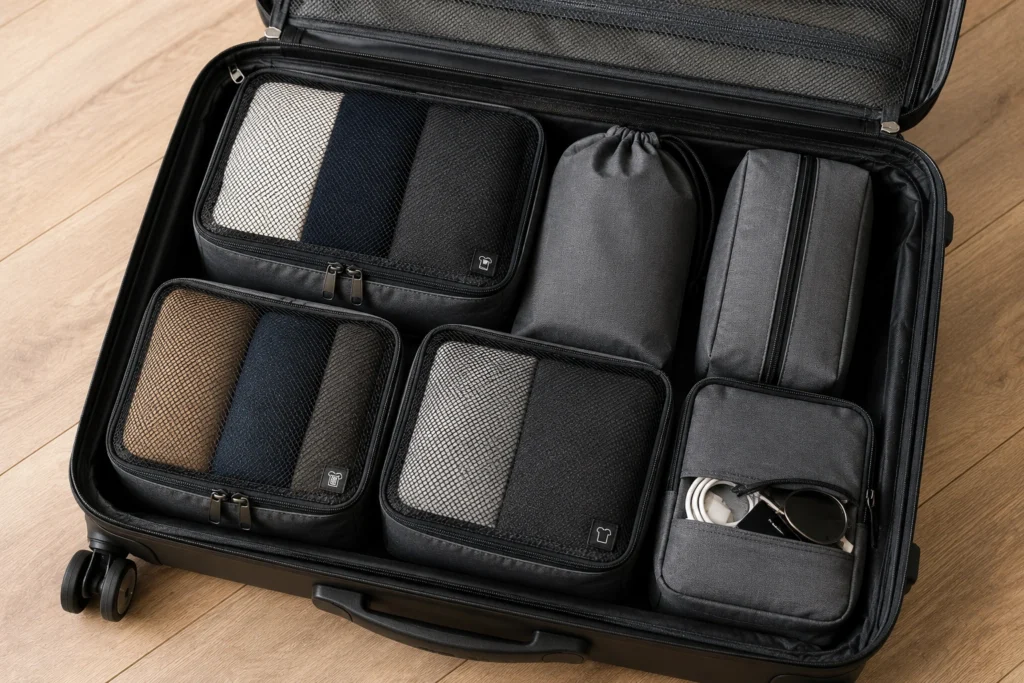
If you’re building your first travel kit, start with packing cubes, a universal adapter, a power bank, and a luggage tag. Those four items solve more real-world travel problems than an entire shelf of airport gadgets.
The average international traveler carries at least three charging cables, one passport, multiple booking confirmations, and enough clothing for several climates. Organization matters because every misplaced item costs time.
And travel creates a specific kind of frustration. It’s standing in a security line while looking for a charging cable that somehow moved to the bottom of your bag. It’s arriving after a nine-hour flight and discovering your phone battery has 4% remaining.
The right accessories reduce those moments.
What Travel Accessories Reward — and What They Punish if You Pack Blind
Travel accessories work best when they solve a specific problem.
The mistake is buying products before understanding your trip.
A first-time traveler heading to Tokyo for ten days needs different travel gear than someone backpacking through Europe for six weeks. Yet many people buy identical accessory lists because a packing video told them to.
A neck pillow illustrates the problem. On a two-hour flight, it’s unnecessary. On a 14-hour overnight route from London to Singapore, you’ll probably use it more than anything else in your carry-on.
The same applies to money belts.
Many first-time travelers buy one immediately. Then spend the entire trip wearing it awkwardly under clothing while visiting cities where normal awareness would have been sufficient. A secure crossbody bag often solves the same problem with less inconvenience.
Buy for the trip.
Not the fear.
The Travel Accessories Worth Building Your Packing System Around
A good packing system starts with organization.
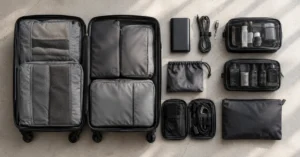
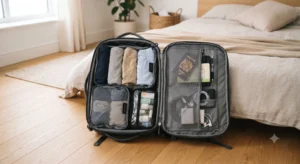
Packing Cubes
The strongest travel accessory purchase for most people.
They separate clothing categories, reduce packing time, and prevent the familiar hotel-room explosion where every item ends up spread across a bed.
Look for:
- Ripstop nylon
- Double stitching
- Mesh visibility panels
- Compression zippers
Maintenance is simple. Hand wash occasionally and air dry.
Expected lifespan: 3–7 years depending on fabric quality.
Universal Travel Adapter
International travel without one becomes annoying immediately.
Choose a model supporting:
- US plugs
- UK plugs
- EU plugs
- Australia/New Zealand plugs
- USB-C charging
Many travelers learn this lesson at airport electronics stores where adapters often cost twice normal retail pricing.
Power Bank
Battery anxiety is real.
Maps, translation apps, boarding passes, ride-hailing services, and banking apps all compete for battery life.
A 10,000mAh power bank balances capacity and portability. Most weigh between 180g and 250g and fit inside a jacket pocket.
Luggage Tracker
Five years ago this category felt optional.
Today, it feels practical.
A tracker won’t prevent lost baggage. It does tell you whether your suitcase is sitting in Frankfurt while you’re standing in Rome.
That’s useful information.
Buying Travel Accessories: How to Choose Without Wasting Money
The traveler-first framework is simple.
Every accessory should pass three tests.
Test 1: Does It Solve a Real Problem?
Not a hypothetical problem.
A cable organizer solves an everyday problem.
An oversized waterproof pouch for documents you rarely access often doesn’t.
Test 2: Will You Use It More Than Twice?
Travel accessories live in a difficult category.
Many seem useful in theory.
Few survive repeated trips.
The products that remain in your bag after five journeys are usually the products worth recommending.
Test 3: Does It Earn Its Weight?
Every item competes for space.
A 400g accessory may not sound heavy until you carry it through three train stations and an airport terminal.
Weight matters.
Particularly when airlines increasingly enforce cabin baggage limits.
What Travel Accessories Actually Cost: Three Spending Tiers
| Tier | Budget | Mid-Range | Worth-the-Splurge |
| Total Setup Cost | $50–80 | $120–220 | $300–600+ |
| Organization | Basic cubes | Durable branded cubes | Premium compression systems |
| Power | Basic charger | Fast-charging power bank | Multi-device ecosystem |
| Security | Luggage tags | RFID storage | Smart trackers |
| Best For | Occasional trips | Frequent travel | Constant travel |
Budget Tier: $50–80
Enough for:
- Packing cubes
- Universal adapter
- Luggage tags
- Cable organizer
For one or two trips annually, this covers most needs.
Mid-Range Tier: $120–220
This is where value peaks.
You gain:
- Better materials
- More durable zippers
- Faster charging
- Improved organization
Most travelers should stop here.
Worth-the-Splurge: $300–600+
Useful only if you travel frequently.
The gains become incremental rather than transformational.
Better convenience.
Not dramatically better trips.
Common Travel Accessory Mistakes First-Time Travelers Make
Buying Before Packing
Pack first.
Then identify problems.
Many accessories become unnecessary once you understand how much space you actually have.
Prioritizing Security Over Accessibility
A passport hidden in five layers of protection sounds smart.
Until immigration asks for it.
The best systems balance security and convenience.
Ignoring Maintenance
Travel accessories wear out.
Elastic stretches.
Zippers fail.
Batteries degrade.
A cheap accessory that lasts one trip is often more expensive than a better-built version lasting five years.
Packing Too Many Organizers
This mistake is surprisingly common.
I’ve seen travelers carry pouches for cables, chargers, documents, toiletries, medications, cameras, batteries, snacks, and miscellaneous items.
At some point the organizers become the luggage.
Don’t let that happen.
Recommended Travel Accessories by Trip Type
Weekend City Break
Pack:
- Small power bank
- Packing cube
- Luggage tag
Skip:
- Compression bags
- Large organizers
Two-Week International Vacation
Pack:
- Universal adapter
- Power bank
- Packing cubes
- Cable organizer
- RFID document holder
This covers nearly every common travel problem.
Long-Term Backpacking
Pack:
- Compression cubes
- Durable power bank
- Backup charging cable
- Laundry bag
- Tracker for checked luggage
Durability matters more than appearance here.
You’ll notice zipper quality after month three.
Family Travel
Organization becomes the priority.
Color-coded packing cubes save time because everyone knows which items belong to whom.
Simple.
Effective.
Worth doing.
Frequently Asked Questions About Travel Accessories
What travel accessories should I buy first?
Start with packing cubes, a universal adapter, a power bank, and luggage tags. Those four items improve organization, charging reliability, and baggage identification without adding significant weight.
Are packing cubes actually worth it?
Yes. Packing cubes reduce clutter, simplify unpacking, and make it easier to locate clothing quickly. They don’t create extra space, but they use existing space more efficiently.
Do I need an RFID wallet for travel?
Not always. For most trips, normal awareness and secure storage are sufficient. RFID wallets become more useful when carrying multiple cards and passports internationally.
How much should I spend on travel accessories?
Most travelers can build a practical setup for $120–220 (2025–2026 rates — verify before travel). Spending beyond that usually improves convenience rather than solving new problems.
What’s the most overrated travel accessory?
Oversized travel organizers often create more complexity than they remove. Organization helps. Excessive organization becomes another thing to manage.
Continue Exploring
- travel gear guide: If you’re building a complete packing setup, continue with our travel gear guide for backpacks, luggage, footwear, and carry-on systems.
- travel essentials checklist: A complete packing checklist helps you decide what belongs in your bag before buying additional accessories.