| Hair Type | Main Need | Common Mistake | Core Focus |
|---|---|---|---|
| Straight | Oil control | Over-washing | Lightweight care |
| Wavy | Balance | Ignoring frizz | Hydration + structure |
| Curly | Moisture | Brushing dry | Definition + hydration |
| Coily | Deep moisture | Product skipping | Sealing + protection |
Introduction
Most people don’t have “bad hair.” They just have routines that don’t match their hair type. A straight-haired routine applied to coily hair doesn’t fail loudly — it just slowly dries everything out until nothing behaves the way it should.
A proper hair care guide isn’t about buying more products. It’s about understanding how often your hair actually needs water, oil, cleansing, and protection. Once that pattern is clear, everything else becomes simpler — and cheaper.
This guide breaks hair care into routines you can actually follow, not beauty magazine ideals. No assumptions. No product overload. Just structure that holds up in real life.
Quick Overview: Hair Types, Products, and What Actually Changes
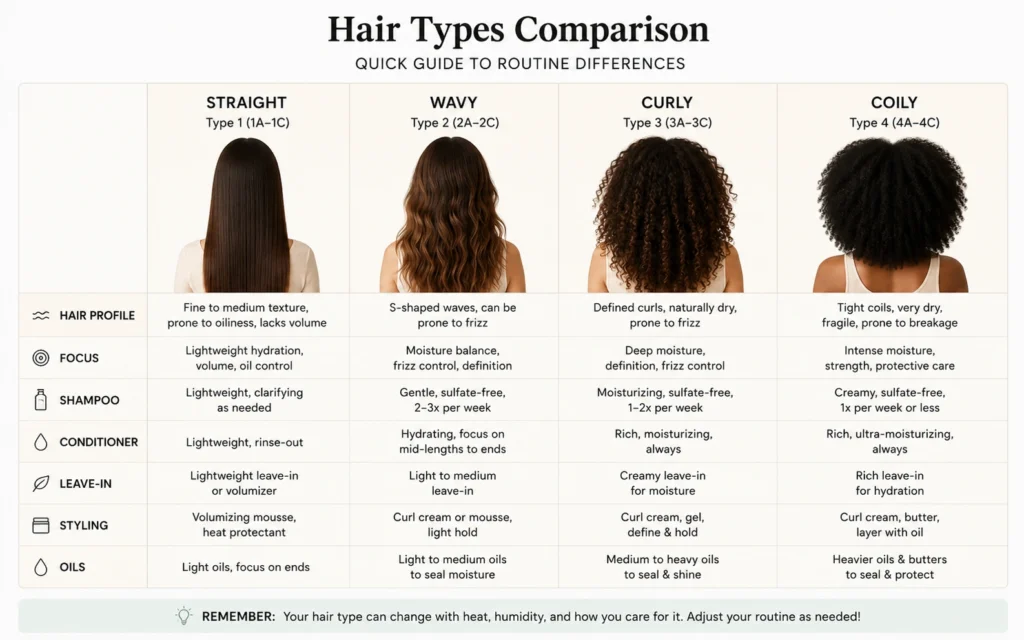
Hair care changes less by “brands” and more by structure.
Straight hair distributes oil quickly. Curly and coily hair doesn’t. That single difference changes everything — from shampoo frequency to styling methods.
A blunt truth most beginner guides skip:
You don’t need more products. You need fewer mistakes.
And those mistakes are usually predictable:
- washing too often
- not conditioning enough
- using heavy products on fine hair
- skipping moisture entirely on textured hair
Fix those, and results improve faster than any “miracle oil.”
Benefits of a Consistent Hair Care Routine
Consistency sounds boring until you skip it for a month.
Then you notice:
- uneven texture
- frizz that wasn’t there before
- scalp dryness or excess oil swings
- breakage that feels sudden but isn’t
A stable routine does three things:
First, it normalises your scalp. Oil production stops overreacting.
Second, it reduces mechanical damage — less random brushing, fewer harsh washes.
Third, it removes decision fatigue. You stop guessing what your hair needs every morning.
Most people don’t need a new product. They need repetition done correctly.
Routine Guide for Every Hair Type (Step-by-Step System)
Straight hair needs restraint more than effort. Washing 2–3 times a week is usually enough. Conditioner should stay light — applied mid-length, not near the roots. The mistake is over-cleansing, which pushes the scalp into rebound oil production.
Wavy hair sits in the middle but behaves inconsistently. Some days it’s flat, some days frizzy. The fix is balance: mild shampoo, consistent conditioner, and occasional leave-in cream. Avoid heavy oils unless the hair is very dry.
Curly hair changes the entire structure of care. Detangling happens only when wet, ideally with conditioner already in. Moisture retention becomes the priority, not volume control. Skipping leave-in products is where most routines fail.
Coily hair requires sealing, not just moisturizing. Water alone evaporates quickly. That’s why layering matters: leave-in conditioner, then cream, then oil. Not all at once every day, but in structured intervals depending on dryness.
A simple rule that applies across all types:
If your hair feels worse after “fixing” it, you’ve overcorrected.
Common Hair Care Mistakes That Quietly Ruin Results
The most damaging mistake isn’t bleaching or heat styling — it’s inconsistency.
People rotate products too fast. One week sulfate-free shampoo, next week heavy oil treatments, then nothing for ten days. Hair doesn’t respond well to confusion.
Another issue: brushing dry curly or coily hair. It creates breakage that looks like “shedding,” but it’s actually mechanical damage.
And then there’s heat. Not heat itself, but unprotected heat. Straighteners used without protection slowly reduce elasticity until hair stops holding shape entirely.
One honest admission:
Most damage I’ve seen wasn’t from salon treatments. It was from daily habits done slightly wrong for years.
Recommendations: Products, Frequency, and Realistic Routines
You don’t need ten products. You need four categories done correctly:
- Cleanser (based on scalp oil level)
- Conditioner (non-negotiable for all types)
- Leave-in (for texture control)
- Oil or serum (for sealing or finishing)
Frequency depends on hair type, not trends. Straight hair may need washing every 2–3 days. Curly or coily hair often thrives on 1–2 washes per week.
Budget reality:
- Budget routine: ₹500–₹1,200/month
- Mid-range: ₹1,500–₹3,000/month
- High-end: ₹3,500+ (mostly styling + treatment layers)
More expensive rarely means more effective. It usually means more sensory comfort — scent, texture, packaging — not better structure.
Frequently Asked Questions About Hair Care Guide
How often should I wash my hair?
It depends on scalp oil production. Straight hair usually needs washing every 2–3 days, while curly and coily hair can go longer. Over-washing is more damaging than slightly delayed washing for most people.
Do expensive shampoos work better?
Not consistently. Ingredient compatibility matters more than price. Many mid-range shampoos perform the same core function as premium ones without cosmetic extras.
Can one routine work for all hair types?
No. The base steps are similar, but moisture levels, frequency, and product weight must change. Ignoring this is where most routines fail.
Is oiling necessary?
It depends on hair type. It helps coily and dry hair more than straight hair. For some scalps, heavy oiling can actually cause buildup issues.
CONTINUE EXPLORING
- Beauty pillar guide overview — broader skincare and grooming system that connects to hair health
- structured daily hair care routines — deeper breakdown of weekly schedules and product layering logic