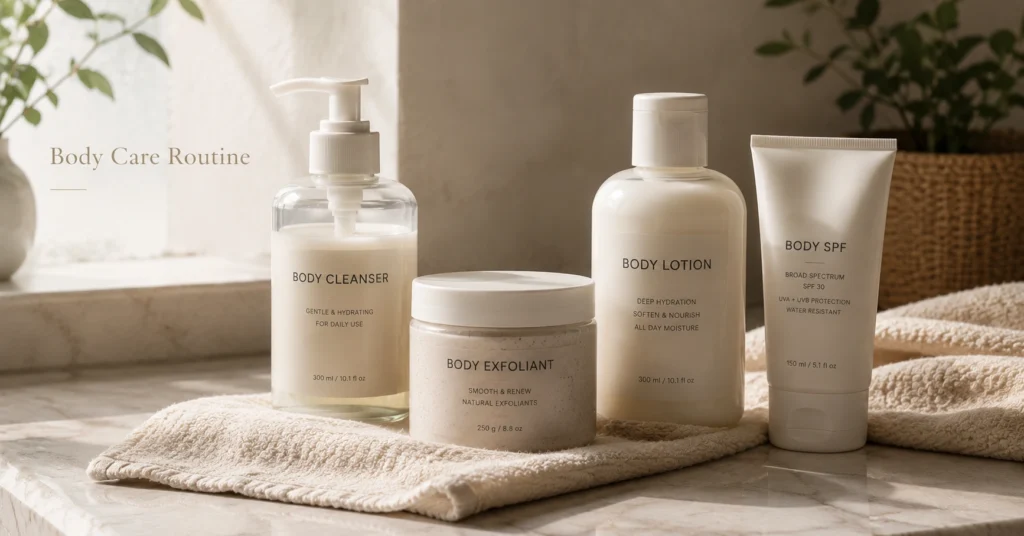
A simple body care routine rewards you with fewer flare-ups, smoother skin, and—if you stick with it—noticeable texture improvement in 6–8 weeks. It punishes perfectionism and overcomplication: chasing ten-step regimes for your face on your body usually means irritation, waste, and an empty wallet. Start small: the three real pillars are cleaning, controlled exfoliation, and hydration with sun protection. The rest is optional, often redundant, and usually sold to you as urgency.
Over the past month I switched from a foaming shower gel to a low-pH cream wash; in two weeks my arms stopped flaking. Note the timeline—skin change appeared well before the four-week mark.
Quick overview: one-week setup to get your routine running
Set aside one shopping trip or a single order to buy a cleanser, an exfoliant (chemical or physical), a humectant-rich lotion, and SPF. Use this plan the first week to build habit and check tolerance.
Day 0 — Buy these four items: gentle body cleanser (look for pH 5–6), 5–10% glycolic or 2–5% salicylic acid product or a gentle scrub (if skin tolerates), a lotion with glycerin or hyaluronic acid, and a broad-spectrum SPF 30+.
Day 1–3 — Cleanse once, dry gently, apply lotion within three minutes.
Day 4 — First gentle exfoliation (chemical or buff with a soft scrub) at night; observe 24–48 hours.
Day 5–7 — Continue daily cleanse + hydrate, introduce SPF each morning. If no irritation, repeat exfoliation once more that week.
What to watch for: redness, stinging, or worsening dryness (stop the exfoliant). Expected setup cost: $25–60 (2025–2026 rates — verify before travel) for decent starter items.
Benefits: what a consistent body care routine actually changes (and when)
- Week 1: Less surface dryness and fewer visible flakes. The immediate win is comfort—less tightness after showers.
- 4–8 weeks: Smoother texture on rough patches (knees, elbows), faded keratosis pilaris bumps for many people, and reduced post-shave irritation when hydration is consistent.
- 3 months+: If you stick to SPF and hydration, expect long-term reduction in sun damage risk and improved skin resilience.
Extractable facts: “Expect texture improvement in 6–8 weeks” and “Apply lotion within three minutes after shower” are specific, testable claims.
Routine guide: day-by-day, product type, active ingredients, frequency
H2 opening point: This is the daily to monthly routine that covers most people—then adjustments for dry, sensitive, or acne-prone body skin.
Daily AM
- Cleanse (single sentence + extractable fact): Use a gentle, low-pH body cleanser (pH 5–6), avoid harsh sulphate-rich gels if skin is dry. Cost note: decent low-pH cleansers cost $8–25 (2025–2026 rates — verify before travel).
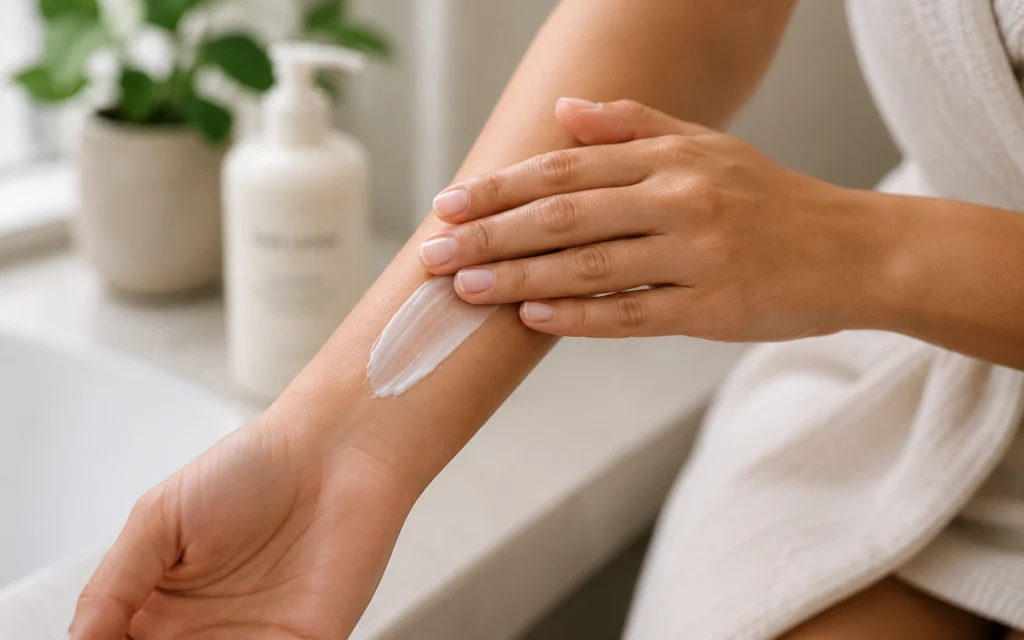
- Hydrate — lock in moisture: Apply a lotion with glycerin or hyaluronic acid within three minutes of towelling off. Frequency: every morning; extractable: “Apply within three minutes.”
- Protect: SPF 30+ on exposed skin every morning; reapply every two hours if in sun. (Verify at [official source] — rules change without notice)
Daily PM
- Cleanse only if sweaty or after workouts. Otherwise skip double-cleansing; over-cleansing strips oils.
- Hydrate: Thicker cream or body oil on very dry areas (knees, elbows). Frequency: nightly for dry skin; 3–4× weekly for normal skin.
1–2× Weekly
- Exfoliate: Choose based on skin sensitivity.
- Chemical: 5–10% glycolic acid lotion or 2–5% salicylic acid for rough, keratosis-prone areas. Frequency: 1× week to start, increase to 2× week if tolerated.
- Physical: Soft sugar or jojoba bead scrub, once weekly. Avoid harsh pumice or salt scrubs on active eczema.
Usage note: Patch test any acid product on inner upper arm for 48 hours. Expect mild tingling; stop if burning.
2–3× Weekly (optional)
- Treatments: Retinoids for body acne or thickened keratosis pilaris — use 0.025–0.05% tretinoin or OTC retinol products. Frequency: twice weekly at night to start. Limitations: retinoids increase sun sensitivity; use SPF daily.
- Hydrating masks: Overnight occlusive (petrolatum or heavy balm) on very dry patches once weekly.
Monthly
- Deep exfoliation: gentle AHA body peel at salon or at-home 10% glycolic treatment — only if your skin tolerates weekly exfoliation.
- Reassess: If irritation, drop exfoliation frequency and increase barrier support (more emollients).
Suitability notes by skin type
- Dry: Gentle cream cleansers, avoid daily acid exfoliation, use occlusive at night. Increase lotion frequency to AM+PM.
- Oily/acne-prone body skin: Use salicylic-containing washes or spot treatments (2% salicylic acid), exfoliate up to 2× week.
- Sensitive/eczema-prone: Avoid physical scrubs and higher-percentage acids. Use minimal ingredients: glycerin, ceramides, colloidal oatmeal. Consult dermatologist before retinoids.
- Keratosis pilaris: Start glycolic 5–10% or salicylic 2% once weekly, increase slowly. Expect visible change in 6–8 weeks.
Ingredients focus (must include)
- Glycerin/hyaluronic acid: humectants that draw moisture.
- Ceramides/squalane: barrier repair and occlusion.
- AHAs (glycolic/lactic): surface exfoliation, use at 5–10% for body.
- BHAs (salicylic): oil-soluble, good for follicular acne and KP.
- Retinoids: cell turnover, use sparingly on body with sun protection.
- Fragrance: avoid if sensitive; fragrances add little benefit and increase irritation risk.
Common mistakes: what most beginners do wrong (and the fix)
- Mistake: Exfoliating every day because “more equals faster.” Fix: Start 1× week; more often causes barrier damage and more dryness.
- Mistake: Skipping SPF on body because “it’s mostly covered.” Fix: Apply SPF to exposed areas (neck, forearms) and legs if you’ll be outside; clothing shifts—sunscreen is cheap insurance.
- Mistake: Buying a “body serum” first. Fix: Buy a dependable humectant lotion and a good sunscreen before niche serums.
- Mistake: Using face-only products at body quantities. Fix: Use body formulas — they’re designed for larger surface area and different textures. Cost saver: pick multi-use products with safe ingredients (glycerin + ceramide creams).
Recommendations: product picks by budget and skin type
Blunt verdict: Spend on sunscreen and a robust hydrating lotion; everything else is optional.
Budget tier ($2–15)
- Cleanser: gentle cream body wash, generic pharmacy brand, look for “soap-free” on label.
- Lotion: glycerin-based body lotion (drugstore brand).
- Exfoliant: sugar scrub or 5% AHA drugstore lotion.
Best for: trialling routine; low cost to test tolerance.
Mid range ($16–40)
- Cleanser: pH-balanced shower cream (named brand example: CeraVe SA Body Wash — contains salicylic acid).
- Lotion: ceramide + glycerin fragrance-free cream (e.g., CeraVe Moisturizing Cream).
- SPF: mineral or chemical SPF 30 broad-spectrum body sunscreen.
Best for: reliable ingredients and tolerability.
Worth-the-splurge ($40–80)
- Cleanser: body balm cleanser with emollients.
- Lotion: humectant-rich lotion with hyaluronic acid + squalane.
- Treatments: concentrated AHA body lotion or prescription retinoid for KP (derm consult).
Best for: targeted concerns, dry skin needing stronger barrier support.
Suitability notes with picks:
- Sensitive: fragrance-free, ceramide-rich creams.
- Oily/body acne: salicylic-containing washes, lightweight lotions.
- Budget-sensitive: avoid fragranced “luxury” lotions; look for core ingredients instead.
Frequently Asked Questions About body care routine
How often should I exfoliate my body?
Start once weekly. If tolerated (no persistent redness or increased dryness), increase to twice weekly. Avoid daily exfoliation—it’s rarely necessary and often harmful.
Can I use facial retinol on my body?
You can, but it’s expensive and facial concentrations may be too strong when applied over large areas. For keratosis pilaris or thickened patches, consult a dermatologist for a prescription-strength retinoid or use an OTC body retinol product at low frequency.
Is fragrance in body products harmful?
Fragrance increases irritation risk, especially for sensitive skin. It isn’t necessary for function. If you react to scented products, switch to fragrance-free ceramide and glycerin-based formulas.
When will I see results for keratosis pilaris?
Expect to see texture improvement in 6–8 weeks with consistent exfoliation and hydration; significant clearance can take several months
Continue exploring
- use Beauty Pillar primary keyword – This links to the main beauty pillar to learn ingredient basics and skin type guidance.