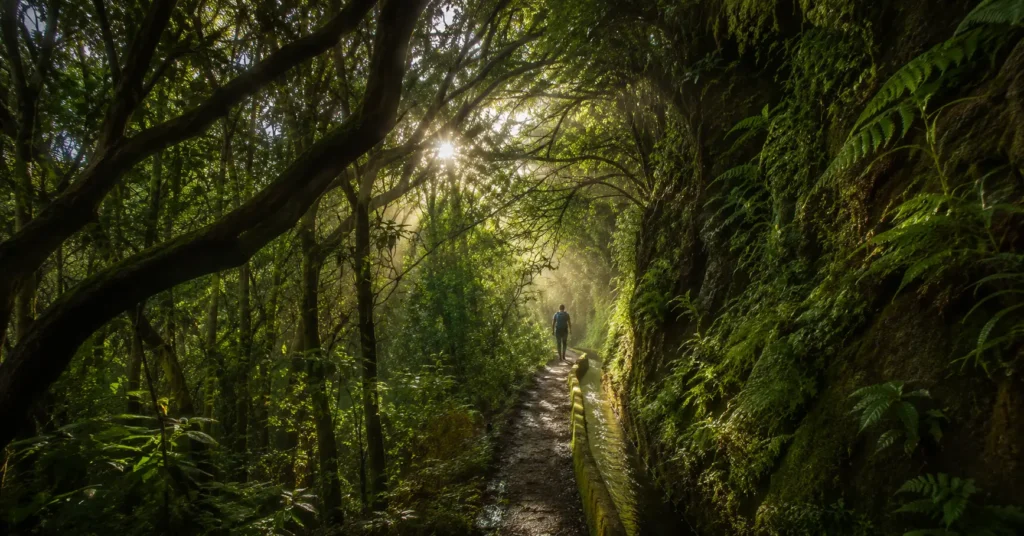
Madeira doesn’t behave like other European island destinations. There’s no beach culture to speak of — the coastline is mostly volcanic cliff — and the interior is a UNESCO-listed laurel forest laced with 2,500 kilometres of ancient irrigation channels you can walk beside for hours without seeing a tour group. Most first-timers book it expecting a relaxed sun holiday and spend their first afternoon genuinely surprised by how dramatic and vertical the place is.
This madeira travel guide is written for that first-timer. It covers what the island rewards, what it costs, how to get around it, and what to actually do with five days — including the parts that most destination pages skip over.
Madeira is an autonomous Portuguese archipelago sitting 1,000km southwest of Lisbon in the Atlantic Ocean. It’s not the Algarve. It’s not the Azores. It’s a 740 square kilometre island of volcanic origin with a capital — Funchal — that functions as a small city in its own right, a climate so consistent it’s been marketed as “the island of eternal spring,” and a wine culture that’s been operating since the 15th century.
Quick Facts Before You Book
| Location | North Atlantic, 1,000km SW of Lisbon; 700km off Morocco |
| Capital | Funchal (population ~110,000) |
| Currency | Euro (€) |
| Language | Portuguese |
| Flight time from Lisbon | 1h 40min |
| Flight time from London | ~3h 15min |
| Best months | April–May, October–November |
| Average temperature | 17–24°C (63–75°F) year-round |
| Cost tier | Southern Europe — €90–130/day mid-range |
| Driving side | Right |
| Visa | Schengen Area — 90/180-day rule applies for non-EU visitors. Verify at official Schengen calculator — rules change without notice. |
What Madeira Actually Is — and What It Asks of You
Madeira rewards curiosity and punishes anyone who arrives expecting Ibiza. The island has no significant sandy beaches on the main island — Madeira’s coastline is basalt cliffs, small shingle coves, and ocean lido pools carved into the rock. If that’s a dealbreaker, book Porto Santo instead (a 2.5-hour ferry ride away, with 9km of golden sand beach). Most people don’t know that option exists.
What Madeira does have is altitude, forest, and food. The interior rises to 1,862m at Pico Ruivo, and the temperature drops noticeably as you climb. The Laurisilva forest covering the north and centre of the island is a direct descendant of the subtropical forests that covered southern Europe before the last ice age — it’s genuinely ancient in a way that takes a moment to register when you’re standing inside it.
Funchal, the capital, sits on the southern coast and is more functional than many visitors expect: a covered market that operates like a living food hall, a cable car to the Monte district above the city, an Old Town (Zona Velha) with a street art tradition and evening restaurants that charge honest prices. It’s a city you can spend two days in without running out of things that repay your attention.
The Experiences Worth Building the Trip Around
Levada walks. The levadas are irrigation channels built from the 15th century onward to distribute water from the wet north of the island to the drier south. The paths alongside them are now the defining Madeiran walking experience — flat or nearly flat (they follow the water gradient), accessible to non-hikers, and running through terrain that shifts from forest to cliff-face to valley within the same hour.
Levada das 25 Fontes and Levada do Caldeirão Verde are the two most rewarding routes for first-timers: each takes 3–4 hours return, and neither requires technical gear. Go on a weekday and start before 9am if you want genuine quiet.
Mercado dos Lavradores, Funchal. The covered market in Funchal’s old town sells the produce that defines Madeiran cooking — espada (scabbardfish, a deep-sea fish with white flesh and a slightly unsettling face), pão de mel (honey cake), and passion fruit in varieties you won’t find in a European supermarket. It’s working market, not tourist display.
Come on a Friday morning before 10am. The flower vendors occupy the ground floor entrance and the fish hall is at the back.
Cabo Girão. One of the highest sea cliffs in Europe — 580 metres of vertical basalt dropping directly into the Atlantic. There’s a glass-floored skywalk at the top that most people photograph and then leave. Skip it — or stay, and look west along the coastline instead of straight down. The coastal view from the cliff edge on a clear morning is the kind of thing that reorganises your scale of reference.
Where to Stay in Madeira: Zones and Real Prices
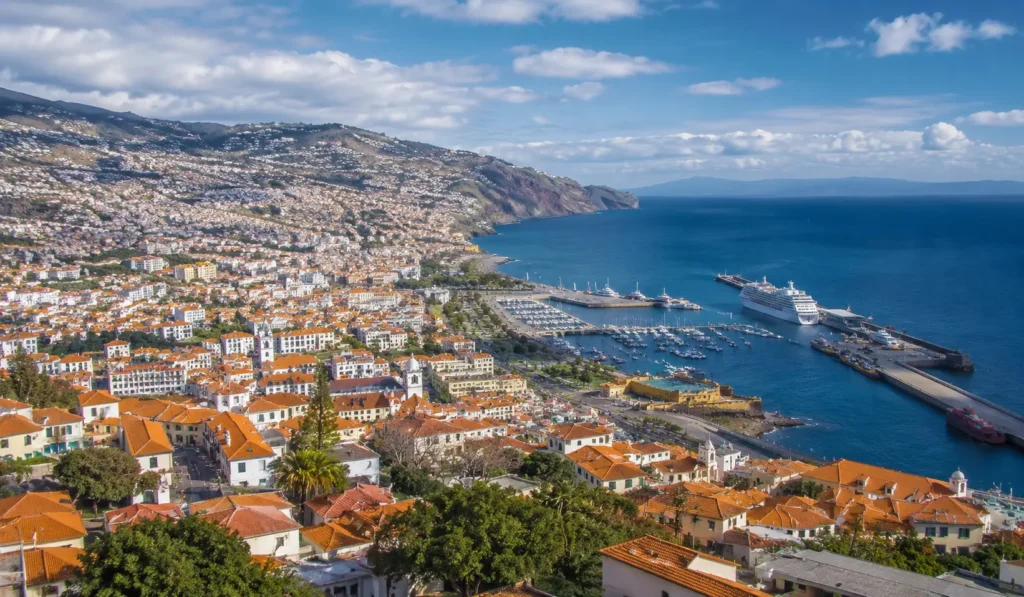
Funchal Old Town (Zona Velha): The most walkable option for a first visit. Within reach of the market, the cable car, and the ocean promenade. Mid-range hotels and guesthouses run €80–130/night. (2025–2026 rates — verify before travel.)
Hotel Zone (Lido/Promenade): West of the Old Town along the coastal road. More resort-oriented, with larger hotels and pool complexes. Prices range from €100–200/night depending on the property and season. Practical, but less atmosphere than the Old Town.
Monte / Camacha (hill villages above Funchal): For visitors who want quiet and don’t mind driving down to the city. Smaller guesthouses and rural properties, €60–90/night. The views over Funchal from Monte at night are worth the compromise of not being walking distance from dinner.
North coast (Santana, São Vicente): For the walking-focused traveller who plans to spend most of their time in the forest and interior. A handful of rural properties and small hotels, €55–80/night. Genuinely isolated in the best sense.
Getting Around Madeira (and Why You’ll Want a Car)
Funchal has a functional bus network and taxis that are cheap by Western European standards (a cross-city ride runs €8–12). For the city alone, you don’t need a car.
But Madeira’s roads are the point. The island has invested heavily in tunnels and expressways that make the interior and north coast accessible in under an hour from Funchal — distances that once took three hours of mountain switchbacks. Renting a car for two or three days gives you access to Pico do Arieiro, the north coast villages, and the levada trailheads that have no practical bus service.
Expect €35–55/day for a small manual car, booked in advance. (2025–2026 rates — verify before travel.) Automatic cars cost more and availability is limited — book early if that matters.
The cable car from Funchal to Monte (€16 one way, €21 return, 2025–2026 rates — verify before travel) covers a specific terrain problem and is worth doing once, especially if you plan to return to Funchal by toboggan (the wicker basket sleds that descend the Monte road — exactly what they sound like, and genuinely fun).
What Visiting Madeira Actually Costs: Three Tiers
| Tier | Daily Budget | What It Gets You |
|---|---|---|
| Budget | €55–70/day | Hostel dorm or basic guesthouse, lunch at a market stall (€8–12), self-catered or café dinners, free levada walks, public buses where available |
| Mid-range | €90–130/day | 3-star hotel in Funchal Old Town, lunch and dinner at local restaurants (€15–25/meal), car hire for 2–3 days, cable car and entry fees |
| Worth the splurge | €180–250/day | Boutique hotel or clifftop property, dinner at Il Gallo d’Oro (Funchal’s two-Michelin-star restaurant), private guided levada walk, full car hire |
Madeira sits in the Southern Europe cost tier — noticeably more affordable than Lisbon in high season, and substantially more affordable than the Canary Islands at equivalent quality. A mid-range week here costs less than four nights in Lisbon in July.
A First-Timer’s 5-Day Framework for Madeira
Day 1 — Funchal orientation. Arrive, walk the Old Town, spend the afternoon in Mercado dos Lavradores, dinner in Zona Velha. Don’t try to do the island on your first day. Get the city in your feet first.
Day 2 — Monte and the cable car. Morning cable car to Monte, walk the gardens, toboggan back down, afternoon at the ocean lido at Doca do Cavacas (natural volcanic pools, €2 entry). Evening: dinner at a restaurant along the Lido promenade.
Day 3 — Levada walk. Drive to Levada das 25 Fontes (trailhead near Rabacal, 45 minutes west of Funchal). 5km each way, roughly 3.5 hours return. Bring water and a layer — it’s cooler in the forest than the coast. Back in Funchal by 3pm.
Day 4 — North coast and interior. Drive the VE3 expressway north through the tunnel to São Vicente, follow the north coast road east to Santana (traditional A-frame thatched houses), loop back through the central plateau via Pico do Arieiro viewpoint (1,818m). Full day.
Day 5 — Slow Funchal. Farmers’ market if it’s a Saturday, Museu CR7 if football is relevant to anyone in your group (Ronaldo is from Funchal — the museum is better than it sounds), afternoon at leisure. Evening flight if departing.
What to Know That Most Guides Don’t Tell You
Madeira’s weather changes by altitude, and the north and south of the island can have entirely different conditions at the same time. The south coast — where Funchal sits — gets significantly more sun than the north. If you’re driving to the Laurisilva forest in the north and it looks overcast from your hotel window, go anyway. The cloud often sits on the peaks and the forest walks are frequently clear at trail level, even when Funchal looks grey.
Book levada walks independently. The guided group walk market is large and the prices reflect demand rather than value — €45–70/person for routes you can walk free with a €10 trail map app. Solo walking on the main levadas is genuinely safe and well-signed. The only levadas that benefit from a guide are those with tunnel sections in the dark — Levada do Caldeirão Verde has a short one. A head torch solves this.
Madeiran wine is not a novelty. The fortified wines produced here — Sercial, Verdelho, Bual, Malmsey — are aged using a process unique to the island involving controlled heating, which produces a shelf-stable wine that outlasts almost every other style in the world. A bottle of 10-year Blandy’s Malmsey costs €18–25 at the lodge on Avenida Arriaga in Funchal. It’s worth buying two.
And one honest admission: the roads, particularly on the north coast before the expressway tunnels were built, have stretches that are narrow, have no barrier, and drop sharply to the sea. If that’s genuinely uncomfortable for you — as a driver or a passenger — stick to the main expressways and let someone else navigate the scenic coastal routes. The views are worth it, but so is arriving in one piece.
Frequently Asked Questions About Madeira
When is the best time to visit Madeira?
April, May, October, and November. Temperatures sit between 18–24°C (64–75°F), crowds are a fraction of summer levels, and accommodation averages 20–30% less than July or August. Madeira has no real bad season — it’s genuinely mild year-round — but those four months give you the island at its least crowded and most affordable.
Do I need a car to visit Madeira?
For Funchal alone, no — the city is walkable and taxis are reasonable. But Madeira’s best scenery is in the interior and along the north coast, where public buses run infrequently. Renting a car for two or three of your days gives you access to everything the island actually offers. Expect €35–55/day for a small manual car. (2025–2026 rates — verify before travel.)
Is Madeira expensive compared to mainland Portugal?
Slightly. Flights from Lisbon add to the cost, and some goods run higher than on the mainland. But Madeira sits firmly in the Southern Europe tier — mid-range travellers spending €90–130/day eat and sleep well. It’s not cheap, but it’s nowhere near London or Paris pricing.
How many days do you need in Madeira?
Five days is the honest minimum for a first visit — two days in Funchal, one for a levada walk, one for the north coast and interior, one as buffer. Four days feels rushed. Seven is comfortable.
What is Madeira known for?
Three things primarily: the levada walks (irrigation channels turned hiking trails through UNESCO-listed laurel forest), Madeira wine (a fortified wine aged through a heating process unique to the island), and the mild climate — average temperatures of 17–24°C year-round make it one of the few European destinations that works in January.
Continue Exploring
- Portugal travel guide — everything you need to plan the mainland alongside your island visit, including Lisbon, Porto, and the Alentejo.
- Broaden your planning: Before you book flights, our guide to transatlantic booking windows covers the 2–8 month range that consistently returns the best fares to Lisbon and Funchal from North America and the UK.