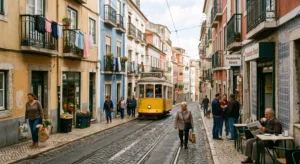
Lisbon sits on seven hills with the Atlantic at its back and three hours of daylight left after you’ve seen the Baixa grid. That’s the math. You’ll exhaust the city’s core in three full days — Alfama’s fado houses, Belém’s towers, the tram 28 circuit done before the cruise crowds arrive at 10am. After that, you’re either repeating yourself or leaving.
The right call: leave. Portugal’s capital is a base, not a boundary. Within 90 minutes by train, you reach medieval towns that predate Portugal itself, Atlantic cliffs that drop into nothing, and palaces built by kings who understood that power looks better from a hilltop. The wrong guide tells you to see everything from Lisbon. This one tells you which five trips justify the train fare — and which tourist trap to skip entirely.
What Lisbon Gives You as a Base — and What It Doesn’t
Lisbon rewards slow mornings and late dinners. It punishes rushing. The city’s public transport works — the metro runs clean and on time, the trams are functional if overcrowded, and a single 24-hour pass costs €6.80 (2025–2026 rates — verify before travel). But Lisbon’s geography works against day-trippers: the main train stations scatter across the city like afterthoughts.
Rossio handles Sintra. Cais do Sodré serves Cascais. Santa Apolónia and Oriente point east toward Évora. Get the station wrong and you’ve lost an hour before you’ve bought a ticket.
Here’s what most guides skip: Lisbon’s day trips require different planning than the city itself. You can’t wing Sintra in August and expect to enter Pena Palace. You can’t show up at Óbidos at noon on a Saturday and find parking within walking distance. The city forgives improvisation; the countryside doesn’t.
The Five Day Trips from Lisbon Worth Your Time
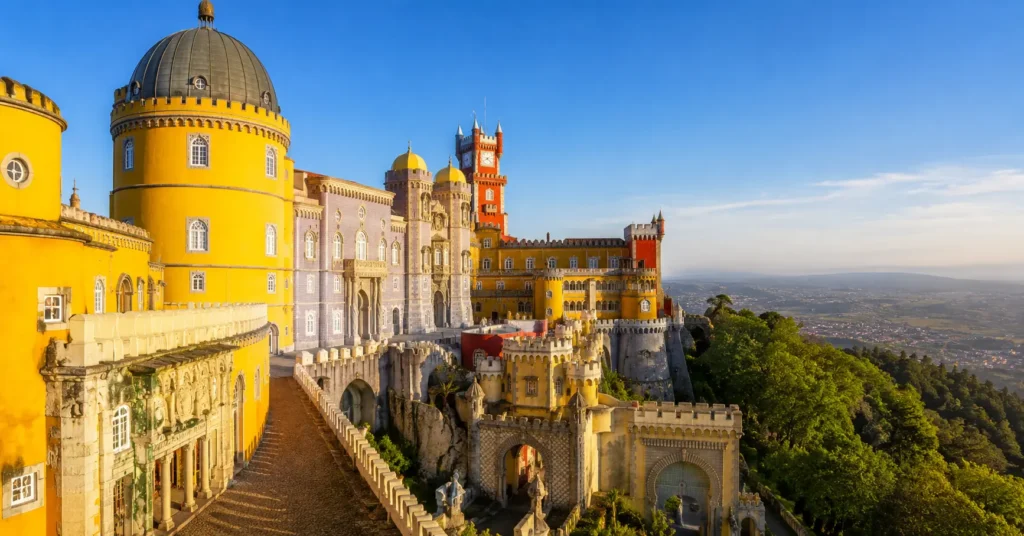
Sintra is the obvious answer. It’s also the correct one. The 40-minute train from Rossio Station deposits you in a village that looks like it was designed for a Grimm fairy tale — because it was, essentially. Kings built summer palaces here starting in the 15th century, each more elaborate than the last. Pena Palace, the Technicolor confection perched on the highest peak, costs €28 for the palace and park combined (2025–2026 rates — verify before travel). Book online at least three days ahead. Same-day tickets vanish by 10am from May through September.
But Sintra isn’t one destination. It’s four. The Moorish Castle walls snake along the ridge for €12. Quinta da Regaleira’s initiation wells and grottoes cost €10 and require two hours minimum. Monserrate Palace, the forgotten cousin, charges €10 and gets a fraction of Pena’s crowds. You can’t do all four in one day without turning it into a checklist. Pick two. Pena plus Regaleira is the classic route. Pena plus the Moorish Castle gives you history without the mysticism.
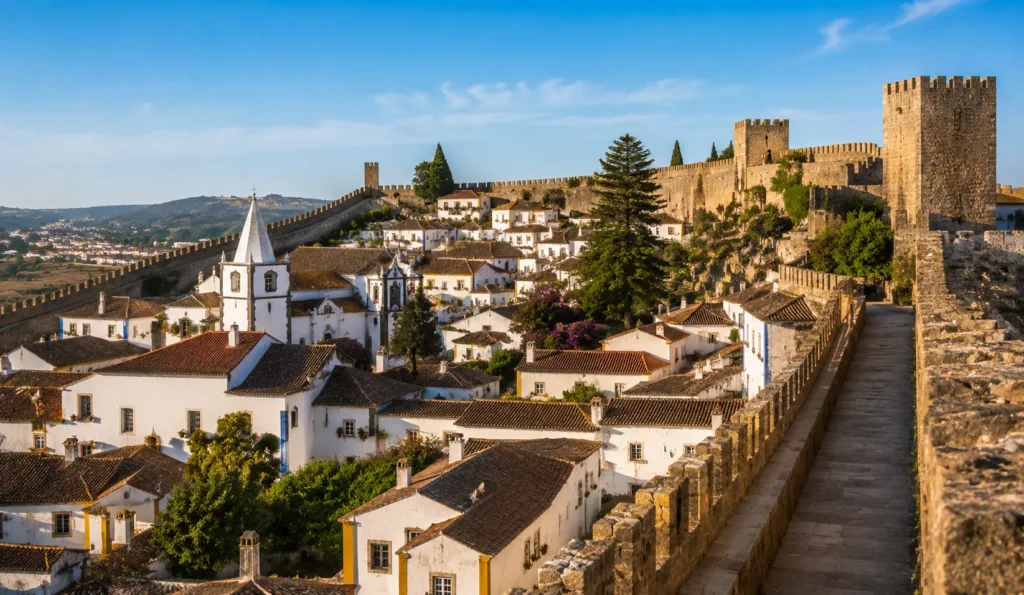
Óbidos is the medieval alternative. The 75-minute bus from Campo Grande station (not a train — the rail line doesn’t go there) delivers you to a walled town where whitewashed houses spill down to a 13th-century castle. Entry to the walls costs €4.50. The castle itself is a pousada now — you can’t tour it unless you’re staying overnight, which costs €200+ and books months ahead. Walk the walls instead. The view over terracotta roofs and the Atlantic beyond justifies the climb.
Cascais is the coastal escape. The 40-minute train from Cais do Sodré runs every 20 minutes and costs €2.30 each way with a Viva Viagem card. This was Lisbon’s summer playground in the 19th century, and it still functions that way — except now the beach crowds are international. The historic center packs into a walkable grid. Boca do Inferno, the cliff formation where the Atlantic smashes into rock, sits 20 minutes west on foot. Go at sunset. The light turns the spray gold.
Évora demands a full day and €60–€80 per person (2025–2026 rates — verify before travel). The 90-minute train from Évora Station — actually, correction, the bus from Oriente Station takes 90 minutes; the train requires a change and takes closer to two hours — delivers you to a UNESCO World Heritage city in the Alentejo plains. The Roman Temple of Évora, misnamed as the Temple of Diana, dates to the 1st century.
The Chapel of Bones, decorated with the skulls and femurs of 5,000 monks, opens at 9am and costs €5. The cathedral entry is €7. You’ll walk between all three in under 15 minutes. That’s the efficiency. The trade-off: Évora feels like a museum town by 5pm when the day-trippers leave and the locals reclaim the plazas.
Nazaré is the wildcard. The 2.5-hour bus from Sete Rios station (€18 round-trip, 2025–2026 rates — verify before travel) gets you to a fishing village that became famous for 100-foot waves. In winter, big-wave surfers chase swells at Praia do Norte.
In summer, it’s a quiet beach town where grandmothers still wear the traditional seven-petticoat dress. The funicular up to Sítio, the clifftop district, costs €3.50 round-trip. The view from the lighthouse justifies it.
| Destination | Transport Time | Cost (2025–26) | Best For | Limitation |
|---|---|---|---|---|
| Sintra | 40 min train | €40–60/person | First-timers, palace lovers | Advance booking essential |
| Óbidos | 75 min bus | €25–35/person | Medieval architecture, photography | Limited evening transport |
| Cascais | 40 min train | €15–25/person | Beach day, easy logistics | Can feel crowded in summer |
| Évora | 90 min bus | €60–80/person | History, UNESCO sites | Longest travel time |
| Nazaré | 2.5 hr bus | €30–40/person | Coastal scenery, surfing culture | Furthest from Lisbon |
Getting There: Real Train Times, Costs, and Booking Windows
Rossio Station sits in the Baixa, five minutes from Restauradores metro. Trains to Sintra run every 15 minutes from 6am to 1am. The fare is €2.30 each way with a Viva Viagem card — the reloadable green card you buy at any station for €0.50. Don’t buy single tickets. They cost more and create paper waste. Load €10 onto the card. Use it for metro, trams, and Sintra trains.
Cais do Sodré handles Cascais. Same card, same fare structure. Trains run every 20 minutes. The line hugs the coast after Belém, giving you river views that turn to ocean. Sit on the right side heading west.
Óbidos and Nazaré require buses, not trains. FlixBus and Rede Expressos both serve these routes. Book online 2–3 days ahead in summer — not because seats sell out, but because prices rise 20–30% at the last minute. The bus from Campo Grande to Óbidos leaves at 8:30am, 11am, 2pm, and 5pm on weekdays. Fewer on weekends. Plan your return before you leave Lisbon.
Évora’s bus from Oriente Station is faster than the train. The rail route requires a change at Casa Branca and takes 2 hours 15 minutes. The bus does it in 90 minutes direct. Rede Expressos runs six departures daily. The first leaves at 7am — take it. You’ll have Évora to yourself until 10am.
What Each Trip Actually Costs (2025–2026)
Budget tier: €35–50 per person. This gets you Sintra or Cascais — train fare, one paid attraction, lunch at a tascas-style restaurant, and a pastel de nata. You’ll walk between sites and skip the guided tours.
Mid-range tier: €60–100 per person. This covers Évora or a fuller Sintra day — transport, two or three paid entries, sit-down lunch with wine, and maybe a guided tour of Pena Palace’s interiors.
Premium tier: €120+ per person. Private driver to Sintra (€150–200 for the day, split between four people), skip-the-line tickets, lunch at a palace restaurant, and a guide who knows which doors are usually locked.
All costs are 2025–2026 rates — verify before travel. Portugal’s inflation has stabilized, but transport fares adjust annually.
What to Skip — and Where to Go Instead
Queluz Palace looks like Versailles designed by someone who’d only seen postcards. The 20-minute train from Lisbon stops there en route to Sintra. The €12 entry fee buys access to rooms last renovated in the 1980s and gardens that feel underfunded. Portugal’s royal family used Queluz as a summer residence for 50 years before abandoning it for — you guessed it — Sintra. They knew something.
Take that €12 and the hour you’d spend at Queluz. Add it to your Sintra budget. Visit Monserrate Palace instead. It costs the same €10, gets a third of the crowds, and features Gothic, Indian, and Moorish architecture blended into something genuinely unique. The gardens alone justify the trip.
Frequently Asked Questions About Day Trips from Lisbon
What is the best day trip from Lisbon for first-time visitors?
Sintra is the essential first choice. The 40-minute train from Rossio Station gets you to fairy-tale palaces and Moorish ruins. Buy the €28 Pena Palace ticket online at least three days ahead — same-day tickets often sell out by 10am in peak season.
How much should I budget for a day trip from Lisbon?
Budget €35–€50 per person for Sintra or Cascais (train, entry fees, lunch). Évora runs €60–€80 due to longer transport and multiple paid sites. All costs are 2025–2026 rates — verify before travel.
Do I need to book day trips from Lisbon in advance?
For Sintra’s Pena Palace, yes — book 3–7 days ahead online. For Óbidos, Cascais, and Évora trains, no advance booking needed. Purchase tickets at the station on the day. Summer weekends require earlier arrival but not pre-booking for transport.
Which day trip from Lisbon can I skip?
Queluz Palace looks like a smaller, less-maintained Versailles from the train window. The €12 entry fee buys 45 minutes of faded grandeur. Take that money and extra hour to Sintra instead — you’ll see why Portugal’s royalty abandoned Queluz for the hills.
Can I visit multiple destinations in one day?
Don’t. Sintra alone requires a full day. Cascais and Sintra can combine if you skip palace interiors and focus on exteriors and gardens, but you’ll spend three hours on trains and rush both. Pick one destination per day. The quality of the experience drops sharply when you try to do more.
Continue Exploring
- Lisbon Travel Guide — Once you’ve exhausted the day trips, return to the capital with this complete guide to neighborhoods, restaurants, and the logistics of navigating seven hills.
- Portugal Travel Guide — Ready to leave Lisbon behind entirely? This pillar guide covers the Algarve’s beaches, Porto’s wine cellars, and the Douro Valley’s terraced vineyards with the same honest specificity.