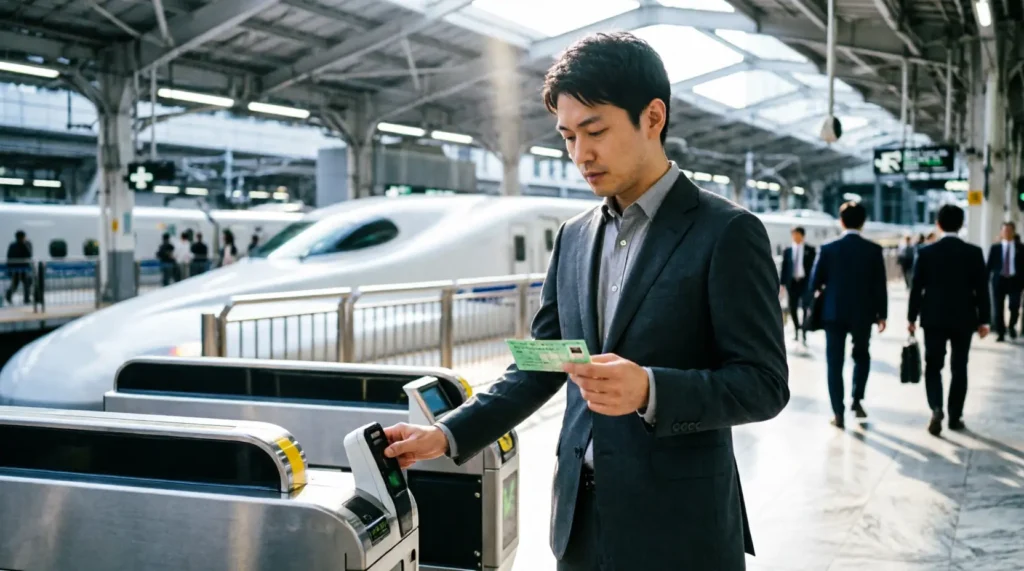
The Japan Rail Pass isn’t what it used to be. In 2026, it’s a calculation, not a default. I learned this standing at Tokyo Station’s Shinkansen gates at 7:15am, IC card in one hand, JR Pass exchange order in the other, watching commuters flow through with the precision of a metronome. The system rewards preparation.
This japan rail pass guide cuts through marketing to give you exact break-even math, regional alternatives, and the honest truth about when to skip it entirely. You’ll leave knowing precisely whether the JR Pass saves you money—or costs you ¥10,000 unnecessarily. (Schedules change — confirm before travel)
Quick Overview
The nationwide JR Pass increased sharply in October 2023. Current rates: 7-day Ordinary Pass ~¥50,000, 14-day ~¥80,000, 21-day ~¥100,000 (2025–2026 rates — verify before travel). It covers most JR-operated Shinkansen (except Nozomi/Mizuho), limited express trains, local JR lines, and the JR ferry to Miyajima. It does not cover private railways, subways, or buses.
What changed in 2023 (and why it matters)
Before 2023, the JR Pass was a near-automatic buy for most multi-city itineraries. The price increase flipped the equation. A Tokyo-Kyoto round trip on Hikari Shinkansen costs ~¥28,000 one-way. Round trip: ~¥56,000. The 7-day pass costs ~¥50,000—but only if you add a third leg (e.g., Kyoto-Hiroshima) does it break even. For many first-time visitors doing just Tokyo-Kyoto-Tokyo, individual tickets now save money.
Who should still consider it
Travelers covering 3+ long-distance segments in 7 days. Example: Tokyo → Kyoto → Hiroshima → Tokyo. Or those adding side trips like Kanazawa or Takayama. If your itinerary clusters in one region, a regional pass often delivers better value (see Budget Guide).
Top Things to Do
Routes where the pass pays for itself
The JR Pass unlocks efficient access to Japan’s cultural spine. Tokyo to Kyoto (2h15m on Hikari) lets you experience the Shinkansen’s quiet precision—no announcements above a murmur, phones silenced, luggage stored overhead. From Kyoto, a 1h40m ride to Hiroshima on the Sakura Shinkansen (covered) delivers you to the Peace Memorial by lunch. Add a day trip to Miyajima via the included JR ferry. This triangle is the classic break-even scenario.
Experiences unlocked by rail access
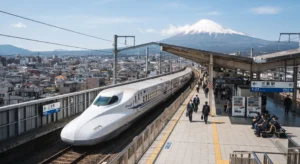
Rail travel in Japan is part of the cultural experience. The moment the train departs Tokyo Station and Mount Fuji appears on the right at Shin-Fuji—clear, snow-capped, framed perfectly by the window—is worth the price of admission alone. The JR Pass lets you chase these moments without ticket-line friction. But remember: the pass is a tool, not the destination. [IL → /kyoto-hidden-temples/ | Kyoto temples beyond Kiyomizu-dera] offers deeper cultural context once you arrive.
Where to Stay
Activation strategy: which stations to target
Activate your JR Pass at major JR hubs: Tokyo, Shinagawa, Shin-Osaka, or Kyoto Stations. These offices have English support and shorter queues early morning. If arriving at Narita, activate at Narita Airport Station (JR East office) to cover your transfer into Tokyo. Pro tip: activate on the day you need it, not arrival day—the pass runs on consecutive calendar days, not 24-hour periods. Staying near a JR Yamanote Line station (Tokyo) or JR Kyoto Line station (Kyoto) maximizes convenience. [IL → /tokyo-itinerary-7-days/ | Tokyo 7-day itinerary] details neighborhood logistics.
Getting Around
JR Pass vs IC card: when to use which
Carry both. The JR Pass covers intercity JR trains. An IC card (Suica or Pasmo) handles everything else: Tokyo Metro, Kyoto buses, convenience stores, vending machines. At Tokyo Station, you’ll tap your IC card for the Yamanote Line to reach your hotel, then present your JR Pass at the Shinkansen gates. The system works because everyone agrees it does—and because you prepared. Load ¥2,000–3,000 onto your IC card initially; you can refill anywhere.
Seat reservations: the 30-second process
Reservations are free with the JR Pass. Visit any JR ticket office, show your pass, and request seats for your planned segments. Staff will print reserved-seat tickets instantly. For Tokyo-Kyoto on a weekday morning, unreserved cars are usually fine. For Kyoto-Hiroshima on a Saturday, reserve. The process takes less time than reading this sentence. (Schedules change — confirm before travel)
Budget Guide
Break-even calculator: Tokyo-Kyoto-Hiroshima example
- Tokyo → Kyoto (Hikari): ~¥14,000
- Kyoto → Hiroshima (Sakura): ~¥11,000
- Hiroshima → Tokyo (Sakura/Hikari): ~¥20,000
- Total individual tickets: ~¥45,000
- 7-day JR Pass: ~¥50,000
- Verdict: Pass costs ~¥5,000 more but adds flexibility for day trips (e.g., Nara, Miyajima). If you add one more segment (e.g., Hiroshima → Osaka → Tokyo), the pass breaks even.
Regional passes that often beat the national JR Pass
Here’s the honest negative: For many itineraries, the nationwide JR Pass is overkill. If you’re focusing on Kansai (Kyoto, Osaka, Nara, Himeji), the JR Kansai-Hiroshima Pass (~¥19,000 for 5 days) covers everything you need at less than half the cost. Exploring Tohoku? The JR East Pass (~¥30,000 for 5 flexible days) includes Nikko and Sendai. Always run the math for your specific route before buying the national pass. [IL → /japan-budget-travel-2026/ | Japan travel costs 2026] breaks down daily expenses beyond rail.
Sample Itinerary
7-day Golden Route with exact rail costs
Day 1: Arrive Tokyo. Activate JR Pass. Use IC card for local transit.
Day 2: Tokyo → Kyoto (Hikari, reserved seat, ~2h15m).
Day 3: Kyoto day trip to Nara (JR Nara Line, covered).
Day 4: Kyoto → Hiroshima (Sakura, ~1h40m). Afternoon at Peace Memorial.
Day 5: Hiroshima → Miyajima (JR ferry, covered). Return to Hiroshima.
Day 6: Hiroshima → Tokyo (Sakura/Hikari, ~4h).
Day 7: Tokyo local exploration. Pass expires midnight.
Total rail cost with individual tickets: ~¥45,000. With JR Pass: ~¥50,000. The pass buys flexibility, not savings, on this exact route.
Pro Tips
Etiquette on Japanese trains
Silence is the norm. Phone calls are frowned upon; set devices to silent. Priority seating is for elderly, disabled, or pregnant passengers—vacate immediately if someone qualifying boards. Eating is acceptable on Shinkansen (ekiben boxes are part of the experience) but avoid strong odors. This isn’t rigidity; it’s a social contract that keeps a 13-million-person city moving smoothly.
Luggage rules you can’t skip
Shinkansen now require reservations for oversized luggage (total dimensions 161–250cm). Book these when reserving seats—no extra cost with JR Pass. Standard suitcases fit overhead. For the Tokyo-Kyoto leg, consider forwarding luggage via Yamato Transport (Takkyubin) to your Kyoto hotel (~¥2,000, next-day delivery). It’s a local secret that turns travel day into a sightseeing day. (2025–2026 rates — verify before travel)
Frequently Asked Questions About Japan Rail Pass Guide
Can I use the Japan Rail Pass on the Nozomi Shinkansen?
No. The JR Pass covers Hikari and Kodama Shinkansen between Tokyo and Kyoto/Osaka. Nozomi trains require a separate ticket. The time difference Tokyo-Kyoto is ~15 minutes—rarely worth the extra cost for most travelers.
Do I need to reserve seats with a JR Pass?
Reservations are free with the JR Pass but not always required. For popular routes (Tokyo-Kyoto, Kyoto-Hiroshima) or peak seasons, reserve at any JR ticket office. Unreserved cars are available but can fill quickly during holidays.
Is the JR Pass valid on local Tokyo subways?
Only on JR-operated lines (Yamanote, Chuo, Keihin-Tohoku). Tokyo Metro and Toei Subway lines require a separate IC card (Suica/Pasmo). Most travelers use both: JR Pass for intercity, IC card for local transit.
Can I buy a JR Pass after arriving in Japan?
As of 2026, the JR Pass must be purchased outside Japan through authorized agents. You receive an exchange order, then activate the pass at a JR office after arrival. (Verify at https://www.japanrailpass.net/ — rules change without notice)
Continue Exploring
- How to navigate Tokyo Station without stress — Go deeper on mastering Japan’s busiest transit hub, from luggage forwarding to platform shortcuts.
- South Korea’s KORAIL Pass compared — Expand your planning: see how Japan’s rail system contrasts with Korea’s for multi-country Asia trips.