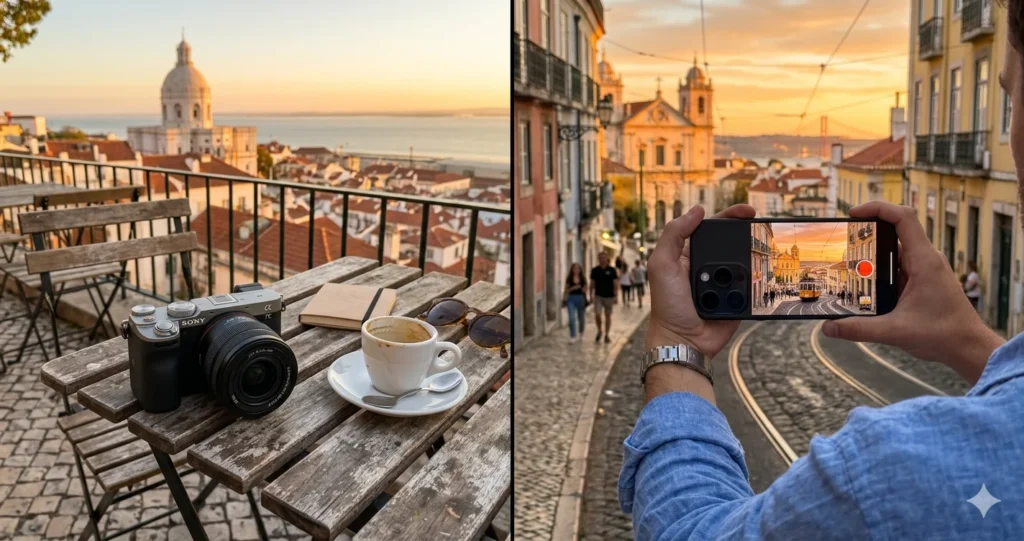
Computational photography has reached a ceiling that physics refuses to break. In 2026, the iPhone 17 Pro Max can simulate a shallow depth of field with 90% accuracy in daylight, but it still falls apart when faced with the erratic light of a rainy Tokyo alleyway. I spent three weeks across Japan this year carrying both the Sony A7C II and the latest flagship phone, and the difference wasn’t found on my Instagram feed—it was found when I tried to print a 24×36 crop of a Shinjuku street scene. The phone’s version looked like a watercolor painting once enlarged; the mirrorless file held the texture of the asphalt.
This post breaks down the logistics, real-world costs, and hard trade-offs of the best travel camera systems available today so you don’t waste $2,000 on a kit that stays in your hotel room.
Quick Verdict: The 2026 Winners
| Use Case | Recommended Gear | Weight (Body + Lens) | 2026 Est. Price |
|---|---|---|---|
| The Professional Minimalist | Sony A7C II + 28-60mm | 675g | $1,999 |
| The Social Storyteller | iPhone 17 Pro Max | 227g | $1,999 |
| The Aesthetic Purist | Fujifilm X100VI | 521g | $1,599 |
| The Budget Explorer | Canon EOS R50 | 375g | $679 |
Overview: The State of Travel Gear in 2026
The market has bifurcated. We are no longer comparing “quality”; we are comparing “friction.” A smartphone offers zero friction but limited latitude. A mirrorless system offers maximum latitude but requires a deliberate commitment to carry.
For the deliberate planner, the decision hinges on the Specificity Test: Are you shooting for a 6-inch screen or for a lifetime of memories? If you intend to crop your photos or shoot in environments with high dynamic range (think sunsets behind cathedral spires), the best travel camera remains a dedicated sensor.
Key Differences: Physics vs. Algorithms
The gap between a flagship phone and a mirrorless camera in 2026 is defined by three metrics:
- Sensor Surface Area: A full-frame sensor (36 x 24mm) is significantly larger than the 1/1.28″ sensor in most flagship phones. This isn’t just about megapixels; it’s about light collection.
- Optical Reach: Digital zoom is still just “cropping and praying.” A dedicated 70-200mm lens uses glass to pull distant subjects closer without losing resolution.
- Ergonomics: In 10°C weather in the Swiss Alps, tactile dials beat a freezing touchscreen every single time.
For the Semi-Pro Traveler: Sony A7C II
Price: ~$1,799 (Body only) | (2025–2026 rates — verify before travel)
- Who it’s for: The traveler doing 2+ weeks in Europe who wants professional-grade files but refuses to carry a camera bag larger than a 6L sling.
- Why it earns its place: It is the smallest full-frame body with a 33MP sensor and class-leading AI autofocus. I’ve tracked erratic puffins in Iceland with this AF system, and it didn’t miss a single frame.
- Honest trade-off: The viewfinder is cramped. If you wear glasses, you will find yourself squinting or relying entirely on the rear LCD.
- Alternative: Choose the Sony A7R V if you need 61MP for massive landscape prints, but be prepared for the 200g weight penalty.
For the High-Speed Creator: iPhone 17 Pro Max
Price: ~$1,199 (256GB) | (2025–2026 rates — verify before travel)
- Who it’s for: The solo traveler who prioritizes immediate sharing, 4K stabilized video for Reels, and keeping their pockets light.
- Why it earns its place: The integration of “Visual Intelligence” in 2026 allows for instant metadata tagging of locations and landmarks. Its 4K 120fps video is more stable than many mirrorless setups without a gimbal.
- Honest negative: The 5x telephoto lens (120mm equivalent) is still a tiny sensor. In anything less than bright noon sun, the “8K” zoom looks grainy and lacks the “pop” of a dedicated lens.
- Alternative: Choose the Samsung S26 Ultra if you prioritize raw zoom distance (100x Space Zoom) over the color science and video stability of iOS.
Cost Comparison: The Total Kit Price
When calculating the cost of the best travel camera, planners often forget the “Tail Costs.”
- Sony A7C II Kit: $1,799 (Body) + $400 (Lens) + $150 (Extra Batteries/SD Cards) = $2,349.
- iPhone 17 Pro Max: $1,199 (Phone) + $50 (Cloud Storage/Case) = $1,249.
The mirrorless system is nearly double the cost once you factor in glass. However, its resale value remains higher. A three-year-old Sony body typically retains 60% of its value; a three-year-old phone is lucky to hit 30%.
Final Recommendation: The Use-Case Verdict
If you are traveling to Iceland for the Northern Lights or Kenya for a safari, do not rely on a phone. The physics of low-light long exposures and telephoto reach will fail you. Buy the Sony A7C II.
If you are hopping between European capitals and your primary goal is documenting the food and the vibe for social circles, the iPhone 17 Pro Max is the correct logistical choice.
Discover more essentials in our comprehensive Travel Gear guide for a full breakdown of how to pack these systems.
Frequently Asked Questions About Travel Cameras
Is the Fujifilm X100VI better than a smartphone?
For the “look,” yes. The X100VI uses 40MP APS-C sensors and film simulations that produce JPEGs requiring zero editing. However, it has a fixed 35mm lens. If you need to zoom in on a distant mountain peak, you’re better off with a smartphone’s telephoto lens or a zoom-capable mirrorless body.
Do I need a tripod for travel photography in 2026?
Only for two scenarios: astrophotography or long-exposure waterfalls. Modern In-Body Image Stabilization (IBIS) in cameras like the Sony A7C II allows for sharp 1-second handheld shots. For most travelers, a tripod is 1.5kg of dead weight that rarely leaves the suitcase.
Should I buy a camera in a different country to save on tax?
(Schedules change — confirm before travel). While “Tax-Free” shopping in Japan or the UAE can save you 10-15%, be warned that many Japanese-market Sony cameras are locked to the Japanese language menu with no way to switch to English. Always verify regional lock status before purchasing abroad.
Continue Exploring:
- Top 3 lenses for travel photography – A guide to the only glass you actually need.
- How to save on flights to fund your gear – Tips for finding the budget to afford that new mirrorless body.