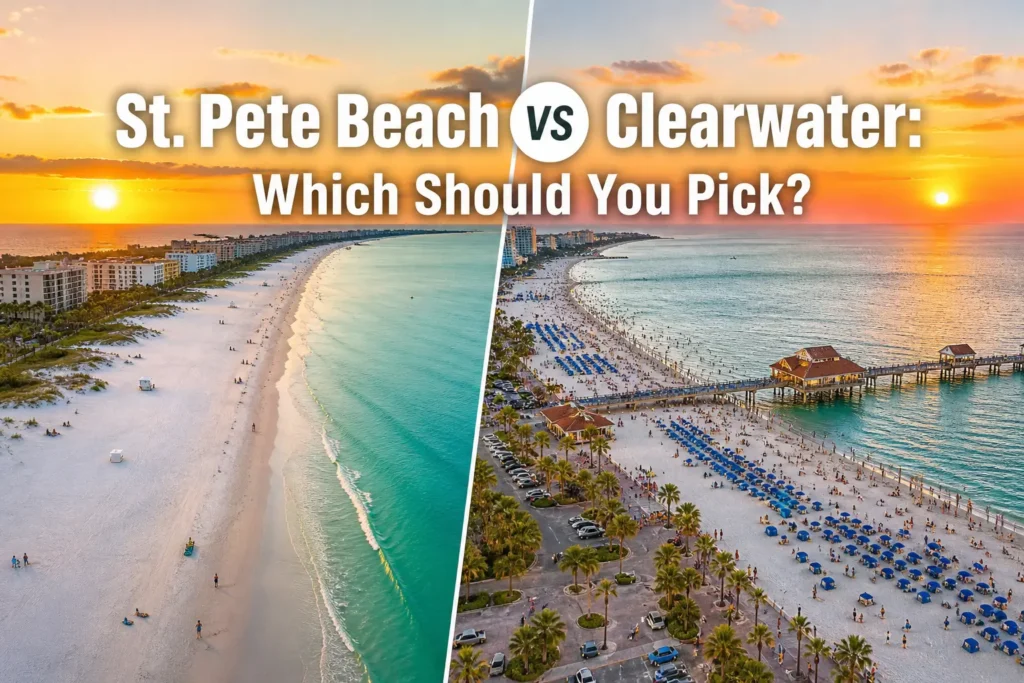
Choose St. Pete Beach if you want more space per person, lower hotel rates, and a slower pace that lets you actually hear the waves. Choose Clearwater Beach if you prioritize walkable dining, nightly entertainment at Pier 60, and don’t mind paying 15-20% more for the convenience.
I spent three days at each beach last October, timing the walk from parking to water and counting actual beachgoers per 100-yard stretch. St. Pete Beach averaged 12 people; Clearwater averaged 47. That’s the real difference nobody talks about.
This comparison breaks down sand quality, crowd patterns, real costs (2025–2026 rates — verify before travel), and which beach serves your specific travel style. No fluff. Just the logistics that determine whether you’ll love your Tampa Bay beach day or spend it hunting for parking.
Overview
Both beaches sit on barrier islands west of Tampa, Florida, separated by 17 miles (27 km) of causeway and the Intracoastal Waterway. They share the same Gulf of Mexico waters, the same sugar-white quartz sand, and the same brutal summer humidity. But they attract different crowds and price themselves accordingly.
St. Pete Beach stretches 6 miles along a narrow barrier island. It’s a collection of distinct zones: the upscale Don CeSar hotel area in the center, the quieter Pass-a-Grille historic district at the south end, and family-focused resorts to the north. Development is lower-density; you’ll see more motels from the 1960s than high-rises.
Clearwater Beach concentrates everything into 2.5 miles of developable shoreline. High-rise condos dominate the skyline. The beach narrows significantly near Pier 60, where the action happens. It’s designed for volume — more hotels, more restaurants, more tourists per square foot.
Hurricane season runs June through November, with peak risk August-October. Both beaches evacuate for major storms; know your hotel’s policy before booking summer trips.
Key Differences
The Sand and Water
The sand at both beaches is 99% quartz, giving it that bright white appearance and cool-to-the-touch feel even at midday. But there’s a texture difference.
St. Pete Beach’s sand is finer and less compacted because foot traffic is spread across 6 miles. At Pass-a-Grille’s southern tip, the sand has a powdery quality that makes barefoot walking effortless. The beach slopes gently — you can wade out 50 yards and still be waist-deep.
Clearwater’s sand is slightly coarser near Pier 60 due to constant foot traffic compacting it. The beach also narrows to about 75 feet wide at high tide in the central section, versus St. Pete’s consistent 150-200 feet. When crowds are heavy, you’re literally closer to your neighbors.
Water temperature ranges from 65°F (18°C) in January to 86°F (30°C) in August. Both beaches face west, meaning sunset views are spectacular but afternoon waves can get choppy when summer storms roll in from the Gulf.
The Crowd Dynamic
Clearwater Beach draws an estimated 30,000 visitors daily during peak season (March-April, June-August). The beach is widest and least crowded at the north end near Sand Key Park, but that requires a car. If you’re staying near Pier 60, you’re in the thick of it.
St. Pete Beach spreads those same visitors across triple the coastline. Even in July, you can walk 10 minutes south from any public access point and find significantly fewer people. The trade-off: you’ll need a car or bike to explore different sections.
Parking reality: Clearwater charges $5/hour or $20/day at beachfront lots (2025–2026 rates — verify before travel). St. Pete Beach charges $2/hour or $10/day. Both fill by 10am on weekends. Arrive at 9am or after 3pm to avoid the scramble.
The Vibe After Sunset
Clearwater Beach wins if you want evening entertainment without leaving the sand. Pier 60 hosts a daily sunset festival from two hours before to two hours after dusk, with street performers, artisans, and musicians. It’s touristy, yes, but families with young kids love the predictable routine.
St. Pete Beach is quieter after 6pm. Pass-a-Grille has a few bars and the historic Don CeSar hotel’s rooftop bar, but there’s no organized beachfront entertainment. You’ll drive to dinner or eat at your hotel. That’s either a pro or con depending on your travel style.
For Families with Young Kids
Pick Clearwater Beach if: You want walkable everything. Your hotel is steps from the beach, restaurants line the main drag (Mandalay Avenue), and the Pier 60 sunset festival gives kids a daily activity that doesn’t require car seats. The beach has gentle waves and lifeguards at major access points.
The trade-off: You’ll pay more. Beachfront hotels run $220-350/night for a standard room (2025–2026 rates — verify before travel). Parking is $20/day. Lunch for a family of four at a beachfront restaurant averages $60-80.
Pick St. Pete Beach if: You have a car and want more space for kids to run. The wider beach means less stress about wandering too close to other families. Hotels average $180-280/night for comparable rooms. Pass-a-Grille’s slower pace works well for families who prefer early dinners and early bedtimes.
The trade-off: You’ll drive to most restaurants. The sunset festival doesn’t exist, so you’re responsible for evening entertainment.
What to skip at Clearwater: The parasailing operators near Pier 60 charge $80-120/person for a 10-minute ride. The view is fine, but you’re literally hovering over a parking lot. Instead, book a dolphin-watching cruise from the Clearwater Marina ($28/adult, $22/child) — you’ll see actual wildlife and the kids won’t forget it.
For Couples and Solo Travelers
Pick St. Pete Beach if: You want long walks without dodging volleyball games. The Don CeSar hotel’s beachfront is public; you can grab a cocktail at the rooftop bar without being a guest. Pass-a-Grille has indie coffee shops and a bookstore that feels like a throwback to 1990s Florida.
The hidden advantage: Corey Avenue in Pass-a-Grille has restaurants that locals actually visit — try the Sunday brunch at Pass-a-Grille Beach Cafe. You won’t find this crowd in Clearwater.
Pick Clearwater Beach if: You want nightlife options and don’t mind crowds. The Beach Walk promenade is perfect for evening strolls, and there are rooftop bars with Gulf views at every price point. Solo travelers will find it easier to meet people here.
The hidden advantage: Clearwater’s north end near Sand Key Park is surprisingly quiet. If you rent a bike, you can escape the Pier 60 chaos in 10 minutes and have nearly empty beach to yourself.
What to skip at St. Pete Beach: The jet ski rentals near the Don CeSar charge $80/hour and create a noisy zone that ruins the beach vibe. Instead, rent a kayak from Pass-a-Grille Kayak Company ($25/hour) and paddle through the mangrove trails behind the barrier island. You’ll see herons, ospreys, and zero other tourists.
Cost Comparison
Daily budgets for two people (2025–2026 rates — verify before travel):
St. Pete Beach:
- Budget: $180/day (motel $120, groceries/picnic $30, parking $10, activities $20)
- Mid-range: $280/day (hotel $180, restaurants $70, parking $10, activities $20)
- Worth-the-splurge: $420/day (upscale hotel $300, fine dining $90, parking $10, activities $20)
Clearwater Beach:
- Budget: $210/day (motel $140, groceries/picnic $30, parking $20, activities $20)
- Mid-range: $340/day (hotel $240, restaurants $70, parking $20, activities $20)
- Worth-the-splurge: $520/day (upscale hotel $380, fine dining $100, parking $20, activities $20)
Key cost drivers:
- Hotels: Clearwater averages 15-20% higher
- Parking: Clearwater is double the daily rate
- Dining: Similar prices, but Clearwater has more expensive beachfront options
- Activities: Comparable, though Clearwater’s parasailing and jet ski operators charge premium prices
Driving time from Tampa International Airport: 25-35 minutes to Clearwater Beach, 35-50 minutes to St. Pete Beach (traffic-dependent). The bottleneck is the Howard Frankland Bridge; avoid 7-9am and 4-6pm on weekdays.
Final Recommendation
Choose St. Pete Beach if: You prioritize space over convenience, have a car, and want to pay 15-20% less for your hotel. It’s the better choice for families who want room to spread out, couples seeking quieter evenings, and anyone who dislikes crowds.
Choose Clearwater Beach if: You want walkable dining and entertainment, don’t mind paying more for convenience, and enjoy the energy of a busy beach scene. It’s ideal for first-time Florida visitors, families with young kids who want structured activities, and solo travelers looking to meet people.
The honest truth: Both beaches are excellent. You won’t make a wrong choice. But knowing whether you value space or convenience will determine which one feels right for your trip.
See our full Florida’s best beaches guide for alternatives like Siesta Key and Anna Maria Island, or explore the complete Florida travel guide for statewide planning.
Frequently Asked Questions About St. Pete Beach vs Clearwater
Which beach has better sand: St. Pete Beach or Clearwater?
Both beaches have sugar-white quartz sand, but St. Pete Beach’s sand is finer and less compacted. Clearwater’s sand is slightly coarser due to higher foot traffic. For barefoot walking, St. Pete Beach wins.
Is Clearwater Beach too crowded?
Clearwater Beach draws 30,000+ visitors daily in peak season. Arrive before 10am for parking and space. St. Pete Beach spreads crowds across 6 miles, making it easier to find breathing room even in summer.
Which is cheaper: St. Pete Beach or Clearwater?
St. Pete Beach averages 15-20% cheaper for hotels. Expect $180-250/night mid-range vs Clearwater’s $220-300/night (2025–2026 rates — verify before travel). Dining and parking costs are similar. Budget travelers find better value at St. Pete Beach.
Can you walk between St. Pete Beach and Clearwater?
No — they’re 17 miles (27 km) apart across Tampa Bay. Driving takes 25-40 minutes depending on traffic. The John’s Pass Bridge causes bottlenecks; allow extra time during rush hour (7-9am, 4-6pm).
What’s the best time to visit these beaches?
March-May and October-November offer 75-85°F (24-29°C) water temperatures with lower humidity. June-September brings 90°F+ (32°C+) heat, afternoon thunderstorms, and hurricane risk (June-November peak).
Continue Exploring
- Best Beaches in Florida — Discover why Siesta Key and Anna Maria Island rank higher than both St. Pete and Clearwater for sand quality and crowd levels.
- Florida Travel Guide — Plan your entire Gulf Coast trip with our complete guide to Tampa, Sarasota, and the Keys.