The best budget airlines for international travel in 2025–2026 are PLAY Airlines and Norwegian for transatlantic routes, and AirAsia and Scoot for Asia-Pacific. That’s the short answer. The longer one matters more: a $179 base fare becomes a $340 fare the moment you add a checked bag, a seat assignment, and a meal.
This guide ranks the carriers that genuinely save money after fees — and names the ones that look cheap until checkout.
Six carriers. Three regions. Real costs at every tier.
The Verdict Table — Budget Airlines Ranked by Region and Real Cost
The table below is the fastest way to match your route to the right carrier. Narrative detail follows for each.
| Carrier | Region | Base Fare (one-way) | With 20kg Bag + Seat | On-Time Rating | Best For |
|---|---|---|---|---|---|
| PLAY Airlines | Transatlantic | $129–$179 | $240–$310 | 78% | No-bag travelers, East Coast USA |
| Norwegian Air | Transatlantic | $159–$249 | $290–$380 | 81% | Widebody comfort, flexible dates |
| Level | Transatlantic | $179–$259 | $300–$390 | 76% | Barcelona connections, South America |
| AirAsia | Asia-Pacific | $45–$120 | $120–$200 | 82% | SE Asia regional hops |
| Scoot | Asia-Pacific | $180–$340 | $280–$440 | 84% | Long-haul Asia, reliability |
| Jetstar Intl | Asia-Pacific | $99–$220 | $180–$320 | 83% | Australia-Asia routes |
(2025–2026 rates — verify before travel. Fares fluctuate daily.)
Verdict by traveler type:
- Carry-on only, flexible dates, East Coast USA departure → PLAY
- Checking a bag, want a proper seat, transatlantic → Norwegian
- Southeast Asia regional travel → AirAsia
- Long-haul Asia-Pacific with reliability as a priority → Scoot
Transatlantic Budget Airlines — What You Pay vs. What You Get
Transatlantic budget airlines have a narrower field than Asia-Pacific. Three carriers do the work. Each solves a different problem.
Norwegian Air
Norwegian is the most established transatlantic budget carrier still operating at scale, and it’s the one to book when you’re checking a bag. Base fares on routes like New York JFK to London Gatwick or Paris CDG run $159–$249 one-way, booked 6–8 weeks out on Skyscanner or Google Flights. Add a 20kg checked bag ($55–$75) and a standard seat selection ($15–$35) and the all-in fare lands at $229–$359 — roughly 35–45% below comparable legacy economy on the same dates. (2025–2026 rates — verify before travel.)
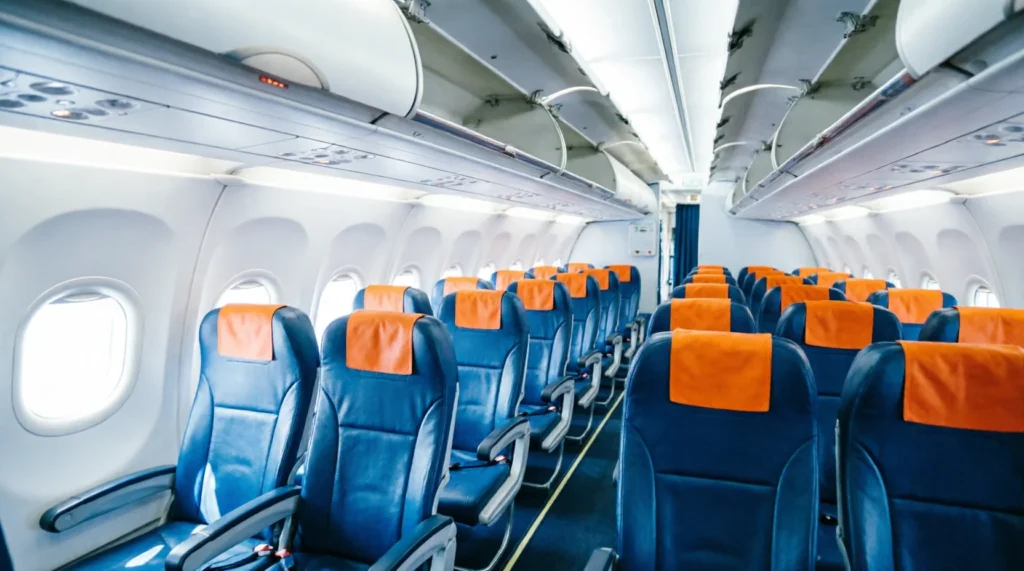
The aircraft are widebody Boeing 787s on transatlantic routes. Seat pitch is 31 inches — tighter than legacy economy at 32–33 inches, but not the 28-inch compression you’ll find on some short-haul budget carriers. I’ve done JFK–LGW on Norwegian twice. The seat is fine for eight hours if you’re under 6’1″. Above that, pay the $25 for a seat with extra legroom on row 40.
The honest negative: Norwegian’s customer service infrastructure when things go wrong is thin. A 2023 delay on my BCN departure took four hours to resolve because the airport desk had one staff member handling 40 passengers. EU261 compensation rules apply — Norwegian will pay — but you’ll wait weeks, not days, for the transfer. Know your rights before you check in, not after.
PLAY Airlines
PLAY is the cheapest transatlantic option for carry-on-only travelers departing from US East Coast cities. Base fares from Baltimore, Boston, New York, or Washington D.C. to Reykjavik start at $129–$149 one-way. Connections onward to 25+ European cities add $50–$120. Total cost: $179–$269 to most of Western Europe, carry-on only, booked 6–10 weeks out. (2025–2026 rates — verify before travel.)
The routing through Reykjavik adds 2–4 hours depending on connection time. That’s the trade. If you’re checking a bag, the math shifts — bag fees on PLAY run $55–$75 each direction, which erodes the fare advantage over Norwegian quickly. Use PLAY when you’ve mastered one-bag travel. Use Norwegian when you haven’t yet.
Level (Iberia Group)
Level operates transatlantic routes from Barcelona and Amsterdam, with connections into South America — Buenos Aires and Bogotá specifically — that no other budget carrier covers at comparable prices. Base fares from Barcelona to Buenos Aires run $299–$399 one-way, against $650–$900+ on legacy carriers for the same dates. (2025–2026 rates — verify before travel.)
On-time performance (76%) is the weakest of the three transatlantic carriers here. Book Level for South America connections and for Barcelona departures. Don’t book it when schedule reliability matters more than the fare saving.
Asia-Pacific Budget Airlines — The Strongest Market for Cheap International Flying
Asia-Pacific is the most competitive budget aviation market in the world, and the savings are proportionally larger than anywhere else. Three carriers dominate.
AirAsia
AirAsia covers more intra-Asia routes than any other budget carrier — 165+ destinations across Southeast Asia, with fares that regularly drop to $45–$80 one-way on routes like Kuala Lumpur to Bangkok, Singapore to Bali, or Bangkok to Hanoi. Booked 4–6 weeks out on the AirAsia app (which frequently runs app-exclusive promotions), an all-in fare with a 20kg bag runs $90–$160 on most regional routes. (2025–2026 rates — verify before travel.)
The AirAsia app is genuinely the best place to book — flash sales appear there 48–72 hours before they hit Skyscanner. Turn on notifications and check it the week you plan to travel.
The honest negative: AirAsia’s punctuality varies sharply by hub. Kuala Lumpur (KUL) departures run 82–85% on-time. Certain secondary hubs — Penang and Langkawi included — run closer to 68–72%. If you’re connecting onward, build a 3-hour buffer at KUL minimum.
Scoot
Scoot is the budget arm of Singapore Airlines, and that parentage matters. Its on-time performance (84%) is the highest of any carrier in this comparison. Its long-haul routes — Singapore to Tokyo Narita, Singapore to London Gatwick, Singapore to Sydney — use Boeing 787-9 aircraft with 29-inch seat pitch in standard economy.
That’s tight for 13 hours to London. It’s manageable for 7 hours to Tokyo, and the fare saving against Singapore Airlines on the same route runs $280–$450 per person return. (2025–2026 rates — verify before travel.)
Scoot’s ScootPlus cabin (the middle tier between economy and business) runs $120–$180 more than economy one-way on long-haul routes. For anything over 9 hours, that upgrade is worth pricing. The seat becomes a 35-inch pitch lie-flat-adjacent configuration that genuinely changes the calculus on overnight flights.
Jetstar International
Jetstar’s strength is Australia-Asia routes: Sydney to Bali, Melbourne to Tokyo, Brisbane to Singapore. Backed by Qantas, its operational reliability and customer service infrastructure are the most robust of the Asia-Pacific budget carriers. Base fares from Sydney to Bali run $99–$149 one-way, all-in with a 20kg bag at $160–$230. (2025–2026 rates — verify before travel.)
Jetstar’s Starter Plus and Flex bundles make the total fare visible before checkout — no surprises at the bag drop. For first-time budget airline travelers in the Asia-Pacific region, Jetstar is the lowest-friction introduction to the category.
Budget Airlines That Disappoint — And Why They’re Still on Lists
Two carriers appear in nearly every “best budget airlines” roundup and shouldn’t headline your booking decision.
Wizz Air operates competitive fares across Eastern Europe and into the Middle East, but its Wizz Priority membership ($65–$85/year) has become a near-mandatory purchase for carry-on access on most routes — without it, your cabin bag goes in the hold at $30–$50 per flight. Price the full cost before booking, not the base fare. (2025–2026 rates — verify before travel.)
Ryanair is the cheapest airline in Europe on paper and frequently the most expensive in practice for travelers who don’t read the fare rules. The 10kg carry-on limit (enforced aggressively at gates since 2023), mandatory check-in at $55 if not done online, and $35–$55 bag fees make the $29 base fare a starting point, not a price. Ryanair works perfectly when you know exactly what you’re buying. It is a trap for anyone who doesn’t.
How to Book Budget Airlines Without Getting Burned

Step 1. Always price the full itinerary — base fare + bags + seat selection + airport check-in fee if applicable — before comparing against legacy carriers.
Step 2. Use Google Flights for initial route discovery and date flexibility. The calendar view shows the lowest fare across a 30-day window in one screen.
Step 3. Cross-check on Skyscanner once you have a target fare. Skyscanner occasionally surfaces budget carrier fares that don’t appear on Google Flights, particularly for AirAsia and PLAY.
Step 4. For Asia-Pacific routes, check the airline’s own app after pricing on aggregators. AirAsia, Scoot, and Jetstar all run app-exclusive promotions that don’t surface on third-party sites.
Step 5. Book directly on the airline’s website for the final purchase. Third-party bookings add a layer of friction if you need to change or cancel — budget airlines are difficult enough to deal with directly without adding an OTA in the middle.
Step 6. Screenshot your fare breakdown before purchase and save your booking confirmation to a cloud folder accessible offline. Budget airline apps are not always functional at international airports with poor connectivity. A saved PDF is faster than a login screen.
Step 7. Check the baggage allowance against your actual bag weight before the airport. A 1kg overage on a budget carrier runs $25–$50 at the gate. A luggage scale costs $12 on Amazon and pays for itself on the first trip. (2025–2026 rates — verify before travel.)
Frequently Asked Questions
What is the cheapest airline for international flights?
PLAY Airlines offers the lowest transatlantic base fares, starting at $129–$179 one-way from US East Coast cities to Europe via Reykjavik. AirAsia holds equivalent price dominance across Southeast Asia, with regional fares from $45–$80 one-way. Neither is the cheapest once bags are added — always price the full itinerary before deciding. (2025–2026 rates — verify before travel.)
Are budget airlines safe for international travel?
Yes. Every carrier in this guide holds IATA membership and operates under its country’s national aviation authority — EASA for European carriers, DGCA for AirAsia, CASA for Jetstar. Safety record and ticket price are not correlated. The trade-off is comfort, flexibility, and service quality — not safety.
Which budget airline has the fewest hidden fees?
Scoot and Jetstar both offer clearly tiered fare bundles — Starter, Starter Plus, Flex — with total costs visible before checkout. PLAY and Norwegian itemize every add-on separately. Neither approach is deceptive; Scoot and Jetstar are simply easier to price at a glance
Is it worth booking budget for flights over 8 hours?
The math usually works at $300+ savings per person. On a 10-hour Scoot flight, seat pitch is 29 inches versus 32–33 inches on legacy economy. If the saving is under $100, it’s a closer call. Over $300, most deliberate planners take the trade.
Do budget airlines cover you if the flight is cancelled?
Coverage depends on the carrier’s country of registration. Norwegian and PLAY fall under EU261/2004 — which mandates up to €600 compensation per passenger for cancellations and significant delays within carrier control. AirAsia, Scoot, and Jetstar fall under their respective national aviation rules, which are less generous. Always check the carrier’s conditions of carriage before booking. (Verify current rules at the carrier’s official site — policies change.)
Continue Exploring
- find cheap flights on any budget: The strategy behind finding cheap international flights — booking windows by route type, the tools that surface fares aggregators miss, and the exact sequence for booking a sub-$500 transatlantic ticket. The logical next step after choosing your carrier.
- travel credit cards with no foreign transaction fees: The card you use to book the fare matters as much as the fare itself. A 3% foreign transaction fee on a $400 ticket costs $12 — and compounds across every purchase of the trip. This guide covers the cards that eliminate it entirely.