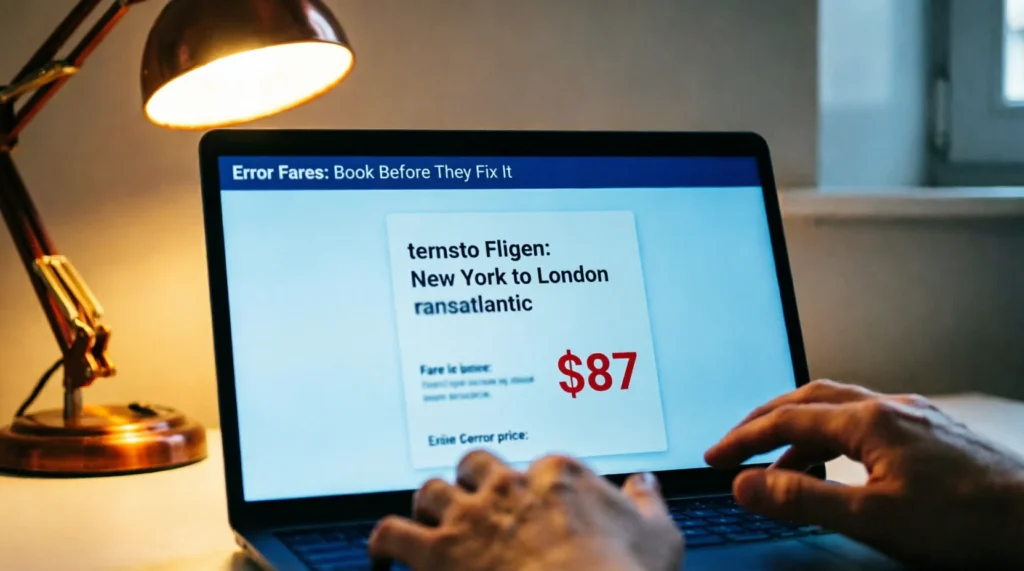
An error fare is a flight priced far below its correct market rate due to a glitch — a currency conversion failure, a fat-finger pricing entry, a software error during a fare-filing update. They are real. They are bookable through normal channels. And the window to act is usually under 12 hours, often under two.
This error fares guide tells you what they are, how to find them before they disappear, and exactly what to do when you spot one. If you follow this process, you will book one eventually. Most travelers never do because they didn’t know the process existed.
What Is an Error Fare?
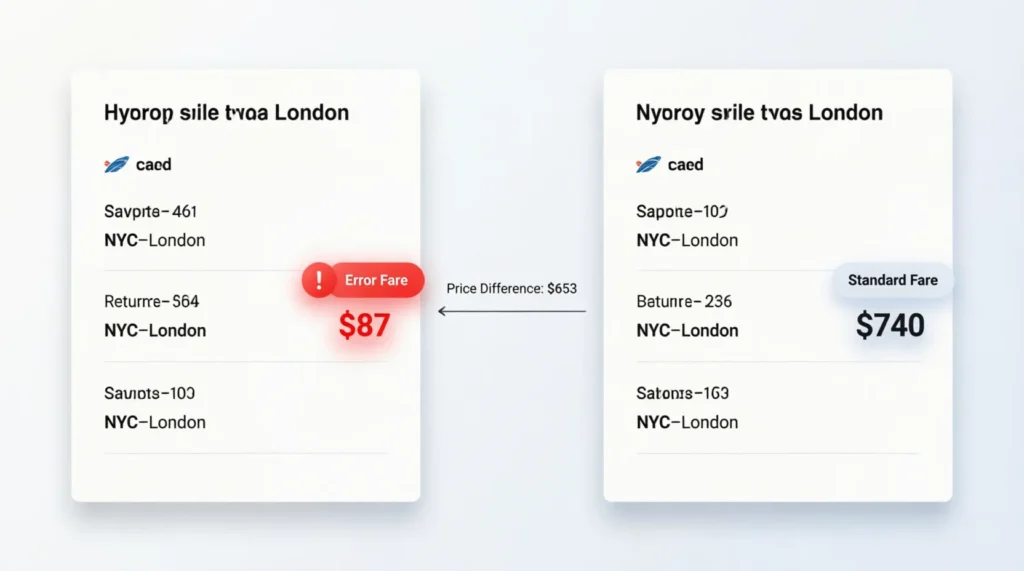
An error fare is a flight ticket priced at a fraction of its true market rate because of a pricing mistake on the airline’s or booking platform’s end. A transatlantic business-class ticket that normally sells for $4,200 appearing at $189 is an error fare. A Sydney-to-London economy ticket priced at $310 instead of $1,400 is an error fare. The underlying flight is real. The aircraft, the seat, the routing — all correct. Only the price is wrong.
These fares enter the global distribution system (GDS) the same way every other fare does. They book the same way. They appear on Google Flights, Skyscanner, and third-party booking sites like any other ticket. The difference is they are not supposed to be there at that price, and once the airline or platform notices, the fare is pulled.
Two categories exist. A pricing error originates with the airline — a fare-filing mistake in their revenue management system. A display error originates with a booking platform — the fare is correct at source but converts, rounds, or displays incorrectly on the front end. Both are bookable. Both disappear fast. Display errors tend to vanish faster because the platform can fix them without touching the airline’s system.
Why Error Fares Are Worth Your Attention
Error fares represent the single largest per-booking saving available to any traveler using public, legal booking channels. A $3,000 business-class seat appearing at $300 is not an exaggeration — it is a documented category of fare that surfaces multiple times per month across global routes.
The savings are asymmetric in ways that matter. Most flight hacking — points, miles, fare sales, booking windows — produces savings of 20–40% on economy tickets. Error fares can produce savings of 70–95% on premium cabins that are otherwise inaccessible without years of points accumulation. I have booked transatlantic business class on an error fare twice. Both were honored. Both cost less than an economy ticket on the same route would have cost at market rate.
The honest downside: error fares are canceled. Not always. Not even usually. But it happens, and when it does, you lose the seat — not your money. The refund comes back in full. What you lose is any non-refundable downstream booking you made assuming the trip was confirmed. The risk management section below covers exactly how to protect against that.
How to Find and Book an Error Fare — Step by Step
Step 1 — Set Up the Right Alerts
Subscribe to Going (formerly Scott’s Cheap Flights) for curated mistake fare alerts. Their team monitors global fares actively and sends alerts within minutes of a confirmed error fare surfacing. The free tier catches some. The premium tier at $49/year (2025–2026 rates — verify before travel) catches most. This is the single highest-return travel subscription available.
Set Google Flights price tracking on your most-traveled routes. When a route drops abnormally, you receive an email. Google Flights does not specifically flag error fares, but an unusual drop on a tracked route is often the first signal.
Add Skyscanner price alerts on flexible-date searches for destinations you genuinely want to visit. Skyscanner’s “Everywhere” search, set to your departure airport, will surface anomalous pricing across all destinations when sorted by price.
Kayak Explore works best as a secondary check — use it to confirm an anomalous price is genuinely below market before you book.
Step 2 — Verify It’s Real
Cross-check the fare on at least two platforms before booking. Confirm the routing makes geographic sense. Confirm the travel dates are what you intend — a common error fare variant involves inverted outbound and return dates that look correct until you read carefully. Confirm the booking class. A fare displaying as economy that books into a business-class fare bucket is an error fare of a specific type that some airlines honor and others do not.
A real error fare books normally. No unusual prompts. No error messages. It just prices at a number that should not exist.
Step 3 — Book Immediately, on the Right Card
Use a credit card with no foreign transaction fees. Use a card with travel protections — trip cancellation, trip interruption — so that if the fare is honored and then the trip is disrupted, you have coverage. Do not book on a debit card: if the fare is canceled and a refund dispute arises, a credit card gives you chargeback rights a debit card does not.
Speed is not optional. Error fares that survive past the 2-hour mark are rare. Book first. Evaluate after.
Step 4 — Confirm and Document Everything
Screenshot the fare at the moment of booking. Screenshot the booking confirmation page. Save the confirmation email to a dedicated folder immediately — do not rely on search to find it later. Note your booking reference (PNR) and, critically, watch for a separate ticket number.
A booking reference is not a ticket. A ticket number is a 13-digit number beginning with the airline’s carrier code — 001 for American, 006 for Delta, 125 for British Airways. It appears in your confirmation email within minutes to hours of booking on most carriers. No ticket number means the booking has not been finalized by the airline.
Step 5 — Hold Off on Non-Refundable Bookings
Do not book non-refundable hotels. Do not book non-refundable tours. Do not book connecting flights on a separate ticket. Wait until the airline has issued your ticket number before committing to any downstream spending that you cannot recover if the fare is canceled.
This is the step most travelers skip. It is also the step that determines whether a canceled error fare is a minor inconvenience or an expensive problem.
The Tools That Actually Surface Error Fares
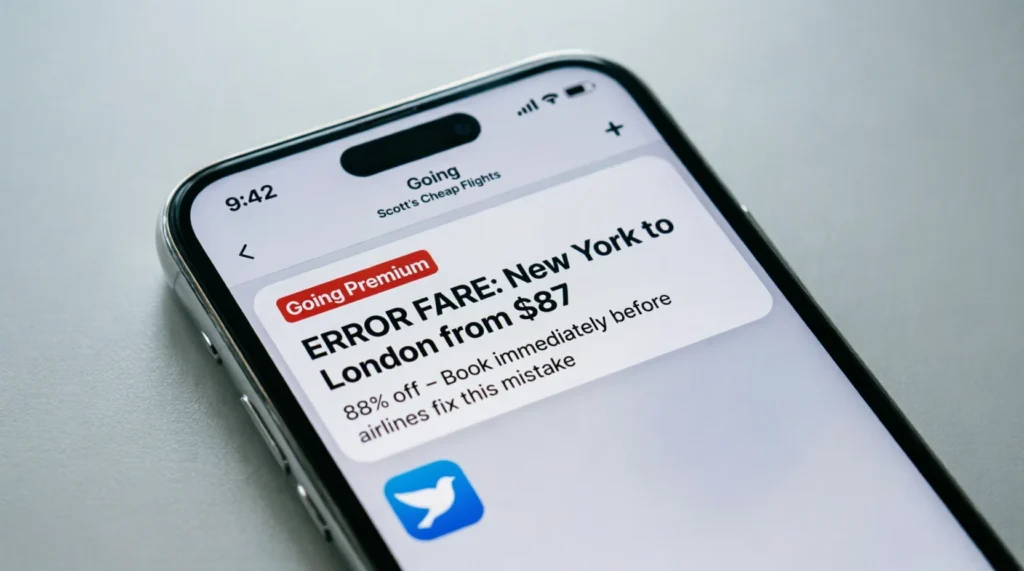
Going (formerly Scott’s Cheap Flights) — The most reliable source for curated mistake fare alerts. Human analysts verify each deal before sending. Premium tier: $49/year (2025–2026 rates — verify before travel). Best for: travelers with flexible schedules who can move on short notice.
Google Flights — Best for monitoring specific routes you already plan to travel. Price tracking alerts on saved searches are fast and accurate. Does not specifically identify error fares, but will surface them when they hit your tracked route.
Skyscanner — Best for open-destination searching. “Everywhere” search sorted by lowest price across all destinations surfaces abnormal pricing faster than route-specific searches. Price alert functionality is useful but slower than Going for confirmed errors.
Kayak Explore — Best as a verification tool. Use it to confirm a price is genuinely anomalous relative to the route’s historical range. Not a primary discovery tool for error fares, but useful for the verify step.
Secret Flying and Airfarewatchdog — Aggregator sites that post publicly reported error fares. Slower than Going because they rely on community submissions rather than active monitoring. By the time a fare appears on these sites, it may already be dead. Worth checking as a secondary source, not a primary one.
how to find cheap flights on any budget: For the full framework on booking windows, search tools, and flexible-date strategy beyond error fares, the cheap flights guide covers every lever available on a standard search.
Mistakes That Cost Travelers the Fare
Waiting to research before booking. The verification step takes four minutes. The fare may not survive four minutes of hesitation after that. Book, then verify. The refund process on a fare you decide not to take is straightforward.
Booking on a debit card. If an airline cancels a fare and delays the refund — which happens — a credit card gives you dispute rights. A debit card does not.
Posting the fare publicly before booking. When an error fare is posted to social media or public forums, airline revenue management systems detect the traffic spike and pull the fare faster. Book first. Share after, if at all.
Confusing a booking reference with a ticket number. A PNR is a reservation. A ticket number is confirmation the airline has accepted the fare and issued the document. Airlines can cancel an unticketed booking without issuing a refund dispute. Once ticketed, cancellation requires a full refund.
Booking non-refundable hotels immediately. Covered above. The only mistake on this list that costs money rather than just the seat.
Pro Tips From Someone Who Has Booked Several
Set your Going alerts for regions, not just specific cities. A mistake fare from New York to anywhere in Europe is useful if you can move on it. Restricting alerts to single routes means missing fares on adjacent routes that would work just as well for your trip.
Check error fare posts between 10 PM and 2 AM local time in the originating airline’s home country. Revenue management teams work business hours. Errors filed late in their working day often survive overnight because no one catches them until the morning shift. The Going team monitors around the clock. You don’t need to — but knowing that overnight fares have higher survival rates helps calibrate when to act without delay.
If an error fare is in business or first class, the honor rate is higher than economy. Airlines face a different calculus on premium cabin errors: the optics of canceling a $189 business-class seat from someone who genuinely booked in good faith are worse than canceling a $40 economy seat. Not a rule. A pattern.
Finally: go in with the correct expectation. An error fare is not a guaranteed ticket. It is a high-probability, low-cost bet on a seat that may or may not materialize. Book it that way. Don’t restructure your life around it until it is ticketed.
Frequently Asked Questions About Error Fares
Are error fares legal to book?
Yes, booking an error fare is legal. Whether airlines must honor them depends on jurisdiction and ticketing status. In the US, DOT guidance has historically supported fare honoring after ticketing, but policies have shifted. Check current DOT rules before assuming the fare is protected. (Verify at dot.gov — rules change without notice.)
Do airlines always cancel error fare bookings?
No. Many error fares are honored, particularly once a ticket number is issued. Airlines calculate the reputational and service cost of mass cancellations against the revenue loss and often choose to honor the fare — especially when the error ran long enough to generate significant volume.
How do I know if my error fare has been ticketed?
A ticket number is a 13-digit number beginning with the airline’s carrier code — 001 for American, 006 for Delta, 125 for British Airways. It appears in your booking confirmation email or in Manage My Booking on the airline’s site. A booking reference (PNR) alone is not a ticket.
What happens if the airline cancels my error fare booking?
You receive a full refund to your original payment method. You do not receive compensation for non-refundable downstream bookings made on the assumption the trip was confirmed. This is the one financial risk in the process — and it is entirely avoidable by following Step 5.
How long does an error fare typically last?
Most disappear within 2–24 hours. Some are corrected in under 30 minutes. Fares that survive past the 12-hour mark have a measurably higher honor rate. The window is narrow — if you see a confirmed error fare, book before you do anything else.
Continue Exploring
- how to find cheap flights on any budget: The complete framework for flight search strategy: booking windows by route type, tool selection, and flexible-date tactics that work on every search — not just error fares.
- travel credit cards with no foreign transaction fees: The card you book an error fare on matters. This guide covers the cards with the protections — trip cancellation, no FX fees, chargeback strength — that make error fare booking lower-risk.